
Pacific Island nations voice disappointment after COP31 agreement remains elusive
 Caalamka
After two days of overtime and nearly 200 countries locked in tense negotiations, COP31 ended not with a breakthrough but with a collapse that sparked anger from climate advocates and vulnerable nations alike.
The UN climate summit in Turkey descended into a chaotic finish yesterday as delegates rejected the final agreement, bringing the meeting — which ran two days past its scheduled close — to an abrupt and bitter end and highlighting the growing strain on global diplomacy.
UN Secretary-General Antonio Guterres, who had urged governments during the talks to send fossil fuels “the way of the dinosaurs,” said he was deeply dismayed by the outcome.
“I share the very profound frustration of all those who expected governments to rise to the moment the climate crisis demands,” the outgoing UN chief said in a statement.
People protest outside the plenary ahead of the Closing Plenary session at COP31
Pacific island nations, confronting rising seas and other existential threats tied to warming temperatures, voiced sharp disappointment.
“We have been let down on all sides,” the delegation from the Marshall Islands at COP31 said in a statement.
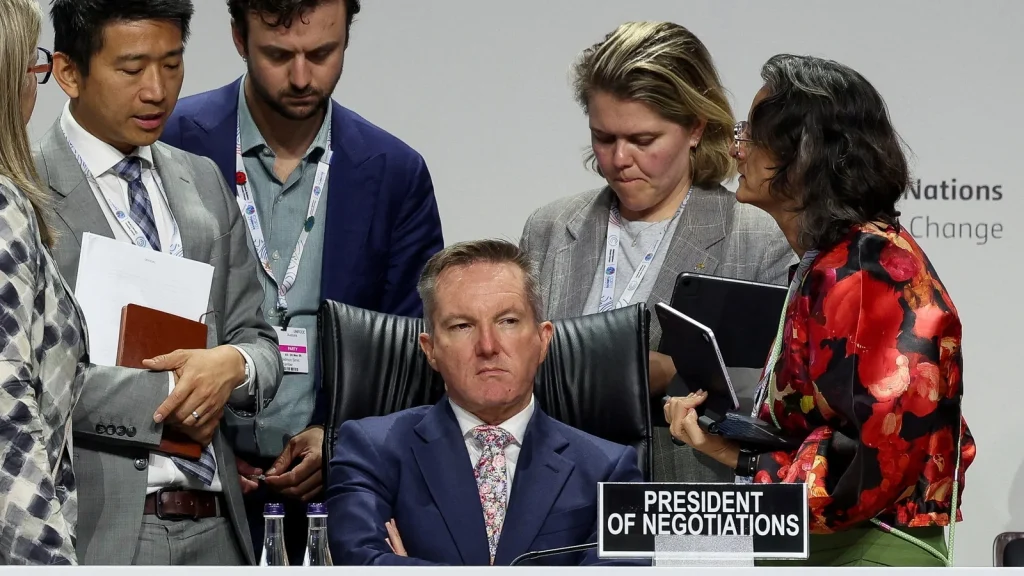
Chris Bowen, the COP31 negotiations chair, acknowledged he failed to secure consensus among the nearly 200 participating nations, saying talks ran aground on what he described as “unbridgeable red lines.”
“Unfortunately, we were unable to reach agreement on a cover decision… And that’s disappointing. Very disappointing,” Mr Bowen, who is Australia’s climate minister, told reporters.
More than 49 hours after the summit was meant to conclude, COP31 President and Turkish Environment Minister Murat Kurum brought the record-running meeting to a close with a bang of the gavel.
Calls for reform
Mr Bowen said the summit unfolded against “the most complicated and fraught geopolitical environment in living memory,” as soaring energy prices and the fallout from the Middle East war further complicated already difficult negotiations.
COP31 President and Turkey’s Minister of Environment Murat Kurum (L) seen on stage in Antalya
Australian Prime Minister Anthony Albanese, whose country co-hosted COP31 with Turkey, likewise pointed to “difficult geopolitical times” as he explained why the talks failed.
With climate-linked disasters hitting countries from Europe to Nepal and pressure mounting for tangible progress, Mr Bowen sought a unifying “cover decision” intended to demonstrate that governments remained aligned on confronting the crisis.
Instead, the effort unraveled along familiar lines, with disagreements over fossil fuels resurfacing as the European Union and Saudi Arabia clashed over how quickly the world should move away from coal, oil and gas.
The EU, several small island states and other climate-vulnerable countries said they could not accept language that avoided naming the fuels scientists identify as the main drivers of global warming.
“This COP, I believe, was hijacked by some oil states,” climate minister Darragh O’Brien told Reuters on behalf of the EU when asked about Saudi Arabia’s role in the negotiations.
EU cannot accept deal that fails to mention fossil fuels – O’Brien
“We will not endorse a cover decision… that does not even mention fossil fuels, which is the key driver of climate change,” said Ireland’s climate minister, Darragh O’Brien, whose country holds the rotating EU presidency.
“And we will not accept a COP that greenwashes fossil fuel.”
Panama, Vanuatu and the Marshall Islands also objected and, as the negotiations imploded, COP31 stretched into the longest climate summit on record.
Former US vice president and climate advocate Al Gore said it was “outrageous that a handful of petrostates have veto power over any mention of fossil fuels.”
The COP process is “in need of significant reform,” Mr Gore wrote on X, arguing most countries had tried “to move forward in good faith.”
Falling short
The breakdown revived memories of the 2009 Copenhagen summit and reignited questions about whether the world’s climate talks can deliver results at the pace the crisis demands.
“It certainly fell short today,” said UN climate chief Simon Stiell.
“The world cannot afford a repeat.”
Even as the COP process stumbled, governments have been pursuing action beyond the annual summit framework.
Around 60 countries joined a first-of-its-kind conference in April focused on phasing out fossil fuels, while several nations at COP31 presented their own national plans to exit coal, oil and gas.
In a last-ditch attempt to salvage consensus, co-hosts Turkey and Australia managed only a veiled reference to fossil fuels in the final text.
That draft also drew criticism for retaining a call to expand carbon capture, an expensive technology promoted by the fossil fuel industry.
“We believe that climate change requires all solutions on the table,” said Mohammad Ayoub, a climate negotiator for oil giant Saudi Arabia.
Read more:
Next UN Secretary General will inherit hotter world and harder task
As criticism mounted over the omission of fossil fuels, the co-hosts sought to rally countries around a global push to electrify the world economy.
They argued that “electrification” could reduce heat-trapping emissions while strengthening energy security, but the proposal was ultimately sunk — along with the rest of the failed Antalya Pact.
‘Profoundly disappointed’
Delegations said the collapse squandered a chance to reinforce the Paris Agreement’s 1.5C goal, which scientists expect the world to exceed within a few years as current emissions-cutting pledges fall short.
The summit also exposed rifts over science itself, as a dispute involving the work of the Intergovernmental Panel on Climate Change (IPCC) spilled into the negotiations.
“We are profoundly disappointed by the substance of the cover decision,” said UK climate negotiator Kate Hughes.
“It moves us backwards on the science… It is a lowest common denominator where it should have been, instead, presenting bold collective ambition on climate action.”
As has often been the case at UN climate talks, the summit underscored the divide between major polluters driving emissions and smaller nations that say they are paying the highest price.
Developing countries pressed for a $120 billion target climate goal, but that figure disappeared from the failed agreement.
Ireland has chance to show leadership – O’Gorman
Green Party leader Roderic O’Gorman said Ireland still has an opportunity to show leadership on climate action at the Transitioning Away from Fossil Fuels conference, which is being co-hosted with Tuvalu.
Speaking on RTÉ’s Morning Ireland, Mr O’Gorman said the EU and Pacific Island countries were right to step away from the draft agreement proposed at COP31.
“I think attention is going to move now to the next COP in Ethiopia next year.
“But Ireland actually has an opportunity to show leadership before then with the Transition Away from Fossil Fuels conference that we’re jointly hosting with Tuvalu.
“The Government should be using that as an opportunity to bring together an alliance of countries committed to speeding up the movement away from fossil fuels,” Mr O’Gorman added.
He added: “But those countries actually need to act themselves and that involves ending subsidies for fossil fuels, setting out clear timelines to move towards renewables.
“Those kind of steps will actually, I think, build confidence and show particularly the small island nation states that EU countries, that developed countries are genuinely committed to tackling the pollution from fossil fuels.”