Thursday, February 26, 2026
Home Blog Page 153

UN chief warns climate crisis is pushing Earth toward a dangerous tipping point

Global warming pushing planet to brink, UN chief warns
Antonio Guterres said: 'No country is safe from fires, floods, storms and heatwaves' (Stock image)

A planet on a knife-edge: inside the Geneva alarm bell

The conference room in Geneva smelled faintly of espresso and printer ink. Outside, the Alps wore the soft gold of an autumn afternoon; inside, delegates clustered around screens that looped images of flooded villages, scorched earth and smoke-torn skies.

Antonio Guterres rose to speak with a journalist’s bluntness and an elder statesman’s urgency. “Every one of the last ten years has been the hottest in history,” he told the packed hall. “Ocean heat is breaking records while decimating ecosystems. And no country is safe from fires, floods, storms and heatwaves.”

The words landed like a bell. They were not an abstract scolding but a report from the front lines: from subsistence farmers in the Sahel to fishers in the Pacific, from city planners juggling evacuation routes to insurers recalculating risk. The United Nations had convened this extraordinary meeting to mark 75 years of the World Meteorological Organization and to push a basic question into stark relief: how do we protect people now, not sometime in the distant future?

Warnings that mean the difference between life and loss

There is a deceptively simple answer that keeps resurfacing in these conversations: good warnings, given early enough. Guterres urged countries to build and fund comprehensive disaster warning systems. “They give farmers the power to protect their crops and livestock. Enable families to evacuate safely. And protect entire communities from devastation,” he said.

It is more than rhetoric. Studies and models show that being warned 24 hours before a hazardous event can reduce damage by up to 30%. Already, since a global push launched in 2022, more than 60% of countries have introduced multi-hazard early warning systems, an important uptick toward a 2027 target for universal coverage.

But the coverage is uneven. In the hall, delegates from island states talked about coastal sirens that fail during storms when electricity is down. A coastal mayor from Fiji—lean, with a sun-tanned face that had spent a lifetime on the water—leaned in during a lunchtime discussion and said, “A siren without a roof to run to is only a noise. We need shelters, boats, roads that don’t wash away.”

The World Meteorological Organization issued a sobering reminder: over the last fifty years, weather, water and climate-related hazards have killed more than two million people—and 90% of those deaths were in developing countries. The inequality burned through the numbers like salt on an open wound: those who contribute least to global warming are by far the most likely to die when the climate’s fury arrives.

Methane: the quick burn we keep forgetting

If early warnings are the first line of defense against immediate harm, methane is the short, sharp weapon in the climate fight that global leaders keep under-using. A UN observatory that stitches together data from more than 17 satellites reported that nearly 3,500 methane plumes were flagged across oil and gas operations—but only about 12% of those alerts resulted in any acknowledged action.

“We are talking about tightening the screws in some cases,” said Inger Andersen, executive director of the UN Environment Programme, which oversees the observatory’s Methane Alert and Response System. “We can’t ignore these rather easy wins.”

The point is technical but urgent: methane doesn’t stick around as long as carbon dioxide, but in the near term it is a far more powerful heater—roughly eighty times more effective at trapping heat over a 20-year window. That makes cutting methane a fast track to slowing near-term warming. More than 150 countries signed a 2021 pledge to reduce methane emissions by 30% this decade—yet the commitments are not translating into rapid fixes on the ground.

Satellite technology, once the exclusive province of space agencies and defense contractors, is now being used to shine a spotlight on leaks. The International Methane Emissions Observatory’s system integrates dense satellite coverage to find plumes and send alerts to governments and companies. But the observatory found only 12% of alerts triggered a response—an improvement over last year’s 1%, yet still a fraction of what scientists say is necessary.

Giulia Ferrini, who heads the observatory, noted the potential in turning these alerts into quick wins: “We documented 25 instances where notification led to a large emissions event being fixed. Imagine scaling that up.”

Where the low-hanging fruit is—and why it’s still there

The oil and gas sector represents the largest, most straightforward opportunity to cut methane quickly: reducing venting, fixing leaks, stopping flaring where feasible. Investors have noticed. Earlier this month, representatives of asset managers holding more than €4.5 trillion urged the European Union not to weaken methane rules amid debates that hinted at rolling back standards to facilitate trade in liquefied natural gas.

Beyond fossil fuels, the observatory plans to broaden its gaze toward other major emitters—metallurgical coal used in steelmaking, agricultural sources, and waste. Each of these has a different fix timeline and cost profile, but the principle is the same: targeted detection plus swift repair yields outsized climate benefits.

Local voices, global implications

Back on the streets of Geneva, a delegate from Bangladesh—a delta nation shaped by tides—told me that an early warning system he helped install had cut losses from cyclones dramatically. “We used to lose whole harvests,” he said. “Now, if the alert goes out, families move animals to higher ground, children are moved to school shelters. It’s not perfect, but it saves lives.”

Across town, a climate scientist I met over coffee—white-haired, a little wearily hopeful—said, “We have the technology and the evidence. What we lack is the politics and the will to act at the speed the science demands.”

That lack of will is not just a moral failing; it’s a strategic mistake. Early warning systems and methane reductions are cost-effective. They protect livelihoods, stabilize markets, and reduce the human tragedy that reverberates in waves: displaced families, broken schools, and the slow erosion of trust in institutions that can’t keep people safe.

What now? A choice that will define this decade

The conference in Switzerland was not a moment for platitudes. It was a call to action executed in real time: to build shelters and sirens, to fund satellites and repair crews, to make the political choices that prevent avoidable suffering. The question for readers is both intimate and vast: what would you prioritize if you had to protect your community tomorrow?

Some answers are technical—fund local meteorological services, train emergency responders, mandate rapid-response teams for methane leaks. Some are structural—invest in resilient infrastructure, equitable insurance, and climate adaptation funds targeted at the most vulnerable. All of them require money, coordination, and a willingness to reorder priorities.

We face a simple arithmetic of survival: more warnings, earlier and clearer, mean fewer lives lost. Faster methane action means cooler air in decades that matter to this generation. The tools exist. The science is clear. The question now is whether societies, leaders and markets will move with the urgency the moment demands.

When you close your browser tonight, consider this: in a world where an alert can buy a family a day to flee a flash flood or a repair crew can stop a massive methane plume from turning into a warming catastrophe, inaction becomes a choice. What will you choose to support—voices for preparedness, or the slow erosion of safety?

Guddoonka Baarlamaanka oo digniin adag u diray xildhibaanada ka maqnaada fadhiyada

Screenshot

Nov 22(Jowhar)- Guddoonka Golaha Shacabka ee Baarlamaanka Federaalka Soomaaliya ayaa digniin adag u diray xildhibaanada si joogto ah uga maqnaada fadhiyada iyagoo aan cudur daar ka bixin, iyadoo guddoonka uu sheegay in tallaabooyin isla xisaabtan iyo masuuliyad lagu sugayo mustaqbalka dhow ay ku dhaqaaqi doonaan.

Ukraine Reports Six Dead After Overnight Russian Missile Strikes

Ukraine says Russian overnight strikes kill six
Ukrainian officials said the attacks ran through most of the night

Night of Fire: Kyiv and a Nation Left in the Dark

They woke to sirens and ash. By dawn, much of Ukraine had been stitched with smoke, half the capital blacked out, and a grieving country counting bodies and broken lives.

Last night’s barrage — a mix of ballistic missiles and kamikaze drones — left six people dead, including two children, and knocked out electricity across broad swathes of the country, officials said. Debris from downed weapons rained over Kyiv, sparking fires in at least half of the city’s districts and turning familiar streets into scenes of chaos and rescue.

Where the city met the sky

In Dniprovskyi district, neighbors converged in their slippers and coats as smoke bled from a high-rise. Firefighters worked against a backdrop of emergency lights and the distant, ceaseless thud of anti-aircraft defenses. Ten people were pulled from the blaze; a child among five patients admitted to hospitals across the city.

“I smelled something like metal and burnt paper and then the windows shattered,” an elderly woman who lives two blocks from the damaged building told me, still holding her shawl tight. “We’ve had air raids before, but tonight it felt… larger. Closer.”

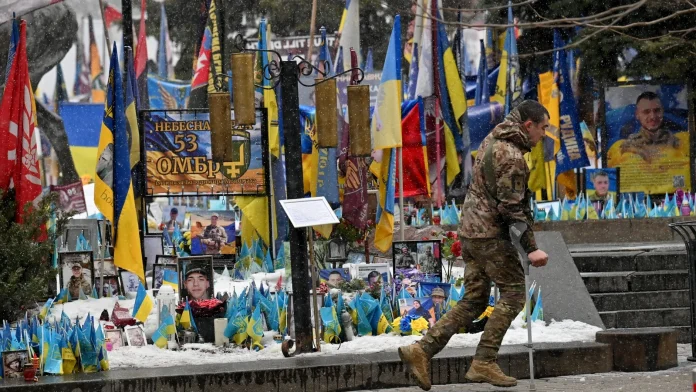
Fires flared in Desnianskyi, Darnytskyi and the Pecherskyi district — the latter home to the Kyiv Pechersk Lavra, a centuries-old monastery whose golden domes are a symbol of Ukrainian spiritual endurance. Smoke curled in the winter air, a dark ribbon over a place where people have prayed through worse storms.

The human toll

Ukraine’s emergency services reported two people killed in Kyiv itself. Four others, including two children, were killed in strikes on areas surrounding the capital. In the southeastern frontline region of Zaporizhzhia, rare but relentless overnight shelling wounded 13 people, according to regional governor Ivan Fedorov.

These are numbers that flatten faces into statistics — until you meet the families, the firefighters with soot-tracked cheeks, the children in hospital corridors. “People think numbers are easy to swallow,” said a volunteer medic who treated burn victims through the night. “But every number is a life: a mother, a son, a schoolteacher. That’s what keeps me going.”

Lights out: an energy system under siege

As the strikes unfolded, Ukraine’s energy ministry reported widespread emergency outages — in Kyiv and “most regions” of the country. Svitlana Hrynchuk, the energy minister, pledged on social media that emergency teams were responding, but offered few immediate details. In Poltava region, oil and gas installations in Myrhorod district were damaged, the regional governor said.

Power grids, substations, and energy plants have been recurrent targets since the start of Russia’s full-scale invasion on Feb. 24, 2022. Analysts say attacking infrastructure aims to degrade civilian resilience — to make winter colder, hospitals more vulnerable, and everyday life intolerable.

“Electricity is not just a convenience here — it’s a lifeline,” explained an energy engineer in central Ukraine who asked not to be named for security reasons. “When you cut heat and light, you cut water pumps, medical refrigeration, communications. It’s a multiplier.”

Recent rounds of attacks have left hundreds of thousands — and in past waves, millions — without power or running water at once. For families with small children, the elderly, or those on life-sustaining medical devices, the stakes become acute within hours.

Voices on the ground

In a kitchen warmed only by a gas stove and the hush of a single lamp, a young mother wrapped her child in a blanket and said: “We’ve had cold winters, but never this many broken nights. The kid asks why the lights are gone, and what do you tell a five-year-old?”

Kyiv’s mayor, Vitali Klitschko, confirmed rescues and hospital admissions and appealed for calm and solidarity. “Our city is scarred today,” a municipal spokesperson told reporters, “but people are helping one another — emergency crews, volunteers, ordinary neighbors.”

From a war-weary frontline village near Zaporizhzhia, a teacher leaning on the fence of her burned-out school said, “We teach kids to read and to dream. Now we teach them to hide in basements. It’s not the kind of lesson any of us wanted to give.”

What officials are saying — and what it reveals

Kyiv’s leadership has repeatedly urged stronger, collective international action; one senior Ukrainian official lamented that global responses have yet to be sufficient to halt what he called “the killing.” Diplomacy and summits have become uneven instruments in the face of continued strikes — a fact underscored by reports that a planned summit between the U.S. president and the Russian leader was put on hold after Moscow rejected calls for an immediate ceasefire.

“We proposed a pause; instead, the killing continues,” said a government aide. “That tells you where we are and how urgent the call for collective deterrence has become.”

Beyond tonight: a pattern, a strategy

There is method in this destruction. Attacking energy infrastructure during autumn is not random — it is a strategic attempt to sap morale as temperatures fall. Winter has repeatedly been used as a pressure point in conflict, from the trenches of history to modern information warfare. The recent strikes appear to be a continuation of that grim logic.

Analysts warn that systematic damage to power networks can take months and significant resources to repair, especially when repeated attacks target the same systems. “You can rebuild a substation,” an international security analyst said, “but not the confidence of a population that must sleep with a bag packed and a torch under the pillow.”

Small acts of defiance

And yet, amid the blackout, small things spark hope. Volunteers gather hot meals in school cafeterias that double as shelters. Municipal utility crews, sometimes working from phone flashlights, mark out damaged lines and coordinate repairs. Artists and neighbors hang lamps and candles in windows, not just for light but as a communal signal that life refuses to be extinguished.

“We bake bread on a makeshift oven and share it,” a volunteer baker said quietly. “You’d be surprised how much a warm loaf and a cup of tea can stitch the soul back together.”

Questions to sit with

How does a society sustain itself when its most basic services are weaponized? What responsibility does the rest of the world bear when civilian infrastructure becomes a battlefield? And most urgently: as winter approaches, what must be done to protect hospitals, schools, and the elderly?

These are not rhetorical flourishes — they are policy dilemmas that require immediate, concrete answers. They demand coordination of humanitarian relief, international engineering assistance to harden energy systems, and a political will to push for safer avenues of negotiation.

Moving forward

Tonight and in the nights to come, Ukraine will measure loss and resilience in equal parts. The flames will be doused, power crews will repair what they can, children will be cradled through another fear-filled sleep. But the scars — on trees, on buildings, on people — will remain.

As the country grieves and rebuilds, the world watches. Will the international response be calibrated to prevent the next blackout, to protect the next monastery, the next school? Or will tonight’s ash become tomorrow’s memory, another line item in a ledger of suffering?

When the lights come back — whenever and however they do — Ukrainians will still be asking harder questions about safety, sovereignty, and solidarity. For now, they hold one another a little closer, cook a little more soup, and refuse, stubbornly, to hand over their nights to fear.

North Korea Launches Ballistic Missile, South Korea Military Confirms

North Korea fires ballistic missile - S Korea military
People sit in front of a television screen showing a news broadcast with of a North Korean missile test

Morning Smoke Over the Sea: A Quiet Launch, a Loud Reminder

It was the kind of morning that presses itself into memory: a pale sky over the East Sea, fishermen tending nets along a rocky coast, a city preparing for a string of high-profile visitors. Then, somewhere beyond the horizon, a plume of vapor stitched the air and a single, distant echo rolled across the water.

South Korea’s Joint Chiefs of Staff would later describe the event in clinical terms—an “unidentified” ballistic missile flew east—but the human story is never that tidy. For residents of the coastal towns who watched the contrail vanish into the clouds, the launch felt like the brittle end of a frayed promise: a reminder that the Korean peninsula’s tensions, though sometimes dormant, are never far from the surface.

Timing and Theatre: Why This Launch Matters

The timing could not be more loaded. The firing came less than a week before APEC leaders were due to arrive in Gyeongju—a city already bracing for the diplomatic choreography of presidents, prime ministers, and a throng of international media. Among the expected attendees was former US President Donald Trump, who, according to public statements, has hoped for another meeting with North Korea’s Kim Jong Un.

“This is not just about hardware,” said a defence analyst in Seoul who asked not to be named. “Every missile, every parade, is a message—internally to the regime, externally to capitals watching for weakness or opportunity.”

What We Were Told

South Korean officials confirmed the launch and said the projectile flew east into open waters. North Korean state media, meanwhile, has been increasingly theatrical in recent months—showcasing what it billed as its “most powerful” intercontinental ballistic missile at a military parade earlier this month, and touting the Hwasong-20’s boundless range. State outlets also reported a successful ninth test of a solid-fuel engine for long-range missiles, suggesting a full test-fire of a new ICBM could be imminent.

From Streets to Strategy: Voices on the Ground

In the fishing hamlet of Pohang, a woman named Min-jung, who sells dried squid on a street corner, paused her work and looked toward the sea. “We hear these things all the time now,” she said. “You get numb, but you don’t forget. You worry for your kids.”

A municipal official in Gyeongju, who was arranging security logistics for the summit, spoke in quieter tones: “We prepare for the spotlight, but security is always layered. A launch like this adds urgency to everything—evacuations, airspace management, communication channels.”

Across the line of control in Pyongyang’s state media, the message is different: strength, resolve, and sovereignty. “If we have these weapons, it is because we see them as the guarantor of our survival,” a defector-turned-activist in Seoul told me. “To the regime, this is not a bargaining chip; this is insurance.”

Hard Numbers and Harder Choices

Put plainly, the technical developments are important. Intercontinental ballistic missiles, depending on design, can exceed ranges of 10,000 to 13,000 kilometres—enough, in some configurations, to reach parts of the continental United States. Solid-fuel missiles, compared with liquid-fuel models, cut preparation time dramatically: liquid-fuel systems can require hours of fueling and safety checks that expose them to being detected or disrupted, while solid-fuel variants can be fired on far shorter notice and concealed more easily.

North Korea has been under successive rounds of United Nations sanctions for more than a decade; UN resolutions have sought to curtail the flow of materials and revenue that fund missile and nuclear programs. Yet sanctions have had mixed effects on curbing weapons development. According to public estimates from international monitors, North Korea has continued to iterate on missile technology through the 2010s and into the 2020s.

  • ICBM range estimates: often cited as 10,000–13,000 km for potential North Korean designs.
  • Launch readiness: solid-fuel missiles can reduce launch prep time from many hours to minutes.
  • Sanctions: North Korea has faced dozens of UN measures since 2006, yet program advances have persisted.

Diplomacy on a Knife Edge

There is a paradox at the heart of North Korea’s posture: on one hand, relentless development of deterrent capabilities; on the other, intermittent openness to talks. Kim Jong Un and former US President Donald Trump met three times in high-profile summits, the glamour of which masked the hard limits of negotiation. The Hanoi summit of 2019 collapsed over disagreements about sanctions relief and the scope of denuclearization—an impasse that persists.

“Kim’s rhetoric this year has been oddly accommodating in one breath and immovable in another,” said a former diplomat who served in Northeast Asia. “He has said he’s open to meetings, but he also insists he will not give up his arsenal.”

Indeed, North Korea’s state media conveyed a recent message from Kim about “fond memories” of his meetings with Trump and signalled a willingness to engage—provided the United States abandons what Pyongyang calls a “delusional obsession” with denuclearisation and instead accepts coexistence as a premise for talks.

Beyond the Peninsula: Global Ripples

This is not merely a regional matter. The actors watching closely include not only Washington and Seoul, but Beijing and Moscow—both of which were portrayed in state parades and coverage as spectators to Pyongyang’s outreach. Each has its own calculus: China worries about instability on its border and the precedent of a denuclearised Korean Peninsula; Russia views the Korean dynamic through a lens of great-power rivalry; the United States sees extended deterrence and alliance credibility at stake.

The launch underlines a broader trend: an erosion of the cooling-off period that followed the diplomatic spritzes of 2018. It raises questions about whether arms control in Northeast Asia can be resurrected or whether incremental advances will continue to be met with incremental security responses—and the potential spiral that brings.

What Comes Next?

For now, the practical measures are familiar: monitoring, diplomatic notes, discussions in back rooms and on phone lines between foreign ministries. For ordinary people on both sides of the border, the calculus is more immediate. A teacher in Busan told me she now spends time in school drills explaining to students what different sirens mean. “You want to give them facts without fear,” she said. “But fear sits in the corners.”

As we watch this small plume of smoke settle into the record of an uneasy morning, it’s worth asking: what would lasting security look like here? Can deterrence and dialogue coexist without one swallowing the other? And perhaps more importantly, how do ordinary lives—markets, schools, seaside cafes—navigate the gap between headlines and daily routines?

There are no easy answers. The launch is a piece of a larger mosaic—a mix of military capability, domestic politics, and international posturing. It is a reminder that in a world of flashpoints, much of the true work is patient, slow, and often invisible: diplomacy, confidence-building, humanitarian ties, and the mundane acts of governance that keep lives steady through turbulent times.

For now, the sky over the East Sea has cleared. The summit in Gyeongju approaches. Leaders will speak in ornate halls, but the conversation that began with a single, solitary plume will continue well after the cameras pack up. What will they do with that conversation? That question now belongs to policymakers—but it belongs to the rest of us, too. How much risk are we willing to live with? And what, truly, is the price of peace?

Dowladda Soomaaliya oo shaacisay saameynta dhaqaale ee xiritaanka USAID

Nov 22(Jowhar)-Joojinta taageerdii Hay’adda USAID horraantii sanadkan ayaa si weyn u saameyaay dhaqaalaha Soomaaliya iyo dakhliga canshuuraha dowladda, sida ay sheegtay madaxa Bangiga Horumarinta iyo Dib-u-dhiska Soomaaliya.

Trump says he won’t accept a ‘pointless’ summit with Putin

Trump says he does not want 'wasted' meeting with Putin
US President Donald Trump's announcement came just days after he said he would meet Russian President Vladimir Putin in Budapest

The Summit That Fizzled: Diplomacy in the Time of Uncertainty

There are meetings that change the course of history, and there are meetings that never happen but still ripple through the world. Last week’s blistering arc — a presidential phone call, a sudden announcement that a summit would be held in Budapest, and then a quick reversal — felt like both.

“I don’t want to have a wasted meeting,” President Donald Trump told reporters from the Oval Office, a phrase that read at once like caution and a diplomatic shrug. Days earlier he had telephoned Russia’s Vladimir Putin and, speaking in an unusually optimistic tone, declared that a face‑to‑face in Hungary would follow within weeks. Then, almost as quickly, the White House put the plan on ice.

For anyone watching closely, the sequence was less about geography than about the fault lines in global diplomacy — the fragility of ceasefire talk, the weight of battlefield realities in Eastern Europe, and the human cost that stubbornly refuses to be sidelined by statecraft.

From a Call to a Cold Shoulder

The pivot happened fast. A White House aide said the leaders of the two countries now had “no plans” to meet in the immediate future. U.S. Secretary of State and Russia’s foreign minister also canceled a planned preparatory conversation. “Things are changing on the war front,” the president added, promising further announcements in “the next two days.”

But what really made diplomats and capitals sit up was not the choreography of talks, it was what unfolded at the smaller, quieter table inside the White House: a closed‑door meeting between President Trump and Ukraine’s Volodymyr Zelensky that one Ukrainian official described bluntly as “tense.”

Pressure on the Edge: Donbas and the Price of Peace

To many in Kyiv, the encounter felt like a private negotiation about public fate. According to Ukrainian sources, the U.S. president urged President Zelensky to accept a deal that would have frozen fighting along the current lines — and to give up control of large swathes of the industrial Donbas region as part of any peace arrangement.

“He asked if we would consider stepping back from territory we still hold,” said a senior Ukrainian official who requested anonymity. “There was pressure. Understandable from a negotiator’s vantage, devastating from ours.”

Ukraine has consistently refused to cede the Donbas — the twin provinces of Donetsk and Luhansk that have been the center of fighting and tension since 2014. To Kyiv, those lands are not bargaining chips but the fabric of the nation: towns with Soviet‑era factories, rivers that run through working‑class neighborhoods,: family cemeteries and Orthodox churches.

Weapons, Warnings, and an Empty Hand

In return for talks, President Zelensky reportedly sought long‑range Tomahawk missiles — weaponry that Ukrainian commanders say is necessary to blunt Russian advances and protect cities from long‑range strikes. The request was denied.

“We came asking for the means to defend ourselves,” an aide to the Ukrainian delegation said. “We left with an outline for a ceasefire that would lock in the front lines — lines that do not reflect the lives of people who have been forced from their homes, who have lost fathers, mothers, children.”

Voices from the Ground: Cities and Kitchens

If this is a story about policy, it is more urgently a story about people. In Kharkiv, a city scorched repeatedly by shelling, neighbors pick through the rubble of a baker’s stall and compare lists of what was lost. An aid worker who has been driving food into northeastern villages for two years shook her head.

“They talk about lines on a map,” she said, “but I know an old woman who walked two miles to retrieve her dog from a basement and found her house burned to a frame. Will a line bring her a new roof?”

In a smaller town near Donetsk, a schoolteacher described the surreal calculus families now perform every morning. “We teach the children to duck and count,” she said. “Duck if you hear the drone, count if it’s far enough. This is what peace looks like to us: fewer explosions, more breakfasts.”

European Leaders Push Back

Across the continent, the nascent idea of trading territory for an immediate halt to fighting met resistance. A broad swath of European capitals — from Paris to London — publicly rebuked the suggestion that Ukraine should give up land as the price of silence.

“We support a ceasefire, and we support negotiations that start from the current line of contact,” a joint statement from a coalition of European leaders read. “But unilateral excisions of sovereign territory cannot be the precondition for peace.”

Numbers That Don’t Lie

It helps to put this human drama against the cold arithmetic of war. Russia launched a full‑scale invasion of Ukraine on 24 February 2022. Since then, fighting has devastated cities, damaged vital infrastructure, and upended millions of lives.

  • Territory: Russia currently occupies roughly one‑fifth of Ukraine’s internationally recognized territory, a complex mosaic of front lines, annexations, and controlled areas.
  • Displacement: As of mid‑2024, UN agencies estimated more than 8 million Ukrainian refugees had left the country, with several million more displaced within Ukraine.
  • Casualties: Estimates vary, but by mid‑2024 the war had claimed tens of thousands of lives among military personnel and civilians alike.

Those figures are not abstractions; they are the reasons diplomats hesitate and populations fear being asked to accept borders redrawn by force.

What This Moment Reveals

Diplomacy is rarely linear. It is an improvisation performed on the stage of power, where domestic politics, realpolitik, and human suffering intersect. The aborted Budapest summit is a symptom: leaders are searching for ways to stop killing without legitimizing conquest. Some want to freeze fighting; others insist any agreement must restore sovereignty and justice.

“The risk is that a frozen conflict becomes permanent,” said an international relations scholar in Brussels. “We’ve seen this elsewhere — frozen lines that last decades, where new generations grow up with walls and suspicion rather than memories of community.”

And there is the geopolitical undercurrent: NATO, an expanding coalition of European states, and the EU have all rallied around Kyiv in form and in rhetoric. Yet the transatlantic alliance also whispers of fatigue, of electoral cycles that bend policy, and of a world where powerful actors test the limits of rules that undergird the post–Cold War order.

Where We Go From Here

There will be more phone calls, more briefings, and more statements. A series of European summits is expected to discuss aid and strategy; leaders will posture, constrain, and console. And on the ground, people will continue to weigh the simple, stubborn truths of their lives: will the baker reopen his shop, will the children play in the square again, will a pensioner reclaim the roof over her head?

What do you think a durable peace looks like for Ukraine? Is it a frozen front line that saves lives today but hardens grievances for tomorrow? Or is it a longer path toward restitution, reconstruction, and a diplomacy that puts justice at its center?

As the leaders in Washington and Moscow circling the idea of Budapest, the real work will be done by diplomats who can marry immediacy with principle, by humanitarian workers who bind up the living, and by ordinary people whose daily courage keeps a country’s heart beating. Those are the meetings that matter most — even if they never make the headlines.

Wararkii u danbeeyay khasaaraha dagaal culus oo xalay ka dhacay duleedka Xudur

Nov 22(Jowhar)-Wararka naga soo gaaraya degmada Xudur ee gobolka Bakool ayaa sheegaya in halkaas uu ka dhacay dagaal culus oo dhexmaray ciidamada dowladda federaalka Soomaaliya, kuwa Koonfur Galbeed, iyo dagaalyahanno ka tirsan Al-Shabaab (AS).

Sarkozy’s Dramatic Descent: From France’s Élysée Palace to Prison

France's Sarkozy: from palace to prison
Nicolas Sarkozy had already been convicted in two other cases but managed to avoid going to jail

A Sunken Throne: The Day Nicolas Sarkozy Walked Through Prison Gates

The morning air over Paris felt unusually thin — as if the city was holding its breath. Where once television cameras pursued a president with an almost feverish appetite for spectacle, now a small procession moved under the rain-slicked trees toward stark concrete and steel.

Nicolas Sarkozy, the once-electric leader who strode into the Élysée Palace in 2007 with a hunger for change, entered prison today. The image is one that European politics rarely produces: a former head of state, in the custody of the state he once commanded.

“It is not a former president of the republic being jailed this morning, but an innocent man,” he wrote on X, the platform formerly known as Twitter, hours before handing himself over. “This morning, I feel a profound sadness for France, which has been humiliated.” He told Le Figaro that he would take with him a biography of Jesus and a copy of The Count of Monte Cristo — a novel about wrongful imprisonment and the dark poetry of revenge.

A life in motion, a career in spotlight

Sarkozy’s trajectory reads like a film: son of an immigrant, a young man with a knack for legal argument, and then a politician who never quite resembled the archetypal French grandee. Born on 28 January 1955, he rose to the presidency at 52, with a hyperactive energy that courted both admiration and ridicule.

He was a man of contradictions: part football fanatic, part cycling aficionado; he had the brassy instincts of a populist and the social cachet of a cosmopolitan married to Carla Bruni, a superstar model and singer. His early presidency promised reform — tighter immigration controls, tougher security, a more assertive French posture abroad. But history delivered a reckoning he could not manage. The global financial crisis of 2008 dented his popularity, and by the end of his single term he left the Élysée with approval ratings that were, at the time, the worst for any post-war French president.

“He was a machine,” recalled Jean-Claude Lefèvre, 68, who runs a corner bistro in Neuilly-sur-Seine, the wealthy suburb often associated with Sarkozy. “He worked every hour. People loved that. And then they hated him. It was as fast as that.”

The legal saga

The arc from glamorous power to handcuffs has been long and increasingly public. Since losing the 2012 election — a bruising defeat that made him the first president since Valéry Giscard d’Estaing unable to secure a second term — Sarkozy’s political life unraveled into a series of legal battles. He was convicted in two prior cases but escaped jail time. This time, a judge last month sentenced him to five years for criminal conspiracy relating to allegations that he sought campaign funding from Libya’s then-leader, Muammar Gaddafi, for his 2007 campaign.

Today’s incarceration is seismic not only because of its symbolism but because of its rarity. France has not seen a former head of state behind bars since the dark aftermath of World War II — a fact that has sent scholars and citizens alike rummaging through history books. Philippe Pétain, the wartime leader, remains the grim reference point for such a fall from grace.

“This is a test for our institutions,” said Dr. Amélie Moreau, a political sociologist at Sciences Po. “Do we have a justice system that is blind — equally capable of prosecuting power as it is of protecting it? That question has been answered many ways across the world in recent decades.” She pointed to a global pattern: in democracies from Seoul to Brasília, accountability for former leaders has become a powerful, often polarising, force.

Voices in the street

Outside the prison gates and in cafés across the city, reactions were split along familiar lines. A right-wing activist, Pierre Garnier, 44, pressed a folded flag into my hand and said, “He’s being hunted for political reasons. You can’t have a democracy if every election loser ends up in chains.” On the other side of the boulevard, Nadège Bernard, 29, who teaches civic education in a Paris lycée, shook her head: “If a president broke the law, what else can you expect? No one is above the law.”

Carla Bruni, who has been by Sarkozy’s side for years and who accompanied him this morning, remains a figure who complicates the narrative — a fashionable presence who attracted press as much as policy did. When a reporter asked her for comment outside the Élysée earlier this week, she replied softly: “We are a family. We will face this together.” Her words, small as they were, carried the weight of private grace against public spectacle.

Beyond a single man: what this means

France must now reconcile two competing memories of Sarkozy. For some, he is the galvanising reformer who refused the old rhythms of French politics. For others, he is the emblem of an era when proximity to power turned into entitlement. That tension echoes wider global debates about leadership, accountability, and the rule of law.

“Every society must find its balance between justice and vengeance,” reflected historian Sylvain Dufour. “When a leader is tried, it forces us to ask: are we strengthening our institutions by holding them to account, or are we deepening political fractures by resurrecting old wounds?”

There are practical questions, too. What will incarceration mean for a man who remains a symbolic influence on the French right? How will his absence alter the conversations of upcoming elections and the shifting alliances that mark modern French politics? Emmanuel Macron, who hosted Sarkozy at the Élysée only days before the imprisonment — a meeting defended as humane and normal — now finds himself shepherding a presidency into uncharted territory.

After the gates

Sarkozy said he would “sleep in prison — but with my head held high.” Whether those are words of defiance, comfort, or resignation is for him alone to know. For the rest of us, the image is rich with meaning: a country watching, a leader stripped of office and title, and a democracy that is both tested and displayed.

What do you think matters more: the spectacle of a fallen leader, or the principle that no one should be above the law? Is this a hard-won triumph for accountability, or a dangerous moment of political revenge? France offers us a study in dualities — pride and shame, power and accountability — and asks the world to watch and judge.

In kitchens and cafés, in university halls and on news channels, conversations will continue. The scene outside the prison today was not just about one man’s descent. It was about how a nation confronts its past, polices its present, and imagines its future.

Japan elects Sanae Takaichi as country’s first woman prime minister

Japan elects Takaichi as first female prime minister
Sanae Takaichi has pledged to 'make Japan's economy stronger'

A New Prime Minister, an Old Country: Tokyo Wakes to Japan’s First Female Leader

When the speaker’s gavels fell and the parliamentary lights dimmed, Tokyo’s morning felt both new and strangely familiar. A first in Japan’s modern political history had arrived — a woman at the country’s helm — and yet the problems on her desk were as weathered as the cedar beams at a Shinto shrine. Sanae Takaichi now stands where a handful of men have stood for decades, inheriting a fragile coalition, a stalled economy and a population that is both greying and shrinking.

“This is a moment for the country, but it’s not a moment of certainty,” said a pensioner named Koji, who had watched the late-night vote on a crackling shop radio in his neighbourhood near Ueno. “We need someone who’ll say ‘no’ when it’s right, not just someone who can make a show.” His voice carried the weary optimism of many older voters who have seen governments come and go but whose pensions remain a daily preoccupation.

How she got here

The path to the premiership was less cathedral than scramble: an 11th-hour coalition, a slim parliamentary majority in the lower house, and an uneasy deal with the Japan Innovation Party (JIP) after the Komeito — long the LDP’s junior partner — walked away. In the lower house vote, she secured 237 of 465 seats cast, and the upper chamber confirmed her in a runoff. Formalities remain — including a traditional audience with the emperor — but the political reality is in place: Japan has its first female prime minister.

That she rose after a recent leadership contest, and only days after becoming head of the Liberal Democratic Party (LDP), underscores the political turbulence beneath the surface. The LDP has dominated Japanese politics for nearly seven decades, governing almost continuously since 1955, yet public support has frayed. Polls this year showed rising disenchantment with stagnant wages, an overwhelmed social safety net and repeated leadership turnover; the country has already seen at least five prime ministers in as many years.

A coalition stitched together at the last minute

The Komeito split, citing discomfort with Takaichi’s conservative views and a corruption scandal, left the LDP scrambling. The bridge to survival was the JIP — a right-leaning, reformist party whose platform reads like a populist wish list: zero-rated consumption tax on food, a crackdown on corporate donations, and a cut in the number of lawmakers.

“We are trying to balance stability with reform,” an LDP aide told me, asking not to be named. “It’s clumsy. But politics is often messy glue.” The coalition is nonetheless a minority in both houses, which means the new cabinet will have to negotiate, bargain and sometimes surrender to pass anything of consequence.

The policy puzzle: economy, defence, and social choices

On the economic front, challenges are glaring. Japan is the world’s third-largest economy by nominal GDP — about $5 trillion — but it carries the heaviest sovereign debt burden among advanced economies, with public debt exceeding 250% of GDP in recent estimates. Inflation, wage stagnation and anemic productivity growth have left many citizens feeling that “Abenomics”, the stimulus strategy associated with Takaichi’s mentor Shinzo Abe, has run its course.

Takaichi has publicly pledged to “make Japan’s economy stronger and reshape Japan as a country that can be responsible for future generations.” In practice that may mean an aggressive combination of monetary easing and fiscal stimulus — the same levers that have been pulled for years with mixed results. The JIP’s promise to exempt food from the 10% consumption tax would be politically popular but would also leave a large hole in revenues; consumption tax has been a critical source of income for an ageing welfare state.

Meanwhile, foreign policy deadlines loom. Washington reportedly seeks clearer commitments on defence spending and energy diversification, and a proposed trade-related investment package — reported in some quarters to be as big as $500 billion — remains vague. A high-stakes state visit from US President Donald Trump is scheduled next week, according to parliamentary calendars; how Tokyo navigates pressure over Russian energy imports and American expectations will test the prime minister’s diplomatic instincts.

Security and neighbours

Takaichi, once a vocal critic of Beijing, has in the past said “Japan is completely looked down on by China” and advocated for greater defence cooperation with Taiwan. Since her rise she’s largely softened her tone, stepping back this month from the contentious symbolism of Yasukuni Shrine visits. But analysts warn that rhetoric can be restrained and policies still hawkish.

“She has signalled continuity in security policy but we should watch the details,” said a political analyst at a Tokyo university. “Japan is navigating a narrow strait between economic interdependence with China and a stronger security alignment with the US.” The choices she makes will ripple across East Asia and into global supply chains.

Gender, image and the paradox of symbolism

The story of a female prime minister should be a simple act of progress. But Takaichi’s platform complicates the narrative. She has spoken candidly about women’s health and her own experience with menopause — a rare and humanising note in political discourse — yet she opposes changing the 19th-century law that requires married couples to share a surname and supports keeping the imperial succession male-only.

“It’s possible to be a trailblazer without being a liberal on all fronts,” said Emi Tanaka, who runs a co-working space in Shibuya. “But for young women, it’s confusing. Do we cheer the first glass ceiling broken only to find the woman at the top upholding other ceilings?” The question hangs in cafés, in corporate elevator rides and on social feeds across Japan.

Local color and the mood on the streets

Walk Tokyo’s neighborhoods and you can see the contrasts. In Ginza, boutique owners politely applaud continuity. Near a pachinko parlor in Ikebukuro, older men shrug; they want steady pensions. Outside a ramen shop in Asakusa, a backpacker from Seoul remarked, “It’s historic, but nothing will change overnight.” Across the country in regional towns, faces tell a different story: empty playgrounds, shuttered shops and school bells that ring for ever smaller classes.

Japan’s population has fallen from a postwar peak — recent figures put it around 125 million — and nearly 30% of people are over 65. Those numbers are not abstract; they are the slow erosion of communities and a looming strain on healthcare, pensions and labour.

What comes next?

Takaichi inherits not only power but paradox. She is both symbol and status quo. She is the first woman to sit in a role long monopolised by men, yet she champions some of the oldest social scripts. Her minority coalition will force compromise. Her economic prescriptions will test Japan’s tolerance for more debt and bolder restructuring. Her foreign policy choices will be watched from Washington to Beijing and Taipei.

Will she be remembered as a watershed moment in representation, or as a footnote in the country’s long political shuffle? That question invites you to consider what real progress looks like. Is it simply a new face in an old chair, or the remaking of institutions to reflect a changing society?

For now, Japan waits. In the coming days, that waiting will be punctuated by meetings with foreign leaders, debates in two parliamentary chambers, and the quiet calculus of voters scanning supermarket receipts and pension statements. The ceremony with the emperor will offer a moment of tradition; the tougher tests are the quiet decisions she must make on hospitals, classrooms and diplomatic cables. Those choices will reveal whether this milestone translates into meaningful change.

So what do you think — does the arrival of Japan’s first female prime minister signal a new chapter, or a carefully staged page-turning? The answer may depend on whether the policies that follow match the symbolism that preceded them.

‘No Kings’ Protests Fueled by a Deeply American Impulse

'No Kings' protest driven by profoundly American impulse
A total of 2,600 rallies were held as part of the 'No Kings' protests across the US last weekend

On Pennsylvania Avenue, Inflatable Frogs and a Quiet, Growing Roar

The sun was generous that Saturday in Washington, but it was the crowd that warmed the city. Inflatable frogs bobbed like green islands amid a sea of earnest faces. A woman in a bright dinosaur suit posed for a teenager’s selfie; an elderly man in a Revolutionary War tricorne hugged a placard that read, “No One Above the Law.” The scene felt part carnival, part civic seminar — an unmistakable American hybrid: festive, purposeful, loud without being violent.

Organisers tallied the weekend’s nationwide turnout at roughly seven million people participating in some 2,600 rallies across the United States. Those are organisers’ figures — not police counts, and the truth in crowd estimation is often messier than the slogans printed on T‑shirts — but even allowing for wiggle room, the scale was notable. Many who had been in the streets in June, when organisers estimated about five million marched, said this felt larger: more suburban families, more small towns showing up in buses, more faces that looked like neighbors rather than rabble-rousers.

What the Numbers Tell Us

Numbers alone don’t make history, but they help map moods. The marchers in the capital were estimated by organisers at around 200,000, filing down Pennsylvania Avenue toward a rally point just below the Capitol. Local police in Washington and New York reported no arrests tied to the marches themselves; where arrests occurred, they were after hours and were categorized as public‑order incidents rather than political violence.

Polling, too, provides texture. The polling aggregator widely associated with Nate Silver put the president’s net approval in the negatives — a reminder that street energy sometimes reflects, sometimes precedes, electoral shifts. On pocketbook issues, the president fared far worse: approval ratings on inflation sat deep in the red, and perceptions of economic stewardship and tariff policy also tilted against him. Immigration, once a perceived strong suit, had cooled in the polls compared with earlier months.

The Mood: Constitutional Angst Dressed for Fun

Walk the route in Washington and you heard the same refrain in different cadences: references to the Constitution, to checks and balances, to “We the people.” “We didn’t come out here because we hate anyone,” said a marcher who gave her name as Clara, a middle school teacher. “We came out because we’ve read the opening lines of our Constitution in school and it keeps ringing in our heads. Someone’s got to look after it.”

That sense — not anti‑America but alarmed for America — seemed to be the engine. Speakers urged votes, petition drives, civic education, and legal challenges rather than violence. In a country where politics often admonishes nuance, the crowd’s disposition was mostly centrist and suburban; it was older on average, polite, citizenly. The megaphones spoke of legality and limits, not of revolution.

One Troubling Sign — And Why Context Matters

Only once did I spot a sign whose symbolism was disputed: “8647,” a number sequence that has been clipped into partisan lore. “86” in restaurant slang has meant to remove someone from service; more recently it has been reinterpreted — in the fevered corners of social media — as a call to do away with the 47th president. To a casual observer on the Avenue it read as an obscure provocation rather than a literal threat. Context matters: one odd placard among hundreds of thousands is not evidence of a violent movement, but it is a reminder of how easily symbols can be magnified.

Security, Satire, and the Theatre of the Moment

Security was visible but contained. I counted half a dozen National Guard troops standing well off the route; police presence was routine event management. Speakers on the dais addressed the crowd from behind bullet‑proof glass; atop the nearby gallery a couple of marksmen in olive observed the scene. The protective choreography was a reminder that in today’s public life, even non‑violent protest exists under the shadow of heightened threats.

Meanwhile, back on social platforms, the president spent his weekend at his Mar‑a‑Lago residence and posted a striking AI‑crafted image on his own social network: him, crown‑tipped, in a fighter pilot’s jacket, scattering what appeared to be manure over a gridded sea of protesters. “Satire,” House Speaker Mike Johnson later called it, adding that some protest signs advocated violence. Local and federal law enforcement officials, however, reported the opposite: overwhelmingly peaceful activity.

From Anticipation of Violence to Unexpected Levity

In the run‑up, public rhetoric dialed up the specter of chaos. Some officials labeled the day “Hate America Day” and warned of coordinated far‑left disruptions. Governor Greg Abbott mobilized National Guard personnel in Texas as a precaution. What arrived in most cities was the opposite: chalked sidewalks, family blankets, protestors trading jokes as easily as earnest conversations about executive power.

In Boston the inflatable frogs were particularly popular; in New York there were picket lines interspersed with accordion players. Across the country, protesters spoke about ICE enforcement, about the erosion of norms, about a legal theory many fear — the so‑called Unified Executive idea — that they believe concentrates too much power in the presidency.

Why This Matters Beyond a Single Weekend

Protest movements are both mirror and engine. They show what people feel now and can nudge what politicians pay attention to next. If established electoral channels seem clogged or unresponsive — a complaint I heard often from marchers frustrated by congressional gridlock — people look for other levers. The “No Kings” days are, in some ways, the unconventional counterweight to a presidency that often governs unconventionally.

But the deeper significance is cultural: the movement is powered by language and ideals — lines from the Constitution and civics classes — that reverberate through American identity. That gives it a resilience beyond party labels. “This is not about Democrat or Republican,” said Marcus, a suburban father from Virginia. “It’s about a system we all learned about in school. If that system gets hollowed out, we all lose.”

Questions for the Reader — And the Road Ahead

What should we make of millions of people taking to the streets in a single weekend? Is this the beginning of a sustained civic awakening, or a momentary expression of a frustrated electorate? Will the protests shift policy or reshape elections, or will they be another chorus easily dismissed by entrenched power?

There are no tidy answers. Movements rise and ebb; institutions adapt or ossify. What feels clear is that millions marching under the banner of “No Kings” is less a demand for chaos than a plea for restraint. As the country nears the 250th anniversary of its founding — a milestone that will be marked with parades and policy debates alike — that plea is likely to be heard again.

And so the question returns to you, reader: when citizens take to the streets en masse, what does democracy ask of its leaders — and of itself? If protest is the language of the concerned, perhaps the truest test is whether political systems can answer in kind.

Russia pounds Ukraine's energy sector with missiles

Russia launches missile barrage against Ukraine’s critical energy infrastructure

0
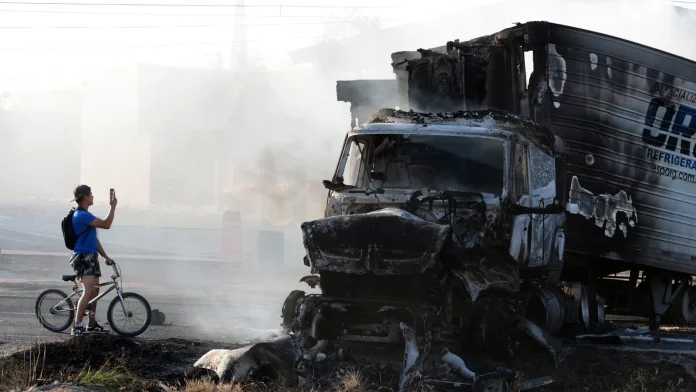
Night of iron and glass: Ukraine wakes to smoke, silence, and the math of loss When dawn came over cities from Kharkiv to Zaporizhzhia, it...
Israel committed two-thirds of press killings in 2025

Israel Responsible for Two-Thirds of Journalist Killings in 2025

0
A Year the World Lost Its Witnesses: 129 Journalists Killed in 2025 On a sunlit morning in Gaza, a battered camera bag sits where a...
Iran rejects US claims on missile programme as 'big lies'

Iran Dismisses U.S. Allegations Over Missile Program as ‘Big Lies’

0
When Words Become Missiles: A Night of Accusation, Denial and a City That Keeps Its Tea Warm There was a peculiar light the night the...
French govt wins two no-confidence votes on energy law

French government survives two no-confidence motions over energy bill

0
A Parliament on a Knife-Edge: How a Decree and Two Defeated No-Confidence Votes Shook France There are nights in Paris when the Boulevard Saint-Germain hums...
US presses missile issue ahead of indirect Iran talks

US intensifies missile pressure ahead of indirect talks with Iran

0
Geneva on Edge: Quiet Halls, Loud Threats — Can Negotiations Pull the Region Back from the Brink? On a frigid morning in Geneva, the air...