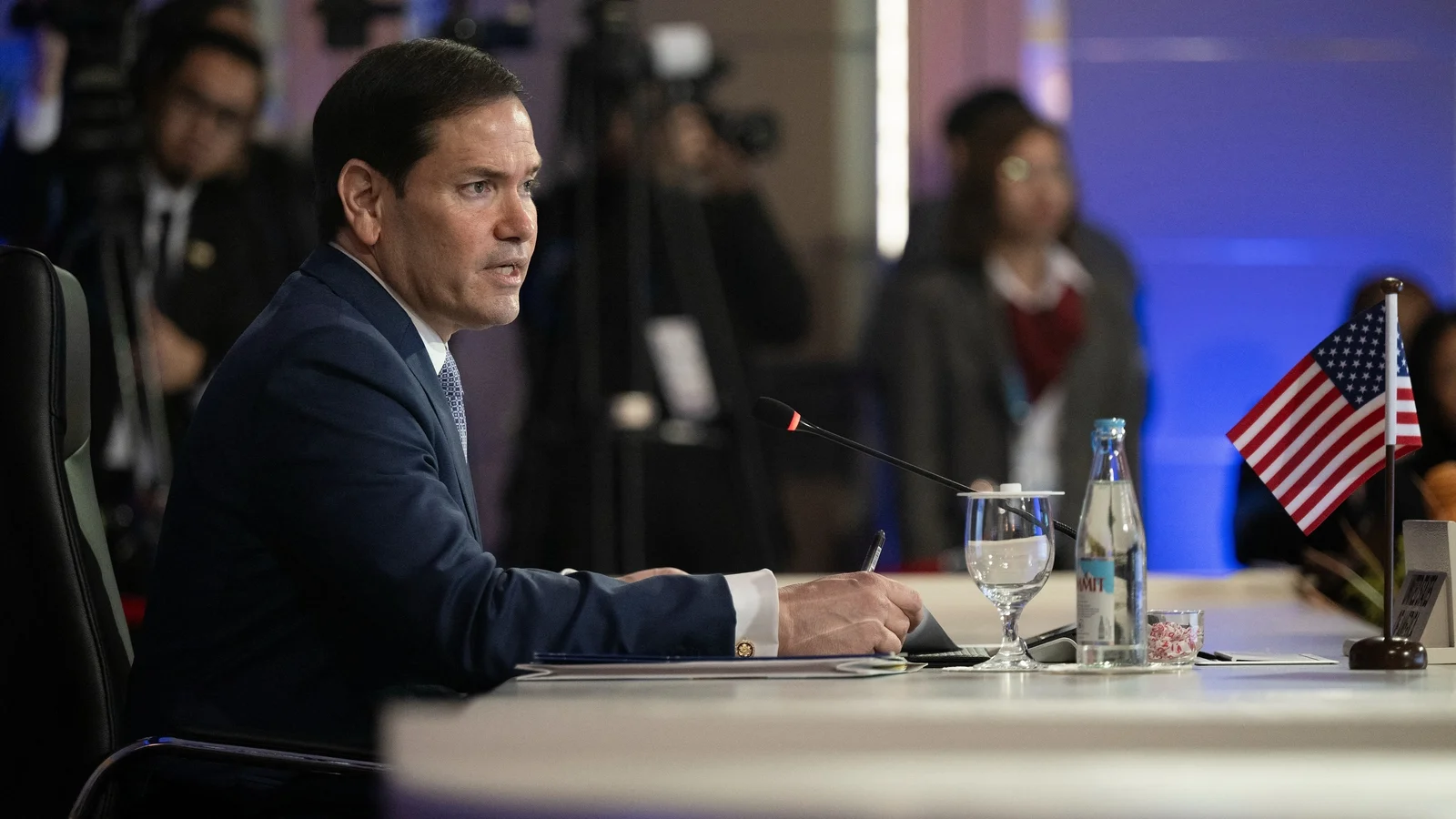
As fighting across the Gulf region squeezes two of the world’s most vital oil corridors, US Secretary of State Marco Rubio says Washington remains open to ending the Iran crisis at the negotiating table — but he doubts Tehran is approaching talks in good faith.
Mr Rubio delivered the warning during a meeting of Southeast Asian foreign ministers, one day after three oil tankers carrying Saudi crude to Asia reversed course in the Red Sea, apparently responding to threats from Yemen’s Iran-aligned Houthis.
The Houthis, who control the coastline near the mouth of the Red Sea, have announced a naval blockade on Saudi Arabia, potentially opening a fresh front in a war that has killed thousands of people across the Gulf since it began on 28 February with US and Israeli attacks on Iran.
Iran has already threatened shipping through the Strait of Hormuz — the narrow passage leading out of the Gulf — making the Red Sea the main alternative route for millions of barrels of Saudi oil each day.
A senior Iranian official said Tehran had received a proposal from mediators for a 10-day ceasefire, an effort to salvage the interim ceasefire agreement signed by the US and Iran in June, which replaced an earlier April ceasefire.
Diplomatic efforts also appeared to continue elsewhere: Iran’s Interior Minister Eskandar Momeni has travelled to mediator Pakistan and urged Islamabad to keep pushing for a breakthrough.
Mr Rubio greets senior government members from East Timor, Vietnam and Cambodia
Mr Rubio greets senior government members from East Timor, Vietnam and Cambodia.
Mr Rubio said the United States was “always committed to diplomacy,” but argued the immediate obstacle was Tehran’s lack of seriousness about negotiation.
“The problem we’re having right now is that they’re not serious about talks. If they’re serious, we’re serious. If they’re not, then we will do what’s necessary to protect our interests, and also the interests of our allies,” Mr Rubio said in Manila.
He underscored that Iran must not be allowed to control the Strait of Hormuz, saying such a move would set a global precedent — including for Southeast Asian nations, many of which face their own territorial disputes in the South China Sea with China.
“If we create a precedent in the Middle East where a nation state can decide that they are going to control an international waterway, charge a toll, and if you don’t pay them blow up your ships, we have created a very dangerous precedent, which will repeat itself in other parts of the world, including in this region,” Mr Rubio said.
With no diplomatic breakthrough apparent, the US military struck targets across Iran for an 11th consecutive night. Residents in Tehran reported hearing explosions in the early hours of this morning as Iran activated air defences over the capital, according to Iran’s semi-official Fars news agency.
Iran’s official IRNA news agency also reported explosions in the southeastern coastal cities of Chabahar and Konarak, and said two blasts were heard in Bushehr, home to Iran’s only nuclear power plant.
The overnight strikes followed Iranian attacks on US military sites in Bahrain, Kuwait and Jordan, and came after a tanker was hit in the Strait of Hormuz.
Iran said it had hit infrastructure belonging to Amazon in Bahrain, where the US technology company operates a regional data centre. Amazon did not comment, and Reuters said it could not verify the claim.
US President Donald Trump said 18 US servicemembers have been killed so far in the war, including four who died in Iranian attacks on US military bases in Jordan and Iraq in recent days.
Oil prices extended gains in Asian trading today after rising more than 2% on Tuesday following the Houthi threats, with Brent crude hovering above $91 a barrel.
‘Gate of Tears’
In a letter to shippers, the Houthis warned they would attack any vessels that load or discharge Saudi oil.
Mr Trump said the Houthis had not yet closed the Bab el-Mandeb — the “Gate of Tears” strait at the entrance to the Red Sea — and he threatened action if they did.
“So far it hasn’t happened,” Mr Trump said. “If something like that happens, we take care of it.”
Against that backdrop, three oil tankers carrying Saudi crude bound for China and India made U-turns in the Red Sea, steering toward the Suez Canal instead of heading past Yemen’s coast at the sea’s southern mouth.
During the war, Saudi Arabia has partly avoided disruption by piping oil to Yanbu on the Red Sea. But if the Houthis fully shut that alternative route, global oil supply could tighten sharply by trapping most Saudi exports.
US Secretary of Defense Pete Hegseth testifies during a Senate Appropriations Committee hearing
Earlier this week, Mr Trump renewed his threat to again strike Iran’s nuclear facilities at Natanz “pretty soon” — a site he said in June 2025 had been “totally obliterated” after the US military bombed the mountain-buried facility that month. Iran has said it would retaliate.
Fifty civilians have been killed and 500 wounded in the recent US strikes on Iran, according to a health ministry official.
Defense Secretary Pete Hegseth told US senators the war has cost the United States $37.5 billion so far, an increase from a previous estimate of nearly $29bn in mid-May.