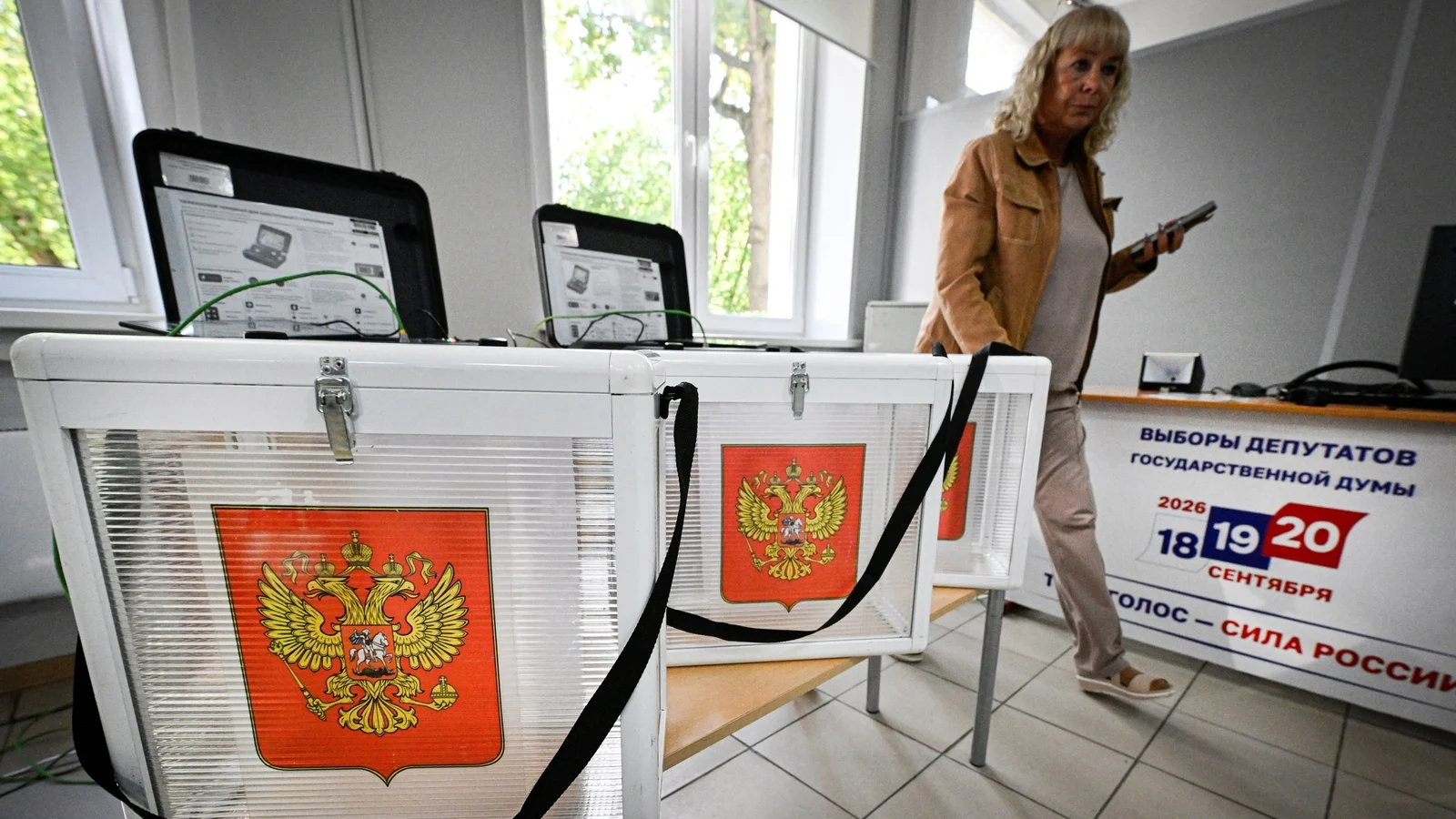
Russians began casting ballots on Friday in a parliamentary election the Kremlin’s ruling party is widely expected to dominate, as the grinding war in Ukraine and a wave of drone attacks push the conflict from distant headlines into everyday life.
The economic and political climate has been seriously affected by four-and-a-half years of full-fledged war with Ukraine.
Swarms of enemy drones have inflicted massive damage on Russian oil refineries and logistical facilities.
The public, which no longer sees the fighting as something distant, is increasingly nervous.
United Russia, the main Kremlin party, is poised to keep its overwhelming grip on the State Duma alongside a few other parties aligned with President Vladimir Putin.
Even so, officials have moved to tighten the screws ahead of the first wartime vote for the lower chamber since the 2022 full-scale invasion.
Before three days of voting that began in Russia’s Far East, the Kremlin stamped out even faint signs of dissent. The only party that dared to criticise the war was abruptly taken off the ballot, while several anti-war politicians have been imprisoned or driven into exile.
For the first time, the election includes residents of four Ukrainian regions that Moscow illegally annexed after the invasion. Ukraine has called the vote illegal.
With the outcome seen as a foregone conclusion and Mr Putin’s hold on power not facing an immediate challenge, analysts say the vote serves a different purpose: rallying the country behind the war effort and projecting legitimacy for the Kremlin’s actions.
“Your choice and resolve will once again demonstrate that millions of people stand behind our fighters, that we are a united people, bound by shared values, historical memory, and love for the Motherland,” Mr Putin said in an address before the vote.
After a summer of Ukraine’s long-range drone strikes, many Russians have felt the war’s impact more directly.
The attacks compounded strains on an economy that, after an early lift from huge military spending, has slid into stagnation. To contain a swelling budget deficit, the government raised taxes and stepped up domestic borrowing.
Strikes on Russian oil refineries triggered a serious fuel crunch that peaked in June, eased for several weeks, then flared again in August.
Further jolting the economy was a spate of attacks on warehouses used by online retailers Wildberries and Ozon. Hundreds of thousands of individual sellers lost their merchandise, a blow that rippled through the wider market.
Together, the developments have weighed on public sentiment. Surveys showed a drop in Mr Putin’s approval ratings, though they remained high: the independent Levada Centre put his rating at 76% in August, down from 87% in September 2025.
Signs of unease have also appeared within the upper ranks of Russia’s establishment.
Andrei Klepach, chief economist of the state VEB.RF bank, cautioned that the pressures could spill over into domestic unrest.
“We won’t win the competition in this war of attrition,” he said at a seminar. “Our costs are mounting. I’m almost sure that we will come to face a social crisis.”
Mr Klepach was dismissed the day after his comments were published.
Mr Putin has conceded the attacks caused significant damage, but has argued the economy can absorb the blows. He said Ukraine had opened a “Pandora’s box”, inviting massive retaliation.
Russia has since intensified strikes on Kyiv and other cities, using missiles and new jet-powered drones while taking advantage of Ukraine’s shortage of defensive interceptors. Moscow has also sharply increased attacks on Black Sea ports, disrupting Ukrainian exports of grain and other agricultural products, a major source of revenue.
As the conflict escalated, concern spread that the Kremlin might be weighing a large-scale mobilisation.
A partial mobilisation of 300,000 reservists in 2022 led hundreds of thousands of Russians to leave the country, a flight that shook domestic stability.
Since then, the Kremlin has leaned on volunteers, luring recruits with comparatively high wages and other benefits. Military experts have warned, however, that the stream of volunteers has slowed even as heavy losses continue.
Ukrainian President Volodymyr Zelensky has repeatedly said the Kremlin is considering a post-election mobilisation, a claim Mr Putin dismissed as “nonsense”.
At a Kremlin meeting with US envoys Steve Witkoff and Jared Kushner on 5 September and a subsequent call with President Donald Trump, Mr Putin said Russia holds the upper hand on the battlefield, signalling he will keep his maximalist demands for striking a peace deal.
In July, the Central Election Commission cleared 11 parties for the parliamentary ballot, including Yabloko, the only one to openly criticise the war.
Within weeks, however, the country’s Supreme Court struck Yabloko from the ballot. The ruling followed an appeal by the nationalist Motherland party, which argued that liberal Yabloko’s anti-war position amounted to seeking the violation of Russia’s territorial integrity.
Kremlin-watchers said the decision appeared to reflect a tug-of-war inside the system: some officials wanted the appearance of competition to boost turnout, while others worried Yabloko could provide a platform for open criticism of the war and stir political instability.
“The risks that the campaign would turn into a struggle for and against peace – that is, a dispute about the war – were quite high, and this clearly was not part of the plan,” said Tatyana Stanovaya of the Carnegie Russia Eurasia Centre.
Maxim Kruglov, a deputy chairman of Yabloko and former member of Moscow’s city council, was convicted in June of spreading false information about the military and sentenced to seven years in prison.
Last month, a court in the Pskov region convicted Yabloko member Lev Shlosberg of speaking out against the war and sentenced him to more than 11 years.
Half of the Duma’s 450 seats are filled by approved parties and the other half by the winners of races in single-constituency races. Yabloko was banished from the party list voting.
Authorities then moved step by step to block individual Yabloko members from standing in most single-constituency contests for the Duma and regional legislatures.
Liberal politician and war critic Boris Nadezhdin, who tried to challenge Mr Putin in the 2024 presidential election, left Russia last month, fearing imprisonment after he was designated as a “foreign agent” and barred from seeking office.
United Russia, which controls more than two-thirds of the Duma’s seats, is expected to preserve its dominance despite widespread war fatigue and a deteriorating economy. Some Russian reports suggest the Kremlin has marginally reduced its target for United Russia, while still expecting it to keep full control of parliament.
“United Russia may be allowed to slip a little – to bring its actual sort of declared results more in line with probably its real results,” said analyst Mark Galeotti, who heads the Mayak Intelligence consultancy, adding that the Kremlin will ensure it “is still absolutely dominant within the Duma”.
The other parties of the so-called “systemic opposition” — the Communist Party, the Liberal-Democratic Party and A Just Russia Party — which follow Mr Putin’s line and strongly back the war, are expected to retain their foothold in parliament.
While Ukraine’s strikes have heightened anxiety, they could also strengthen calls for a harsher response against Kyiv, “as long as they don’t have to be involved in it”, Mr Galeotti said in a podcast.
Chris Weafer, chief executive of the Macro-Advisory Ltd, said that although the attacks have dented morale, the Kremlin’s political supremacy is not under immediate threat.
“There has been a ‘rally around the flag’ anyway since the start of conflict and the opinion polls consistently show the very high level of support,” he said.
And with the final tally effectively set in advance, Mr Weafer said, the Kremlin’s priority is shaping “the public narrative and particularly the turnout” to claim broad public backing for its actions.