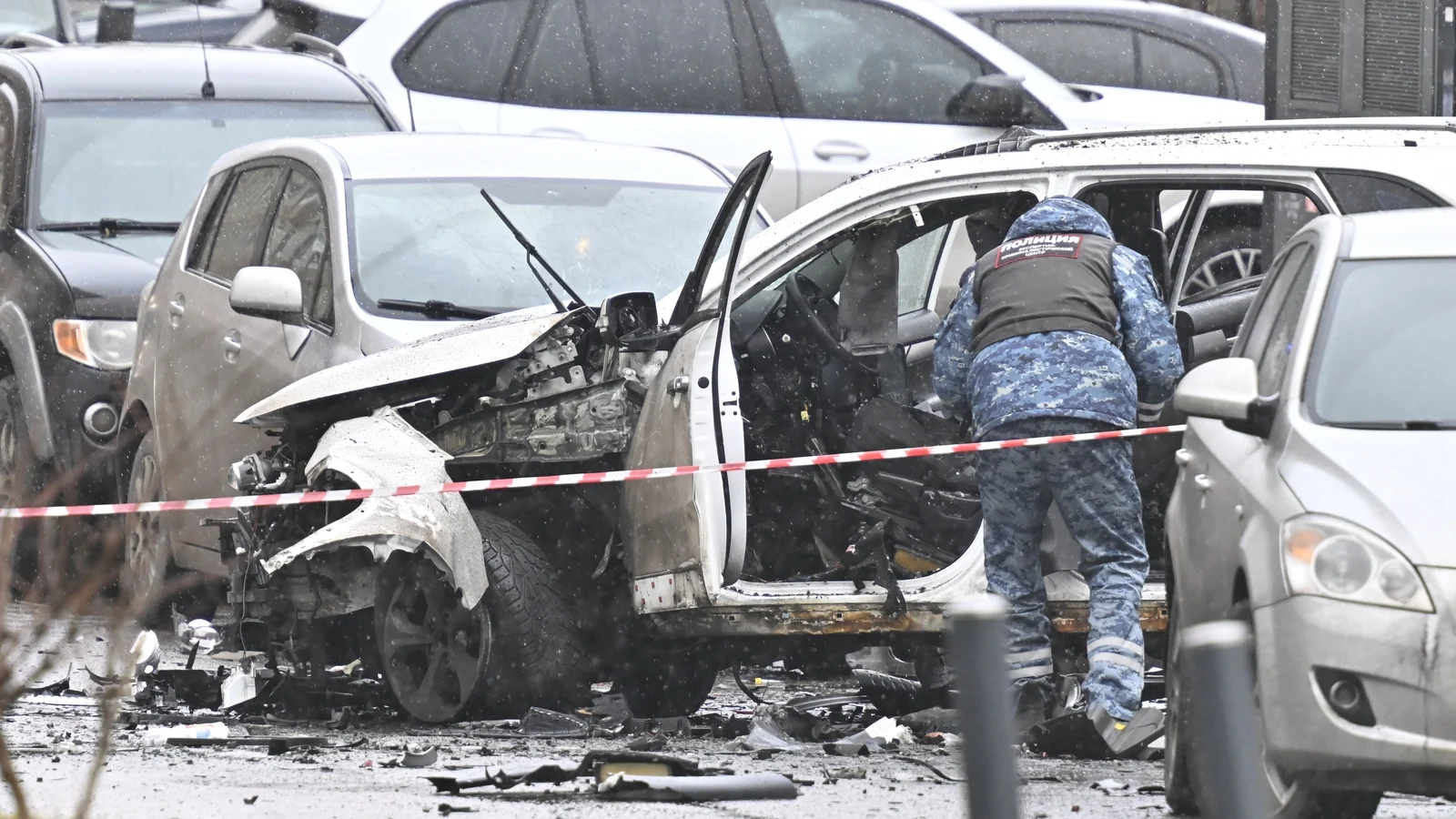
When a Quiet Moscow Street Became a War Zone
It was supposed to be an ordinary morning in a quiet southern district of Moscow — a place of cherry trees, Soviet-era apartment blocks, and market stalls where grandmothers haggle over black bread. Instead, a single blast ripped through the calm, shredding metal, shattering glass and, according to Russian officials, ending the life of Lieutenant General Fanil Sarvarov, a senior military figure whose career had taken him from the mountains of the North Caucasus to the deserts of Syria.
The scene that greeted residents and investigators was cinematic and brutal. A white Kia SUV lay mangled, its doors flung open, its frame twisted and charred. Windows in nearby buildings trembled; a smell of burning and spent cordite hung in the air. Sirens wailed. For those who had called this corner of the city home for decades, the blast was a jolt back to the front lines of a conflict they had long been told took place far away.
Voices from the Street
“The windows rattled,” said Grigory, 70, a lifelong resident whose balcony looks onto the blast site. “You could tell it wasn’t a car backfiring. It was like a thunderclap. We all ran to see.” He paused, then added with a kind of weary pragmatism: “We need to treat it more calmly. It’s the cost of war.”
Others sounded less resigned. A young mother who had been pushing a stroller nearby clutched her child and whispered, “I heard the bang and I thought the world was ending.” Her name, she said, was Yelena. “You feel unsafe in your own city,” she said. “How can anyone sleep?”
Who Was Killed — and Why It Matters
Lieutenant General Fanil Sarvarov, 56, headed the Russian General Staff’s training department, and his service record — deployments to Chechnya in the 1990s and command responsibilities in Syria in 2015–16 — reads like a modern history of Russian military engagement. For Moscow, his death is a blow. For many observers abroad, it underlines a grim fact: the war in Ukraine is no longer confined to battlefield frontlines or occupied territories. It has begun to reach into the heart of Russia itself.
Russian investigators, including the Investigative Committee, announced they were pursuing multiple leads and explicitly said one avenue was whether Ukrainian special services had orchestrated the attack. Kyiv has not commented on the incident. The absence of a statement leaves a space filled by speculation, accusation and the politics of a war in which deniability and covert action are part of the toolbox.
The Pattern of High-Profile Attacks
This strike follows a string of high-profile killings and attempted assassinations that have punctured Russia’s sense of domestic security in recent years — from car bombs and booby-trapped devices in Moscow to explosive gifts delivered in cafés. Each incident is an echo of the asymmetric tactics that emerge when one side lacks the conventional advantage but seeks to destabilize or demoralize the other.
- In April, a car blast near Moscow killed General Yaroslav Moskalik, a deputy of the General Staff.
- In December 2024, an explosive-laden electric scooter killed Igor Kirillov, head of Russia’s radiological, chemical and biological defence forces — an attack claimed by Ukraine’s security service.
- In April 2023, a Russian military blogger was killed when a statuette detonated in a Saint Petersburg café.
- And in August 2022, a car bomb killed Daria Dugina, daughter of a prominent ultranationalist.
Whether these strikes are the work of state-directed sabotage, freelance operatives, or an amalgam of actors remains contested. What is clear is the psychological reverberation: Moscow’s elite, and the neighborhoods where they live, are no longer insulated.
Diplomacy in Miami — and an Explosion at Home
The timing could not be more pointed. The blast occurred just hours after separate talks in Miami involving Russian and Ukrainian delegates and US envoys — part of a flurry of diplomacy aimed at ending a war that has now entered its fourth year. The meetings, mediated by envoys associated with former US President Donald Trump, were described by one US interlocutor as “constructive,” but Moscow called the progress “slow.”
“Slow progress is being observed,” quoted state media said, citing Deputy Foreign Minister Sergei Ryabkov, who also warned against European involvement in the talks. Moscow’s preference for a bilateral route through Washington reflects a larger geopolitical play: the contest not only over Ukraine, but over who gets to shape any post-war order.
Both sides, meanwhile, maintain public ambiguity. Kyiv’s negotiators have been cautious, and President Volodymyr Zelensky has repeatedly questioned whether Moscow genuinely seeks peace or is engaged in a broader geopolitical project. Even as diplomats whisper and trade drafts in hotel rooms across the Atlantic, explosions in Russian neighborhoods are a sharp reminder that the human costs of the conflict reverberate back home.
Experts Weigh In
“This is a classic example of conflict bleed,” said Dr. Olga Markov, a security analyst based in Warsaw who studies irregular warfare in Eurasia. “When a conflict is prolonged, actors find ways to strike where their adversary feels most secure. Targeted killings have both tactical and symbolic value: they disrupt command, intimidate, and send a message.”
“But there are risks,” she added. “Escalation is not just a military calculation. Every such attack feeds a narrative that can harden public opinion and complicate diplomacy.”
What This Means for Civilians and the Idea of Peace
For ordinary people — market vendors, pensioners, parents — the political chessboard is of secondary importance next to the immediate question: am I safe? “You fear going to the supermarket, to the park,” said Dmitri, a shopkeeper who swept glass from his storefront sidewalk that afternoon. “This is not the kind of life one expects in Moscow.”
Beyond personal safety, there is a wider civic erosion. When violence becomes part of daily life, trust in institutions frays. Investigations may begin quickly, but answers rarely arrive with the speed or clarity that would soothe a frightened populace. Meanwhile, the international community watches: negotiations in Miami, the role of European states offering potential peacekeeping contingents, and the murky intelligence assessments about leaders’ ambitions — all are variables that could either temper or intensify the conflict.
Consider the human arithmetic: tens of thousands killed, millions displaced, cities reduced to smoldering ruins. Those figures — estimates from humanitarian agencies and independent analysts — represent real families, small towns emptied of their youth, and a generation whose prospects are reshaped by loss. How much more of this will the world tolerate before the urgency to find a durable settlement overcomes the political inertia?
Looking Ahead: Questions Without Easy Answers
What happens next is uncertain. Will the attack harden Moscow’s resolve and lead to further clampdowns and retaliatory operations? Will it spur negotiators to redouble efforts in Miami and beyond? Or will it deepen the shadow war, in which deniable operations and tit-for-tat violence replace transparent diplomacy?
The blast in southern Moscow forces us to confront an inconvenient truth: wars that begin across borders eventually seep into living rooms. They transform neighborhoods into theaters of geopolitics and turn courtyards into crime scenes. They leave behind questions that are not easily answered by statements from ministries or color-coded maps.
As you read this, ask yourself — what is the cost of peace, and who is willing to pay it? How do we measure security when an explosion can unsettle a city and alter the course of talks thousands of miles away? And finally, what does it say about our shared global condition that diplomacy and violence can so often be found operating on the same day, in different hemispheres, but all connected by the fragile promise of stability?
In the end, the charred metal and shattered glass on that quiet Moscow street are not just evidence of an attack. They are a mirror, reflecting a world where civilian life, military policy, and high-stakes diplomacy intersect — sometimes with deadly consequences.