A Night at the Beach, Waiting for the Moon
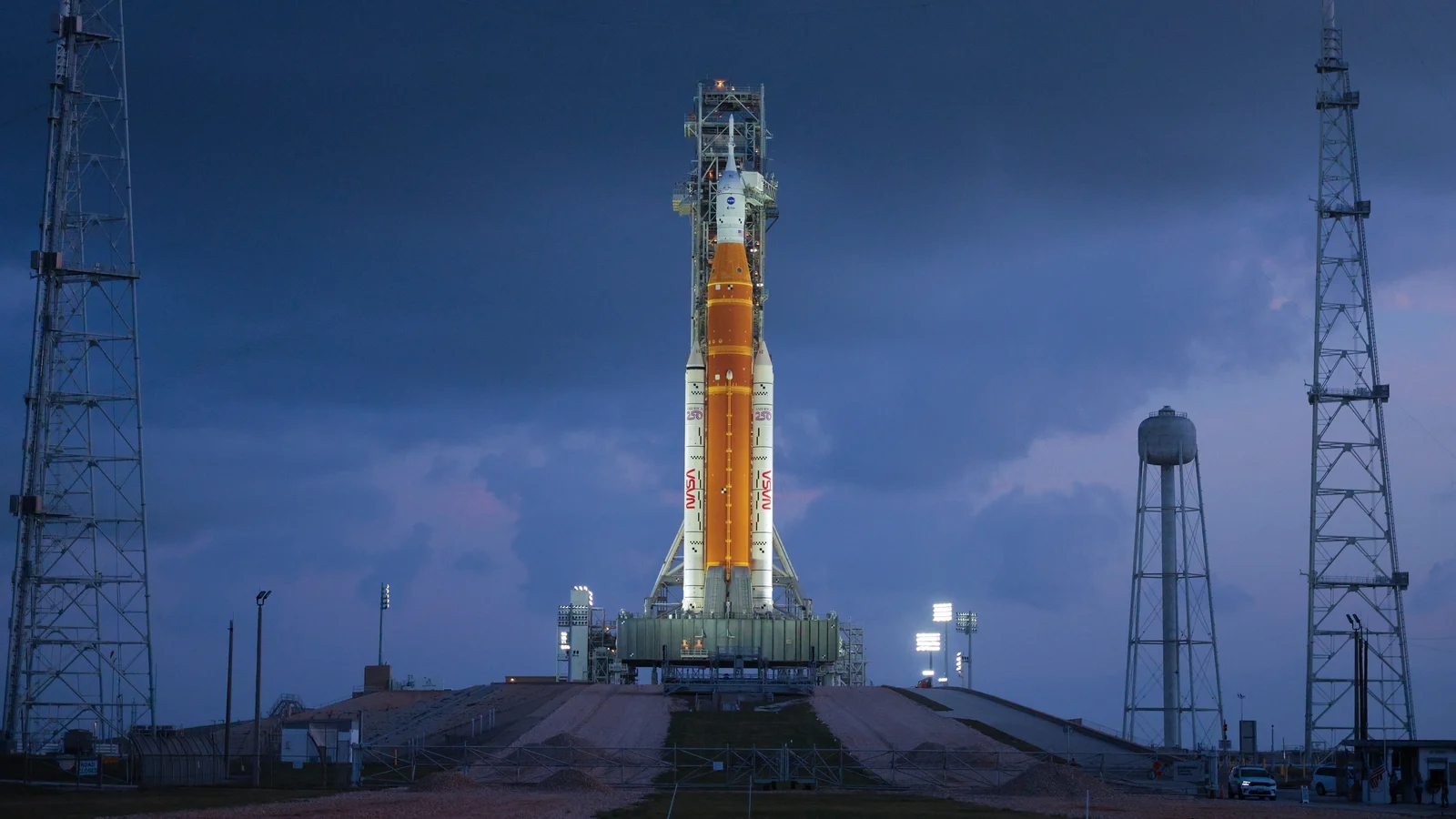
The sun slid low over Cocoa Beach like an orange coin, and the air smelled of salt, sunscreen and the faint tang of hot tar from the waterfront parking lots. Families lounged on towels; teenagers chased the sudden gusts of wind that made their kites skitter. Children pointed at a distant white tower that was, for a few hours at least, the most famous thing on Earth.
For vacationers who’d come to surf and to sleep late, the arrival of a rocket on the horizon was an unexpected punctuation mark in their holiday. For others it was the reason they’d booked a room months ago. Either way, anticipation hummed through the crowd: tonight was launch night for Artemis II, NASA’s long-awaited mission that will carry astronauts farther from Earth than any human has travelled in more than half a century.
Witnessing a Turning Point
“We were supposed to be here for baseball,” said Alyx Coster, a 38-year-old mom from Minnesota, folding up the beach umbrella as the light thinned. “But the kids are beside themselves. They kept saying, ‘Mom, we’re actually going to see history.’ They mean it.”
Jason Heath, a shipbuilder from northeastern Maine who brought his family down for a winter escape, stared at the sea as if trying to spot a trajectory in the waves. “There’s a weird pride in watching humans push a boundary again,” he said. “Whatever happens tonight, you’re part of the moment. You feel it in your bones.”
They’re not alone. Local officials have braced for a crowd that could swell to some 400,000 people across the Space Coast, according to regional newspapers and county estimates. Hotels reported heavy bookings, restaurants extended hours, and small vendors hawked T‑shirts printed with rockets and moon motifs. The economic ripples of a launch—ticketless, free to the public but priceless in effect—are felt up and down the strip.
Not Just a Launch: A Mirror of Our Times
Artemis II is more than a technological spectacle. It’s a statement about who goes to space now. The crew—three Americans and one Canadian—represents a departure from the homogeneity of the Apollo era. For the first time, a woman and a non‑American are slated to travel that far from Earth; the mission may also include the first person of colour to enter lunar distance. For many, that is as momentous as the rocket itself.
“Representation matters,” said Dr. Aisha Mensah, a space policy scholar at a university in Washington. “When kids see themselves in astronauts—girls, children of colour, young people from outside the U.S.—it changes what they imagine possible. That has long-term cultural and economic benefits for the STEM pipeline.”
How Far Are We Going?
Artemis II is expected to eclipse the distance humans reached during the Apollo missions. The farthest recorded human distance from Earth—roughly 400,000 kilometres—was set during the Apollo 13 free-return trajectory. This mission will push that boundary further, following a looping course that will take the crew well beyond low Earth orbit and into cislunar space, a realm where Earth‑Moon gravity plays out like an intricate dance.
“Technologically, it’s a huge step,” said Marcus Alvarez, an aerospace engineer who flew out to watch the launch. “We are testing the Orion capsule’s systems with a crew aboard, and that experience will inform everything from life-support redundancy to navigation in deep space. These are the building blocks for sustained presence at the Moon and, eventually, Mars.”
Between Nostalgia and New Narratives
Not everyone here remembers the Apollo launches, but some do—and their memories are a lens through which they view tonight. Melinda Schuerfranz, 76, who placed a folding lawn chair at the dune line alongside her husband, recalled the first moonshots like a family heirloom.
“Back then you could feel the whole country leaning in. Radios, schoolrooms—everyone watched. There was a hum of national purpose,” she said. “Tonight feels different—more crowded, more informal—but it’s still exciting in its own way.”
Her husband John, a retired mechanic, added, “The space race gave us a cause that felt shared. Now there are more players, more private companies, more countries. That makes it messier, sure, but also richer.”
Why So Few People Know
Despite the scale of the mission and a steady media rollout from NASA, many Americans admitted they’d only learned of the launch by accident. A fragmented information environment—endless streaming choices, a 24/7 news cycle that prioritises some stories over others, and the constant churn of social media—means even headline-making events can slip past large swaths of the population.
“I work nights, I don’t follow the news much,” said Carlos Medina, a lifeguard who spends his days scanning the surf. “I heard someone talking about it and thought, ‘Wow, that’s nearby.’ But it’s not like the old days when you knew the schedule and tuned a radio.”
Local Life, Global Questions
Near Jetty Park and the launch viewing pads, small businesses hum with last-minute sales: coffee shops sell thermoses with astronaut patches, a surf shop posts a launch livestream on a television, and a taco truck offers “moon tacos” with a wink. But the excitement is threaded with practical strain—traffic snarls hours before lift‑off, roads turned into viewing arteries, and volunteers coordinating water stations for the crowd.
The spectacle raises larger questions, too. What does the return to lunar exploration mean for a world facing climate crises, geopolitical tension and unequal access to resources? How do we justify public expense while education, housing and healthcare strain budgets? For many, the answer lies in a balance between inspiration and accountability.
“Spaceflight is expensive,” Dr. Mensah said. “But it’s not just fireworks. Investments in the Artemis program have driven innovations in materials, sensors and medicine. The key is ensuring those benefits reach people who are not at launch sites or in boardrooms.”
Facts to Keep in Mind
- Launch window: Wednesday at 6:24 p.m. local time (about 10:24 p.m. Irish time).
- Estimated crowd: Up to 400,000 people across the Space Coast region, per local reporting.
- Temperature at the beach: Approximately 25°C as evening approached.
- Distance milestone: Artemis II aims to travel beyond the Apollo-era human distance record of roughly 400,000 km from Earth.
- Program scale: Artemis is an international and commercial endeavour involving billions of dollars in investment and partnerships across agencies and private companies.
What Will You Tell Your Children?
As the first stars blinked awake and the crowd tightened, a woman near me turned to her partner and said, “When they ask where we were the night humans went farther than before, we’ll tell them we were right here, sand between our toes.” It was a simple, tender thought—but it cut to the heart of why so many of us gather for launches.
Do we come for science, for national pride, for the souvenir T‑shirts and the beachside atmosphere? Yes. But we also come to be reminded that, in the midst of ordinary days, humans still choose to risk and to dream. We come to be part of a story that extends beyond us, one that asks us to imagine a future where more people—of more genders, ethnicities and nationalities—get to look back at Earth and see home with fresh humility.
So as you scroll past the livestream tonight, or find a clip on social media tomorrow, consider pausing. Imagine the hush as the engines ignite, the flash that turns the ocean into a mirror, the way a child clutching a foam rocket might decide that anything is possible. What story will you tell when your grandchildren ask, “Where were you when the new chapter began?”