A bridge that seemed to cry light: Sydney’s biggest New Year spectacle
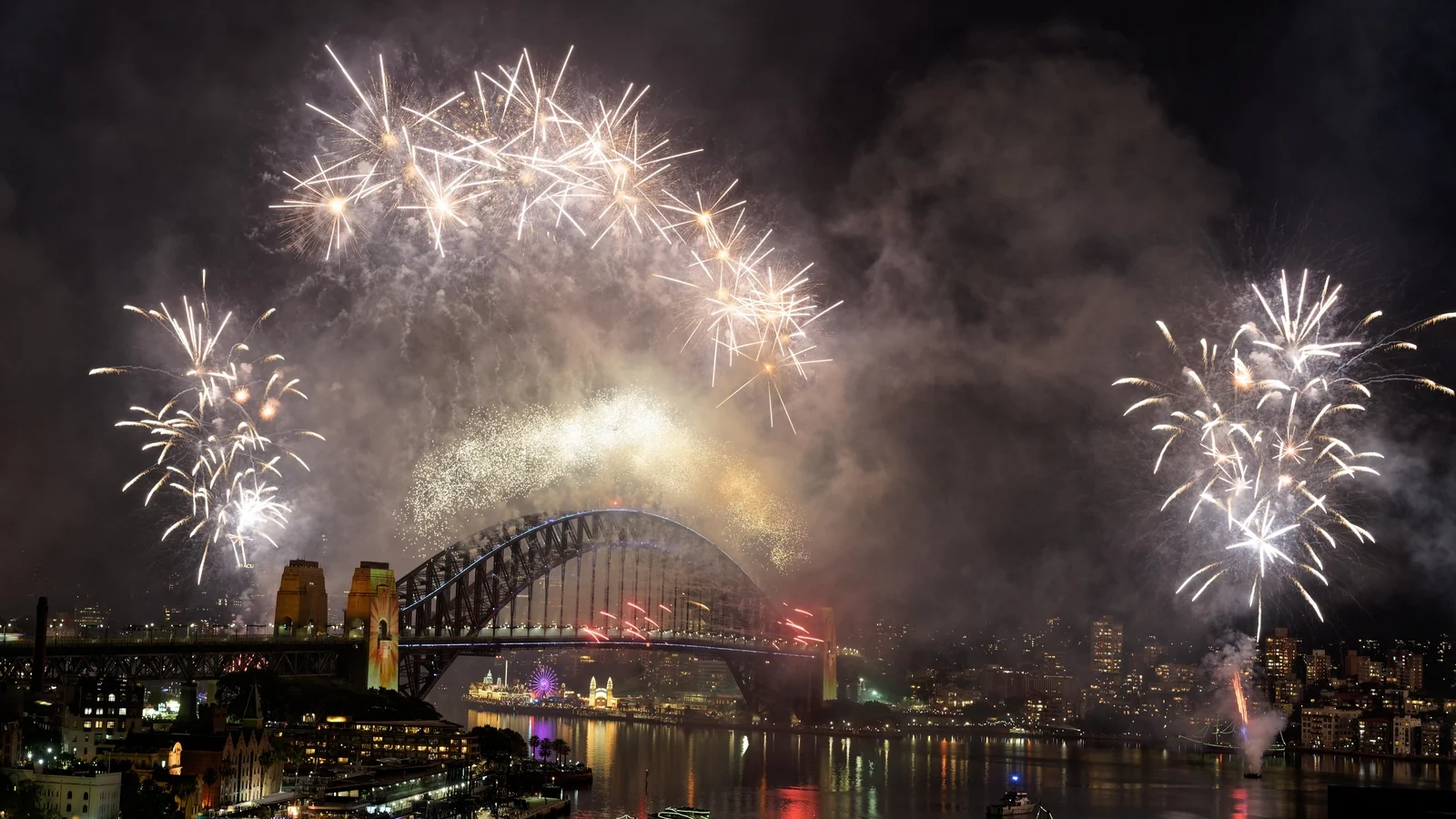
When the clock slid toward midnight on a warm Sydney evening, the Harbour shifted from a ribbon of night to a living painting. Fireworks fell like a waterfall from the top of the Sydney Harbour Bridge — a shimmering curtain of light that, for a few suspended seconds, looked almost like rain. It was the start of 2026, and Australia’s most famous skyline had outdone itself: a 12-minute pyrotechnic opera stretching seven kilometres around the harbour, the largest display the city has ever produced.
This was not a modest sparkler show. Organisers say the display used roughly nine tonnes of fireworks and unleashed about 25,000 individual pyrotechnic shots. They fired from the Harbour Bridge and the white sails of the Opera House, from six city rooftop locations and multiple floating platforms that hovered above the water, choreographing shapes — cockatoos, koalas, bottlebrush blooms — that nod to the continent’s wild heart while dazzling a crowd of hundreds of thousands.
A show stitched with tenderness
There was a tenderness in the spectacle, too. Barely a fortnight earlier, the city had been shaken by a mass shooting at a Jewish festival in Bondi Beach, an attack that left 15 people dead and deepened the ache of any community whose social rituals unfold along crowded shorelines and public squares.
At 11pm, before the fireworks’ roar, the bridge was bathed in white light and the harbour fell into a hush for a minute of silence. People lifted candles and phone lights that looked from a distance like a constellation of small, stubborn stars.
“Right now, the joy that we usually feel at the start of a new year is tempered by the sadness of the old,” Prime Minister Anthony Albanese said in a video message earlier in the evening, summing up a mood that mixed celebration with remembrance. On the foreshore, a woman folded into her partner’s coat and whispered, “We came to feel alive again,” and the person next to her, a vendor selling hot chips, nodded slowly as if to say that grief does not want to be forgotten even amid confetti.
Up close: people, boats, and a city that never sits still
If you’ve never stood on Sydney’s foreshore on New Year’s Eve, imagine a city turned into a thousand little rooms. Families spread picnic rugs with prawns and plum sauce. Buskers — violinists, a didgeridoo player — held small audiences, while a flotilla of boats bobbed in the harbour for front-row seats. From ferry decks to private yachts, people leaned forward as if to catch the pyrotechnic notes before they fell.
“It’s been on my bucket list forever — the fireworks, the bridge,” said a tourist who gave her name as Elena, speaking with the thick, hopeful accent of someone who had travelled for months. “You feel so tiny and so connected all at once.” Nearby, an elderly man with salt-and-pepper hair and a lifelong view of the Harbour shrugged and said, “Every year I think it can’t get better. Then they do this.” His hand gestured at the waterfall of light above the bridge: a gesture partly of pride, partly of gratitude.
Safety under glittering skies
Security felt tighter than usual. Heavily armed police patrolled with visible presence, checkpoints were more numerous, and authorities conducted bag checks in popular vantage points. Organisers and law enforcement said they worked to balance the need for safety with the joy of a public, communal event — no easy feat in an age when public gatherings are inevitably seen through a security lens.
“We planned for risk as well as revelry,” said a senior event official, speaking on condition of anonymity to discuss operational details. “Our priority was ensuring we delivered a world-class show while keeping people safe, and that meant more personnel, more screening points, and a coordinated response across agencies.”
It’s a new normal in a world where major urban events cannot be divorced from questions of crowd control and public safety. But the human instinct to gather, to mark time together, remains stubbornly resilient.
Beyond Sydney: fireworks across a shifting map of celebration
Sydney was not alone. In Auckland, New Zealand, the Sky Tower erupted with roughly 3,500 fireworks, and organisers say they sent around 500kg of pyrotechnics into the night, a five-minute display that lit the tower and the harbour. For the Pacific island nations — Kiribati among them — and for New Zealand, the new year was already here while much of the world slept; they are among the first to usher in the calendar’s fresh page.
Meanwhile, Brazil’s Copacabana Beach prepared for what local authorities expect to be upwards of two million people — a rolling, bright tide of revelers who for years have flocked to the sand in white clothes and bare feet, watching fireworks bloom over the Atlantic. And in Hong Kong, the mood was very different: a planned display over Victoria Harbour was cancelled to honour the 161 people who lost their lives in a tragic housing estate fire in November, an omission that turned empty fireworks stands into a public moment of mourning.
What do fireworks mean in a warming world?
There is another conversation that flares every year at this time: the environmental cost. Fireworks are beautiful, yes, but they are also a burst of particulate matter and metals in the air. Scientists warn of short-term spikes in air pollution following large displays, particularly in cities where weather and geography can trap smoke close to the ground. Some cities have begun experimenting with drone shows or low-emission pyrotechnics as technologists, environmentalists and event planners search for compromise.
“We need to ask what spectacle we can afford,” said an urban environmentalist in Sydney. “We love these communal moments, but we should explore cleaner ways to create them — because the people who love the spectacle are often those who breathe the smoke long after the applause.”
Why the ritual endures
What struck me walking along the Harbour that night was not only the size of the crowds or the technical achievement of the show. It was the way the evening held both joy and care. People hugged strangers. A boy handed a candle to an older woman. A ferry captain, on his PA, invited passengers to keep their voices low during the minute of silence. Rituals, especially public ones, are how communities knit themselves back together after violence or tragedy.
So when you see those images — the waterfall of light cascading off the bridge, the Opera House lit like a theatre of sails, a million pinpricks of smoke in the sky — remember that they tell a double story: one of spectacle and one of repair. We come together to celebrate, yes, but we also come together to steady each other.
What do you carry into a new year when you watch a city make itself luminous? Hope, for many. Memory, for some. Resolve, for others. Perhaps most of all, the feeling that even in an unsettled world, we will still find a way to mark time together.
On the horizon
As cities around the world experiment with how to celebrate responsibly and inclusively, Sydney’s 2026 display will be remembered both for its scale and for its quiet moments of commemoration. The lights came down. The boats returned to their moorings. The harbour, for a few hours, had been a place where grief and joy met under the same sky.
And somewhere on the foreshore, someone will have whispered their new-year wish into the low hum of the departing crowd. What will yours be?