The Morning the Sea Turned Sharp: Sharks, Surfboards and a City on Edge
Sunlight slanted across the gentle curve of Manly’s North Steyne as if nothing dark could disturb the ritual: coffee, the ferry’s chug, wetsuits shivering on the sand, boards tucked under arms. By midday, that ordinary rhythm was fractured by an image people will carry for a long time — a young man dragged from the surf, a crowd doing first aid on the sand, an ambulance wailing down the promenade.
It was the third shark-related incident around Sydney in forty-eight hours, officials say — three separate pinch points where the ocean’s power met human presence. One surfer in his 20s suffered severe leg injuries and was flown to hospital in critical condition after an attack at North Steyne Beach in Manly. Earlier, a boy of about 11 had the luck to walk away shaken but unhurt after a shark chewed a large piece out of his board off Dee Why Point. And, hauntingly, a 12-year-old remained in intensive care after being mauled in Sydney Harbour while jumping from a rock with friends.
“We’ve had three frightening events in a very short span,” said a senior marine-area officer who has been coordinating the response. “People pulled each other from the water. Lifesaving crews and bystanders did what had to be done. But the sea can change on a heartbeat.”
A city’s beaches on sudden lockdown
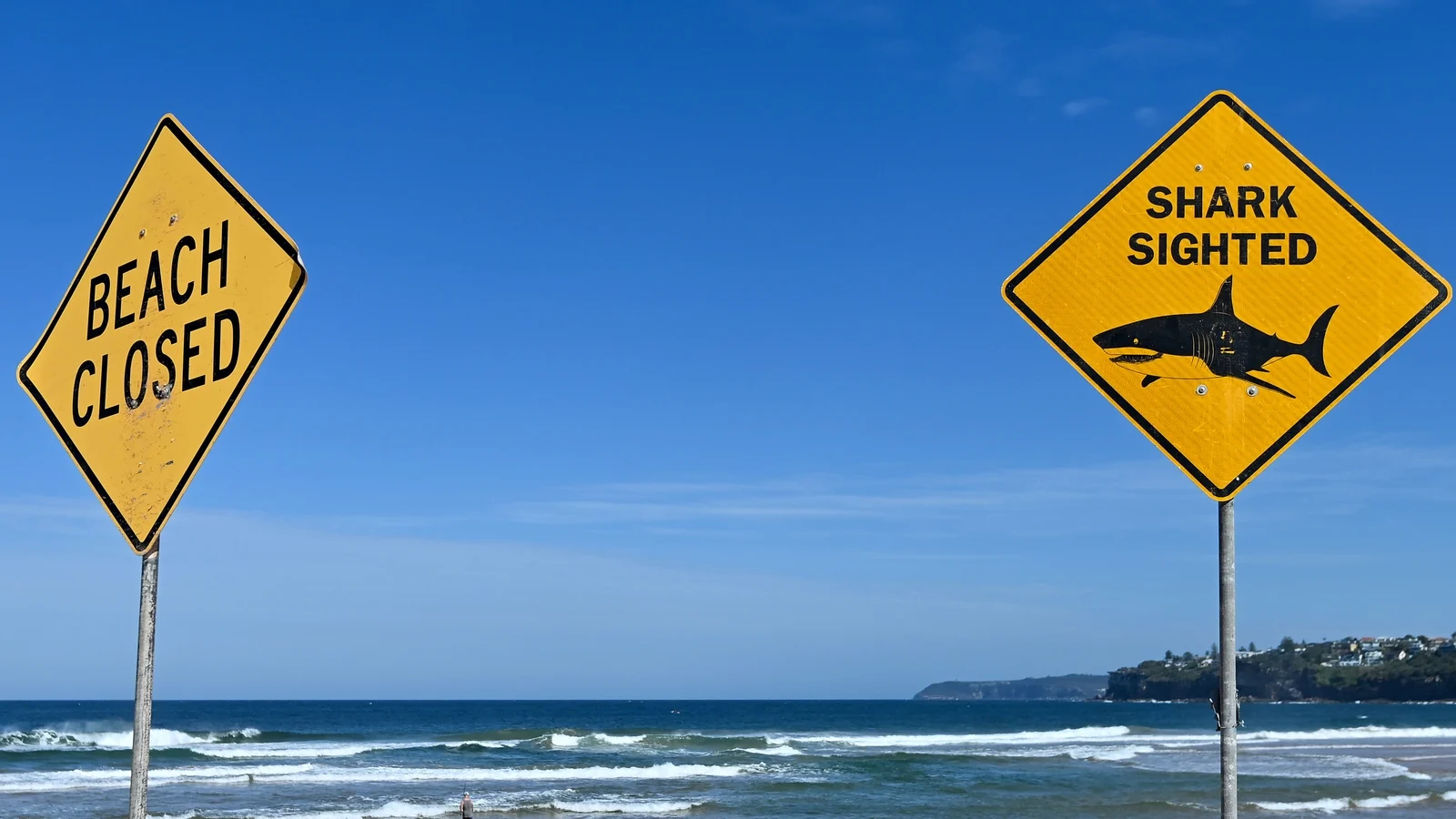
Police closed the northern beaches and placed visible patrols along shorelines as people processed what had happened. Flags that usually mark safe swimming zones were replaced by rows of uniformed officers and the stark yellow-and-black of closing notices.
Local shopkeepers and surf instructors said they understood the need for caution — but they were also grappling with fear for their trade and their way of life.
“It’s heartbreaking to see the kids not in the water,” said Ava, who runs a surf school near Manly Corso. “Surfing is how a lot of us grew up. But when something like this hits, you don’t tell people to go for a swim. You watch mothers holding their toddlers, and you think: how do you explain this to them?”
The rescue, up close
Witnesses described a chaotic and brave scene. “They pulled him up onto the sand and everyone just went into action — people applying pressure, someone shouting for a tourniquet,” said a surfer who was nearby. “The paramedics arrived quickly, but the wound was bad. You never want to see a mate like that.”
Police confirmed that members of the public were the first to administer life-saving care before emergency services arrived. In the harbour incident, officers put the injured boy into a police boat and applied two tourniquets on the way back to shore; he remains in intensive care.
Why now? The science behind the danger
Shark bites are rare, but when they happen they draw a lot of attention. Australia’s database of shark incidents stretches back to 1791 and records more than 1,280 encounters, with over 250 fatalities. What’s changing, scientists say, are the patterns and contexts of those encounters.
“There are several interacting trends,” said a marine ecologist working with coastal communities. “Coastal zones are more crowded — more people in the water means more potential encounters. At the same time, ocean temperatures are shifting migratory routes and altering prey distributions. That increases the chance of sharks and swimmers crossing paths.”
Global sea surface temperatures have risen roughly 1.1°C since pre-industrial times. Warmer waters can nudge species into new areas, and heavy rainfall can push river nutrients and pelican-fishing into harbours, creating murky, brackish conditions that some species like bull sharks favour. Scientists also point to complex changes in fisheries and food webs; some shark populations are declining, while others are stable or expanding in certain regions.
“It’s not a single villain,” the ecologist added. “It’s climate, human behaviour, and the ocean’s own ecology all interacting.”
Local knowledge and high emotion
On the terraces above Manly Beach, conversations veered between sorrow for the injured, anger at what some called “inadequate protection,” and stubborn resolve from surfers who said they would return to the waves.
“You can’t live in fear all the time,” said Tomas, a 34-year-old lifeguard who grew up surfing these breaks. “We teach respect for the ocean. I’m worried, yes. But I also know the sea gives us a lot. The answer isn’t to demonise sharks — it’s to invest in smart safety.”
That phrase — smart safety — came up again and again: drones for aerial spotting, more frequent water-quality testing, public education campaigns about avoiding swimming after heavy rain, and new research deployments to better understand seasonal shark movements.
- Possible safety measures being discussed:
- Increased drone and helicopter patrols
- Smart drumlines and non-lethal tracking devices
- Community alerts and better signage
- Expanded research funding for shark movement studies
How communities cope — and what this means globally
For coastal communities worldwide, this is not a parochial problem. From South Africa to California, Recife to Reunion Island, people are negotiating similar tensions: the need to protect swimmers and surfers, to protect marine life, and to adapt to rapid environmental change.
“We can’t pretend the ocean is a static thing,” said a conservation scientist who has worked on shark mitigation programs. “What we need are local solutions rooted in science and community values. Culling, for example, is extremely controversial, both ethically and ecologically. Non-lethal approaches have promise, but they require commitment and money.”
Public policy tends to lurch from reaction to reaction after high-profile incidents. Yet long-term planning — from improved coastal design to better emergency response training — can reduce harm and preserve the wildness of the sea that so many people prize.
What can beachgoers do?
Experts suggest a few commonsense steps to reduce risk: avoid swimming alone, don’t enter the water after heavy rain or at dusk and dawn when sharks may feed closer to shore, heed signage and lifeguard warnings, and give marine animals space. Communities can demand better monitoring and rapid alert systems.
But beyond tactics and technology lies a deeper question: how do we live alongside powerful, unpredictable nature? Do we re-engineer coastlines into sanitized zones, or do we learn to coexist with greater humility and preparedness?
There are no easy answers. The next time you stand on a Sydney beach and look at the horizon, think of the tangled forces at play: climate change, human curiosity, the ancient rhythms of predators and prey. Ask yourself: what kind of coastline do we want? What balance between safety and wildness is worth fighting for?
For now, the beaches remain quiet, ambulances and signs a reminder of mortality and resilience. People light candles in beachside cafes, surfers sit a little closer to shorelines on their boards, and families hug a little tighter at the day’s end. The sea goes on, impartial and immense, and the city will keep searching for ways to share it more safely.