Fresh tremors rattled southern Spain on Sunday, prompting officials to curb visitor access to Granada’s famed Alhambra and triggering a wave of emergency calls as residents reported cracked walls, falling debris and other damage across the province.
At least three people suffered minor injuries, Andalusia regional official Antonio Sanz said, noting that one of the injured — a child — was taken to hospital.
Spain’s National Geographic Institute (IGN) said three earthquakes, each with a magnitude above 4, struck Granada province.
The latest shaking came a day after a magnitude 5.0 earthquake hit the historic city of Granada, damaging homes and cars and leading to the temporary shutdown of the medieval palace-fortress of the Alhambra — one of Spain’s most visited attractions, which drew 2.7 million people last year.
On Sunday, Alhambra officials again moved to protect visitors and the site itself, restricting tourist access to sections of the vast hilltop complex, a landmark of Islamic architecture in Spain.
The Alcazaba — the Alhambra’s oldest area and its historic fortress — was evacuated after the quake, while entry to the Nasrid Palaces was suspended.
Emergency services said they handled more than 500 calls linked to the earthquakes, ranging from reports of structural cracks and falling masonry to other incidents. They also received about a dozen requests for medical assistance, most involving anxiety attacks.
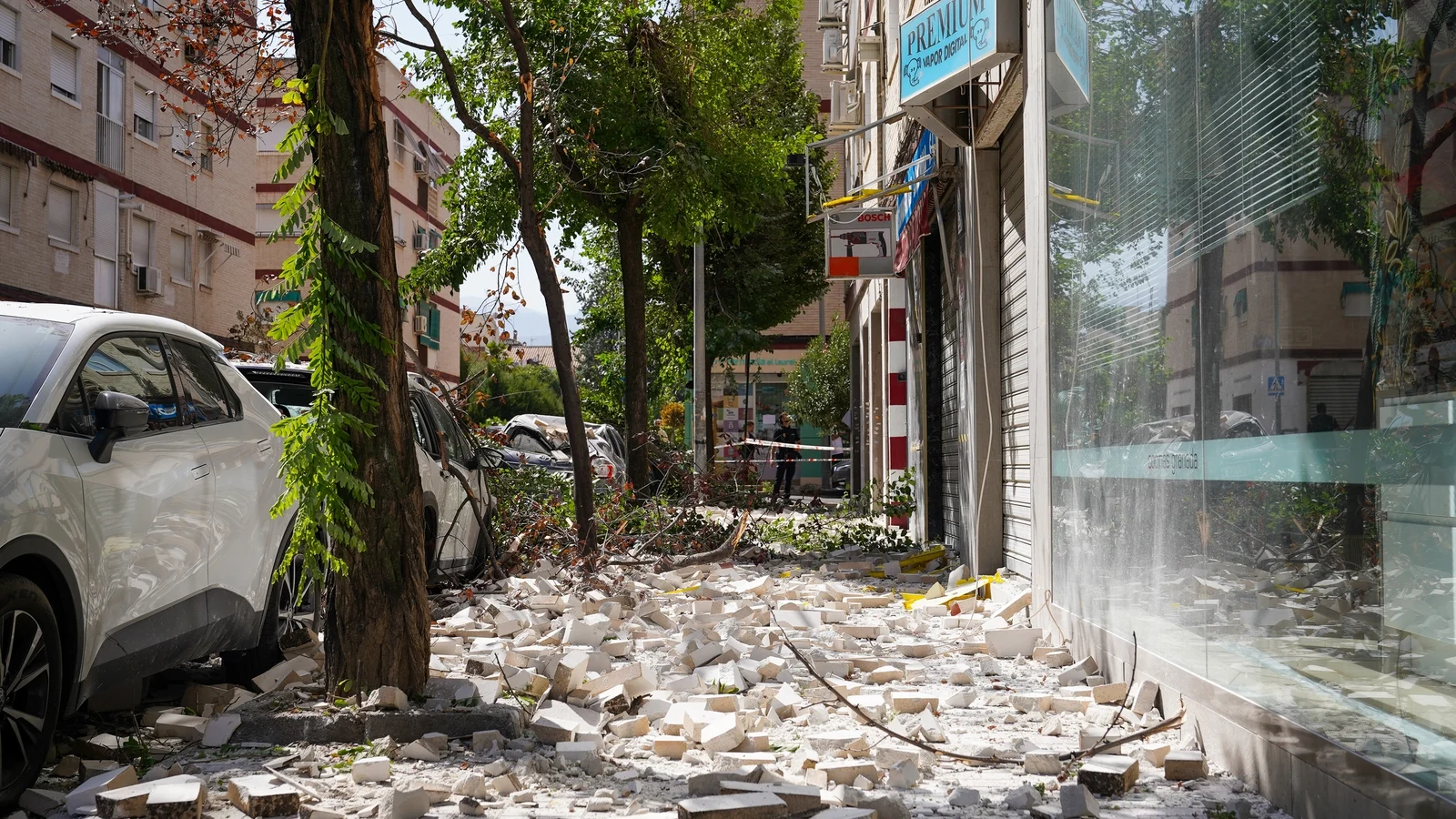
Social media videos from the tourist city showed debris scattered across streets and visible damage to some vehicles.
“Everything came crashing down. It was terrifying,” Cristina Ruiz Lopez, a laboratory worker who was inside a supermarket in Granada when the earthquake struck, wrote on X.
Toni Quinones, a social worker in La Zubia, a town about five kilometres southeast of Granada, said firefighters were “working continuously” in her neighbourhood.
“In addition to cracks and other damage, chimneys are falling, causing more serious damage,” she wrote on X.
As a precaution, Granada city hall ordered all municipal buildings closed except those providing emergency and essential services.
Mayor Marifran Carazo appealed for calm and urged residents to remain indoors, advising that “above all, if there is another tremor, avoid going outside and standing alongside buildings”.
Interior damage to a house in Granada following this morning’s earthquake
“I know the anguish we experienced this morning, especially among our elderly people and young children, who had never experienced a situation like this before.”
Granada’s metro operator said on X it was cutting train speeds to 30km/h as a safety measure, and local media reported evacuations at several hotels.
Across the city and surrounding areas, the tremors left their mark on buildings — mostly residential — with large cracks splitting walls, sections of facades coming loose and bricks littering pavements.
The strongest quake, measured at magnitude 4.7, struck at 10.37am local time and had a surface-level epicentre in Gojar, a town 10km south of Granada, according to the IGN.
Because they originate closer to the surface, such quakes are typically felt more sharply and can inflict more localised damage than deeper tremors of comparable strength.
The Gojar earthquake was followed soon after by two slightly weaker tremors centred in nearby towns on Granada’s southern outskirts.
Saturday’s magnitude 5.0 quake jolted residents awake shortly after 1am.
No injuries were reported from that overnight tremor — possibly because fewer people were outside at the time — though officials said some buildings sustained damage.
“Experts point out that it is possible for seismic movements and aftershocks to continue in the area,” regional government leader Juan Manuel Moreno wrote on X, urging “maximum caution”.