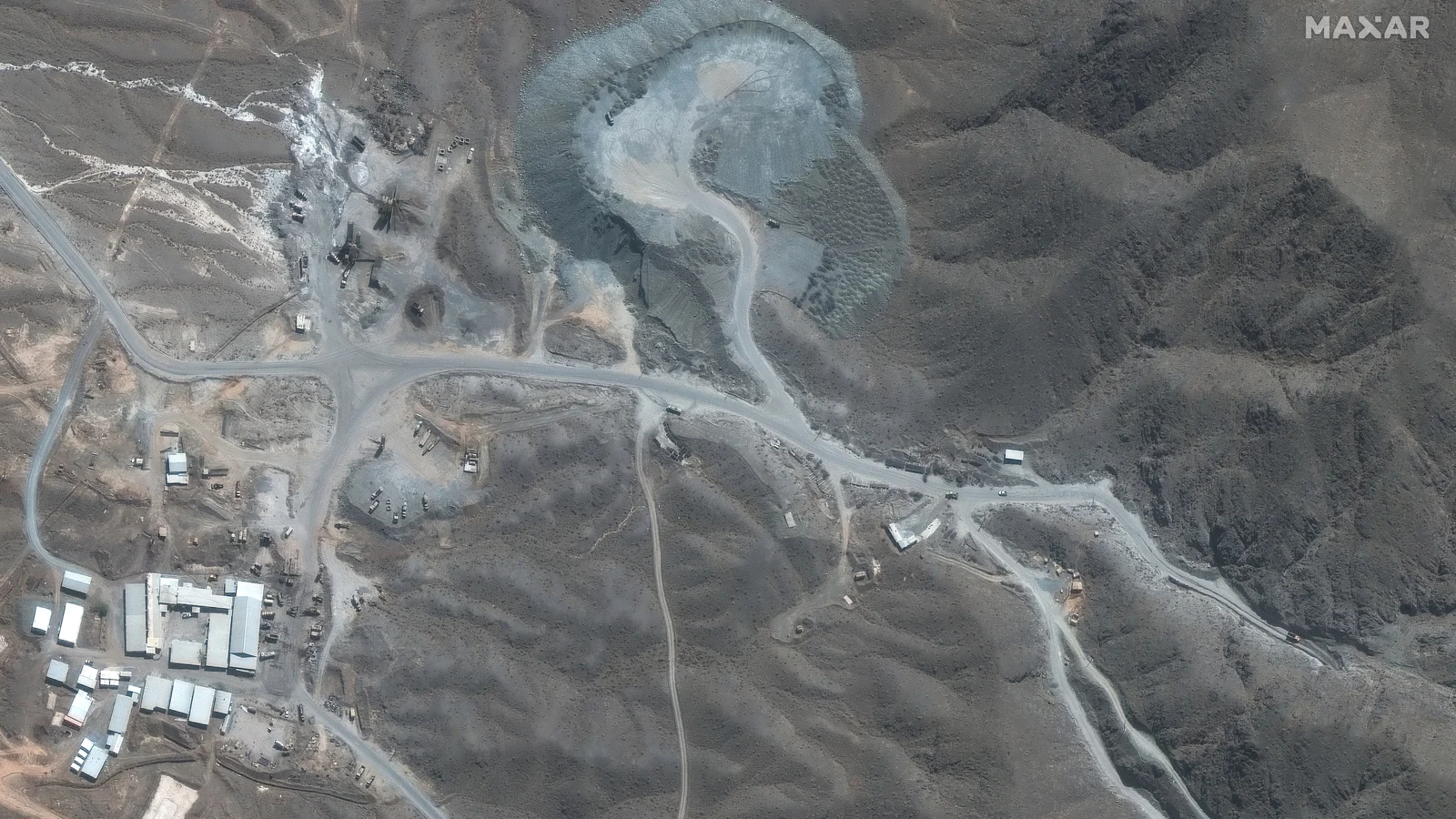
US President Donald Trump signalled the United States intends to intensify its campaign against Iran, warning that an underground nuclear complex known as Pickaxe Mountain could be the next target.
Pickaxe Mountain is a deeply buried nuclear site near Natanz where Western intelligence suspects Iran is building an undeclared enrichment facility.
“We’ll be hitting that area pretty soon, and very heavily,” Mr Trump said, arguing that while he would not usually telegraph military objectives, “there’s not a thing they can do about it.”
Speaking to reporters during a White House meeting with Lebanese President Joseph Aoun, Mr Trump said the damage already inflicted would take Iran decades to reverse.
“If we left right now, it would take Iran 20, 25 years to rebuild. Okay, and we’re not finished at all … we’re not leaving right now.”
Iran intensified its strikes across the Middle East two weeks after its war with the United States resumed, with Jordan, Kuwait and Bahrain coming under attack.
A banner showing an image of Iran’s slain supreme leader Ayatollah Ali Khamenei in Tehran
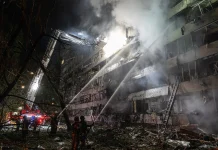
Overnight, US forces bombed targets in southern Iran after President Trump said Tehran would face severe consequences for the deaths of American soldiers.
The strikes came as Iran hit US sites in Bahrain, Kuwait and Jordan, and as a tanker was struck in the Strait of Hormuz.
The tit-for-tat unfolded a day after Yemen’s Iran-aligned Houthis said they would impose a naval blockade on Saudi Arabia — a move that could open a new front and sharpen worries about global energy supplies and trade beyond the Gulf.
Even as the rapidly widening attacks have all but dismantled an interim peace agreement signed last month, indications that Tehran and Washington want to return to diplomacy helped keep oil prices from surging.
US Central Command said it had wrapped up its latest round of strikes on Iran, saying it hit Iranian military command centers, maritime capabilities, missile and drone launch sites, and air defence systems.
State media reported explosions around Shiraz in southern Iran, while Konarak and Chabahar on the southern coast were also hit.
Iran answered with renewed attacks across the Gulf, where recent strikes on desalination facilities have heightened fears of water shortages and highlighted the expanding threat to civilian infrastructure.
Iran’s Revolutionary Guards said they targeted infrastructure in Bahrain belonging to US tech company Amazon, describing it as retaliation for what they called a US strike on the construction site of Iran’s planned Darkhovin nuclear power plant.
Iranian state media also said Iranian forces targeted accommodation facilities used by US military personnel at Bahrain’s Sheikh Isa Air Base. There was no immediate comment from the US military, Bahrain or Amazon on the reported incidents, which Reuters was unable to verify.
The Iranian army said it launched drone attacks against three US military bases in Kuwait. The Revolutionary Guards said they attacked a US military site in Jordan, and Jordan said its forces intercepted and destroyed five Iranian drones.
We need your consent to load this rte-player contentWe use rte-player to manage extra content that can set cookies on your device and collect data about your activity. Please review their details and accept them to load the content.Manage Preferences
Tankers struck
The United Kingdom Maritime Trade Operations agency said a tanker in the strait reported being struck by an unknown projectile, forcing its crew to abandon the vessel and board a lifeboat.
Iran’s Revolutionary Guards said two oil tankers had caught fire after explosions while attempting to transit the southern route of the Strait of Hormuz. It was not immediately clear when those incidents took place.
Iran had been pressing the Houthis to close the Bab el-Mandeb gateway to the Red Sea if the US continued to attack Iranian power infrastructure – putting two of the world’s most vital energy arteries at risk.
A full closure of Bab el-Mandeb would reduce global oil supply by 7% as it would leave most Saudi oil exports unable to leave the region. The disruption would add to the huge cut to oil flows from the war in the Gulf, which has already reduced shipments by 10% of global supply.
Concerns about the flow of energy supplies through the strait have persisted since the fighting resumed
After the Houthis announced their blockade, the Saudi-led coalition in Yemen said it began implementing protection measures for its ships moving through the Bab el-Mandeb Strait.
Oil markets balanced the risk to shipping lanes against reports of diplomatic efforts aimed at containing the conflict, with benchmark Brent crude prices LCOc1 edging slightly lower in early trading.
Diplomatic push to restore ceasefire
A senior Iranian official told Reuters yesterday that Tehran had received a proposal from mediators for a 10-day ceasefire in efforts to salvage the interim deal, intended to pave the way to a lasting agreement to end the war that began on 28 February with US-Israeli attacks on Iran.
Iranian Interior Minister Eskandar Momeni had asked Pakistan to resume its mediation role in the conflict. He later arrived in Islamabad for further talks.
The latest phase of fighting has proved to be among the deadliest of the conflict for US forces. US troop deaths rose to 17 over the weekend.
Mr Trump, under mounting pressure at home over rising gasoline prices since the war began, said the latest US strikes on Iran were honoring the deaths of American service members.
“Every time Iran kills an American Soldier they will pay for that killing many times over! This directive has been passed on to Secretary of War, Pete Hegseth, Chairman of the Joint Chiefs of Staff, Daniel Caine, and every Leader in the Military,” Mr Trump wrote on Truth Social yesterday.
The war has killed thousands of people, mostly in Iran and Lebanon. Parts of Lebanon remain under Israeli occupation following attacks on Israel by Hezbollah fighters, who said they were acting in solidarity with Tehran.
Lebanese President Joseph Aoun is due to meet Trump at the White House today to present a plan on how to disarm Iran-aligned Hezbollah and secure an Israeli withdrawal.