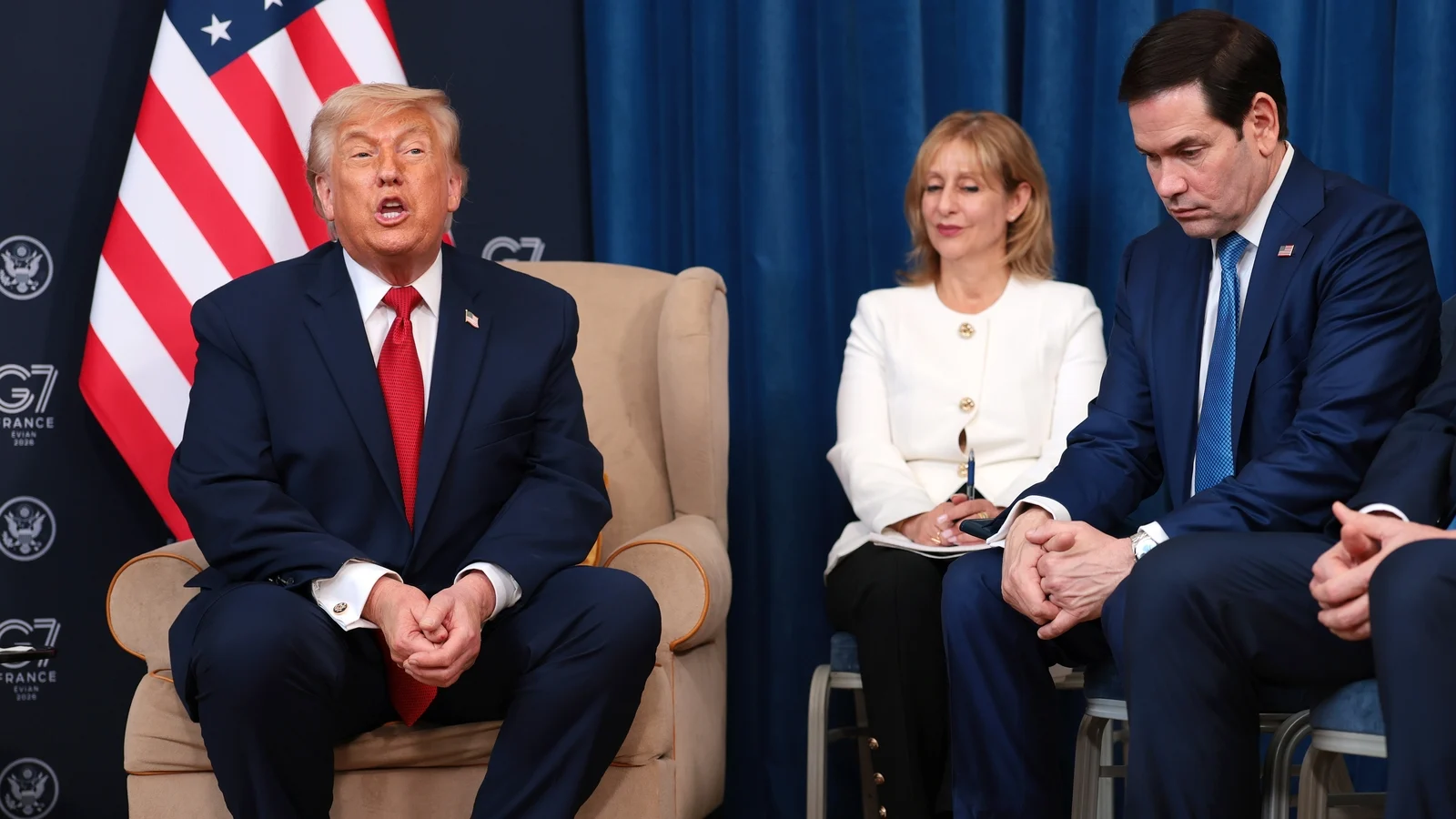
With cameras rolling and tensions high over Ukraine, US President Donald Trump cracked a line that captured the power dynamics at this week’s G7: “I’m the boss.” The quip came as he and fellow leaders used the summit to highlight Ukraine’s improved battlefield fortunes and to roll out a unified pledge of support alongside fresh sanctions against Russia.
Mr Trump’s tongue-in-cheek remark — an acknowledgment of the unspoken reality hovering over the three-day gathering of the Group of Seven powers in the French resort of Evian-les-Bains — followed a joint leaders’ statement that could strengthen Kyiv’s hand as potential peace talks with Moscow come into focus.
Ukrainian President Volodymyr Zelensky and his allies arrived at the G7 aiming to convince Mr Trump that Ukraine’s fightback is producing tangible results, and that Russia is not in a position to dictate terms for any peace deal.
Signals from the leaders’ statement and their public comments suggested Mr Trump has moved closer to Mr Zelensky’s case after years of scepticism.
Even so, any attempt to pressure Moscow into negotiations still hinges on Mr Trump’s follow-through, which has often proved hard to pin down. It remained unclear whether bilateral Trump-Zelensky talks would happen, and questions also lingered over whether Washington will let waivers expire on sanctions limiting Russian oil exports, now that he has secured a preliminary Iran deal.
“I’m the boss,” Mr Trump told G7 chiefs and reporters as he took his seat for a session on global economic security, where leaders were set to talk through critical-minerals supply chains and macroeconomic imbalances.
Watch: ‘I’m the boss’, Trump jokes as he sits down at G7 table
Mr Trump later hailed what he called a “very good” meeting with Mr Zelensky and other G7 leaders.
“There has been a change in position on the part of the United States and President Trump,” Canadian Prime Minister Mark Carney told reporters.
“There is a position that is harder toward Russia and more realistic, in our view, of the situationon the ground of the war.”
Trump’s Iran deal sets tone for talks
Alongside Ukraine, G7 chiefs also welcomed the preliminary peace deal between the United States and Iran — which Mr Trump signed on the eve of the summit — saying they stood ready to help with its implementation.
They said they would work to diversify energy supply routes to cut dependence on the Strait of Hormuz, which Iran has blocked for most of the duration of its war with the US, and to build up stocks.
France is now urging partners to back a joint statement on critical minerals that could include steps to help the West reduce its reliance on China and to protect investors from countermeasures and dumping, diplomats said.
Donald Trump is flanked by Keir Starmer and Emmanuel Macron at the summit
China rattled the global economy last year when some industries came close to grinding to a halt after Beijing imposed export curbs on permanent magnets made of rare earths.
“We are negotiating texts that are significant on critical minerals and, as a consequence, on economic sovereignty,” a French presidency official said ahead of the summit.
Measures being weighed over recent months have ranged from price supports, market standards, subsidies and guaranteed purchases to proposals aimed at scaling up private investment in critical mineral supply chains beyond China. Any steps unveiled at the G7 are expected to amount to initial moves rather than a full solution.
Over-reliance on China
The 2025 restrictions marked the latest stage in Beijing’s steady tightening of exports in niche materials and battery metals. It has also restricted American companies’ access to tungsten and antimony, among others.
Western powers are scrambling to lock in offtake from mines and to expand processing and recycling capacity, but reducing China’s dominance — built over decades — is expected to take years.
The United States in early 2026 proposed a trading bloc for critical minerals. However, countries remain divided over how such a bloc should function, particularly against the backdrop of the White House’s “America First” agenda.
Economic imbalances
Leaders were also set to debate ways to rebalance global trade and confront “predatory competition”, aimed mainly at China.
France encapsulates the imbalance this way: “China produces too much, the US consumes too much and the Europeans invest too little.”
In Europe, concern is mounting over China’s trade surplus and its advance up the value chain — a trend analysts describe as a “second China shock” after its dominance of low-value industries in the 2000s. The surplus stands at €360 billion.
French President Emmanuel Macron sought to engage China ahead of the summit in a final push for cooperation.
Beijing rejects EU accusations of unfair subsidies and has repeatedly promised “strong” countermeasures to the EU’s proposed “Buy European” measures and revised tech sovereignty rules.
EU leaders separately plan to discuss tougher trade defence measures — and a more systematic use of them — in response to surging imports from China at a summit in Brussels tomorrow.
G7 leaders also also due to discuss AI over lunch today, including the liability of bots and agents, and how AI presents truth and falsehood.
OpenAI founder Sam Altman and Anthropic CEO Dario Amodei were expected to attend.