When an Arctic Punchline Turns into a Diplomatic Cold Snap
Walk the harbour in Nuuk on a wind-scoured morning and you’ll hear a dozen small conversations layered over the slap of waves against rusted hulls: talk of fishing quotas, tour boats, a new gravel road, and—unexpectedly—of presidents who fancy buying islands.
“We joke about the tourists who think Greenland is a hotel you can reserve,” said Sara Ivalu, a fish-processing manager who grew up watching polar light paint the fjords. “But jokes fade fast when the world starts taking a keen interest in what surrounds our shores.”
What felt like a reckless, off-the-cuff proposition—world leaders publicly entertaining the idea that Greenland could be bought or heavily militarized—has done something unusual. It yanked the Arctic from the background of defence briefings and environmental reports and put it on the map of immediate global politics.
Why Greenland? Why now?
The answer is not a single sentence, it’s a swollen paragraph: warming seas, shorter voyages, hidden mineral wealth, strategic geography, and a new toughness in international rivalry.
The Arctic is warming faster than the rest of the planet—scientists call it “Arctic amplification.” Since the satellite era began in 1979, the late-summer sea-ice extent has shrunk by roughly 40 percent, with particular lows recorded in the 2010s and early 2020s. The result: passages that were once locked in ice for most of the year are opening for longer windows each season.
That change is rewriting commerce and conflict at the same time. Shipping companies are already testing the Northern Sea Route and the Northwest Passage. For container liners moving goods between East Asia and northern Europe, the time savings can be dramatic—sometimes two to three weeks shaved off a voyage that normally hugs the Suez or Cape routes.
“Time is money,” remarked a Copenhagen-based maritime analyst. “Cut three weeks off a route and you change fuel calculations, insurance, fleet deployment and even bargaining power between ports.”
Resources beneath the cold
Below those thawing surface waters and under permafrost lie mineral deposits, rare earths, and hydrocarbons that have pulled explorers and investors north. Estimates vary, but the U.S. Geological Survey and other bodies have long warned that Arctic basins may hold a significant share of the planet’s undiscovered oil and gas—along with critical minerals used in everything from smartphones to missiles.
Mining in the high north is brutal, expensive and often contested. Yet the lure of high-value deposits has increased interest from state-backed companies and private firms alike. That, inevitably, draws political and military attention.
The military map redraws itself
Look at any map with the North Pole centered and the strategic logic becomes stark. Eight nations touch the Arctic: Canada, Denmark (via Greenland), Finland, Iceland, Norway, Russia, Sweden and the United States. Seven of those countries are NATO members. Russia, by coastline and history, is the region’s heavyweight.
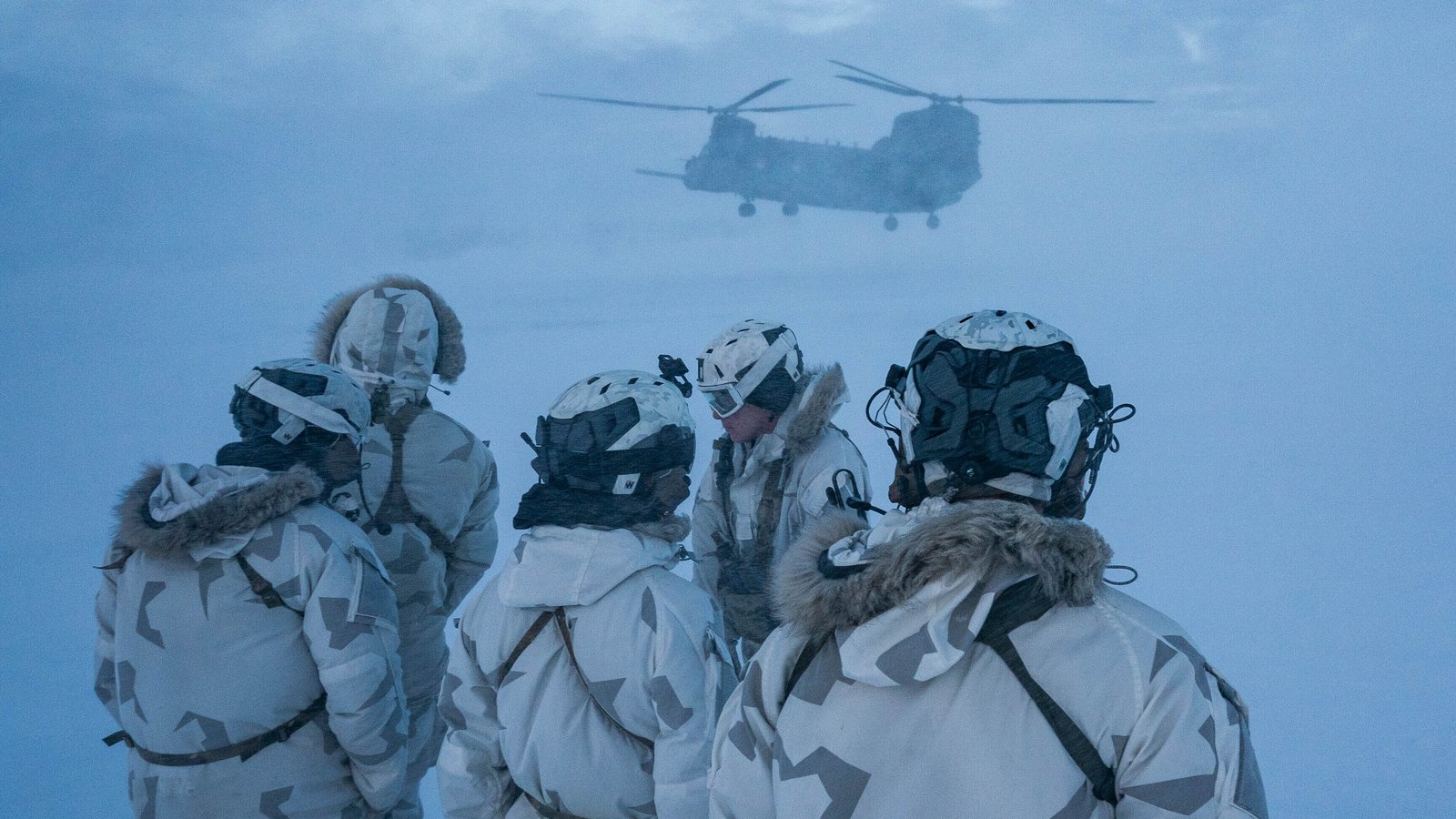
Over the past two decades Moscow has poured resources into the Arctic—reopening Soviet-era airstrips, positioning submarines and missiles, and building logistics hubs to support its Northern Fleet. Since Russia’s full-scale invasion of Ukraine, the once-calm Arctic security environment has shifted toward higher tension: unannounced military drills, close aerial encounters, and electronic interference have become more frequent.
“For us, the Arctic is not a footnote,” said a former Russian naval planner who requested anonymity. “It is a corridor for commerce and a buffer for defence.”
Western capitals have belatedly responded. The U.S. National Strategy for the Arctic Region (2022) and subsequent implementation plans identified gaps in capability—ice-hardened ships, more icebreakers, undersea sensing arrays, and resilient Arctic-ready communications. NATO practices, bilateral basing agreements and multinational exercises have multiplied in the North.
Greenland: sovereignty, self-rule and a third rail
Greenland complicates all of this. A self-governing territory within the Kingdom of Denmark, its population is roughly 56,000 and its capital, Nuuk, hums with the odd mix of Inuit traditions and Danish administration. Greenland’s strategic location—midway between North America and Europe—makes it uniquely valuable for basing and surveillance.
Denmark has been clear: sovereignty is a red line. Greenlandic leaders emphasize self-determination. “We decide our future,” said Malik, a community leader in Ilulissat. “We are not a bargaining chip.”
In practice, that has led to creative, if uncomfortable, proposals. One suggestion from European quarters has been a model akin to the British sovereign base areas in Cyprus—limited areas under foreign use while political sovereignty remains with the host. That idea calms one set of nerves while raising another: will such arrangements preserve self-rule or entangle Greenland in great power rivalry?
Missile shields and the illusion of containment
Presidentially-branded ambitions to secure a “golden dome” of missile defences over North America—drawing inspiration from systems like Israel’s Iron Dome—have also factored into the Greenland conversation. Missile defence is expensive and technically hard. A system that could protect large swathes of North America or Europe would need networks of sensors, interceptors and space-based assets, and that architecture inevitably hits Greenland’s strategic value.
But does one need to own a place to make it useful? Experts say not. Military basing agreements, shared sensor networks and long-term leases can achieve many of the same objectives without upending sovereignty. The diplomatic difficulty is trust—especially after public squabbles that fray alliances.
What the skirmish over an island tells us about the world
There is something almost cinematic about the idea of buying a chunk of Arctic land. But the real story is quieter and more consequential: climate change is rearranging strategic geography; supply chains are shifting; states are recalibrating to new threats.
Hard questions ripple outward. Can European unity survive headline diplomacy that treats allies like counter-parties? Will small communities in the high north be heard when their home is suddenly essential to global security? Can global governance keep up with the pace of environmental change and geopolitical rivalry?
“We are not against cooperation,” said a Danish foreign ministry official. “We are simply asking for a conversation that respects law, history and local voices.”
So here’s a question for you, reader: if climate change reshapes maps and markets, who gets to redraw the lines? Which values do we prioritize—sovereignty, security, local livelihoods, the climate itself?
What’s next
The short-term picture is messy. Expect diplomatic negotiations, quietly rewired defence pacts, new ice-strengthened vessels moving in and out of ports, and more legislation around Arctic shipping and environmental protection. Expect Greenlanders to speak louder about their future. Expect NATO and the EU to wrestle with a mix of opportunity and obligation.
In the end, the Arctic will not be decided over a single Davos handshake or an offhand tweet. It will be decided by years of policy, investment, local activism and climate realities we are only beginning to comprehend. And by the conversations we are willing to have—about fairness, about who gets to protect what, and about whether a warming planet should become yet another theatre for great power competition.
On a cold morning in Nuuk, Sara Ivalu shrugged and looked out at the ice-littered sea. “We can adapt,” she said softly. “But we don’t need to be sold to the highest bidder. Respect us first. That seems a modest request.”