Against the grim backdrop of Himalayan devastation, rescuers in Nepal have pulled two hydropower workers alive from a tunnel choked by debris, a breakthrough that arrived on the tenth day of an exhausting search effort.
Video released by the energy ministry captured the moment rescuers broke into a muddy opening and one man emerged, prompting cheers from those on site.
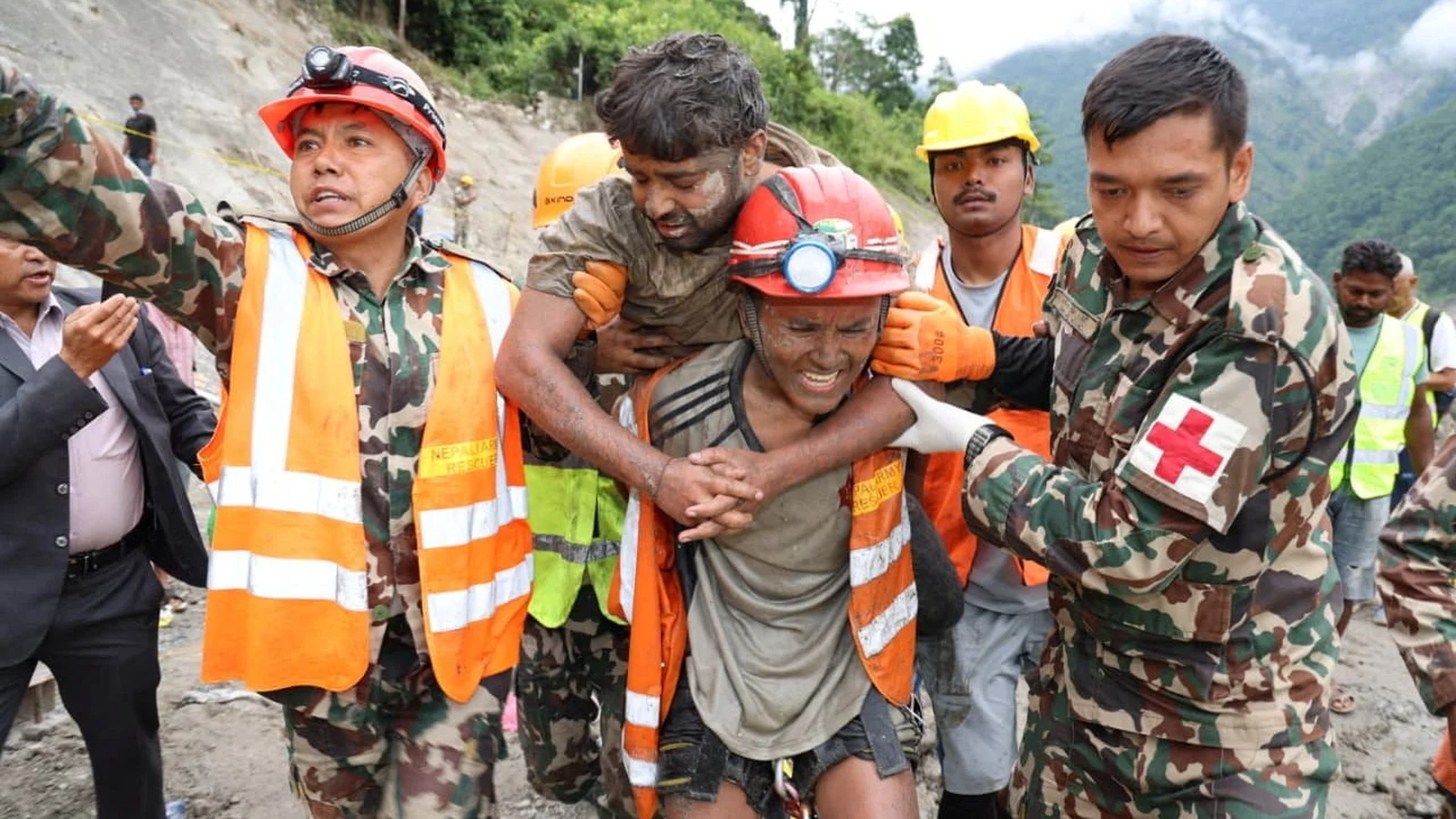
Emergency workers helped him stand before hoisting him onto their backs; he raised a hand as they carried him toward a helicopter.
In a photograph, the second survivor is shown coated in mud with his hands pressed together in prayer, as rescuers moved him away on a stretcher.
Rescuers described the outcome as a “miracle” after last week’s disaster that has killed more than 1,300 people and left over 5,600 missing in Tibet and Nepal.
Moment rescuers pull workers free
“I am so happy, my heart is lighter,” said Amir Maharjan, brother of rescued worker Kabir Maharjan, 45.
Home Minister Sudan Gurung identified the two men as Sanjay Shah, 30, a mechanical foreman, and Maharjan, a mechanical supervisor.
The Nepal Army said both men were receiving medical treatment and that “search and rescue operations are ongoing.”
The pair are among hundreds of hydropower workers who have been unaccounted for since 26 August, when a wall of mud and debris surged through the region after a massive glacial and rock collapse on a mountain along the Nepal-Tibet border.
Energy Minister Biraj Bhakta Shrestha confirmed the rescue took place at the Trishuli 3A tunnel.
Search teams remained active at that tunnel and other locations, with at least 12 hydropower projects smashed by the floods.
The government had initially said it believed more than 100 workers might still be alive inside multiple tunnels.
One of the men pressed his hands together in prayer as rescuers brought him away on a stretcher
‘Miracle country’
Rescue crews in Nepal, backed by specialists from India, China and South Korea, have pressed on in a hunt for survivors believed trapped inside hydropower tunnels, though teams have repeatedly been stopped by dense, hard-packed debris.
Until today, no tunnel workers had been confirmed alive.
Australian rescue expert Arnold Dix, who has been supporting the operation remotely, said the mission was “back in miracle country” after a “week of 24/7 heartache”.
Local residents look at a damaged tunnel of the Trishuli Hydropower Plant
Earlier, Mr Dix said teams at the Trishuli 3A hydropower project thought they had detected a faint reply from within the tunnel.
“They believe they received a faint response from inside saying, ‘hunchha’, yes or OK,” said Mr Dix, president of the International Tunnelling and Underground Space Association, adding he was travelling to Nepal to join the effort.
He said rescuers had called into the tunnel: “Don’t worry, we are rescuing you.”
Mr Dix served as a key adviser during the 2023 Himalayan rescue that freed all 41 Indian workers trapped inside a collapsed, under-construction road tunnel.
He said crews had cut through about 50 to 60 metres of debris clogging the tunnel and were anticipating a breakthrough at any moment.
Less than an hour later, the two men were brought out alive.
Residents walk past a damaged house in Devighat, Nuwakot
‘Himalayan tsunami’
In recent days, some families searching for missing relatives had begun holding symbolic funerals, reflecting fading hopes of finding survivors.
Foreign Minister Shisir Khanal has described the huge wave unleashed by the rock and ice avalanche as a “Himalayan tsunami”.
That day, floods tore through mountain districts, wiping out roads and bridges and damaging multiple hydropower dams.
Communities near the epicentre remain cut off.
The United Nations has warned that the “magnitude of the destruction” is making aid delivery a formidable task, with cargo drones and porters under consideration to reach isolated areas.
“Access has been very, very, very difficult,” said Lila Pieters Yahia, the UN chief in Nepal.
Nepal’s disaster authority said at least 1,287 people have been killed in Nepal, while 5,083 are missing.
Chinese state media reported 21 people dead in Tibet and 541 missing, bringing the overall toll from the 26 August glacial and mountain collapse to 1,308 dead and 5,624 missing.
More than 800 foreign nationals from at least 34 countries are among the missing across Nepal and Tibet in China, including tourists and pilgrims.
Two Irish citizens — identified by the Nepalese Tourism Department as 46-year-old Santosh Sahu and 18-year-old Spandan Sahu — are among those missing.