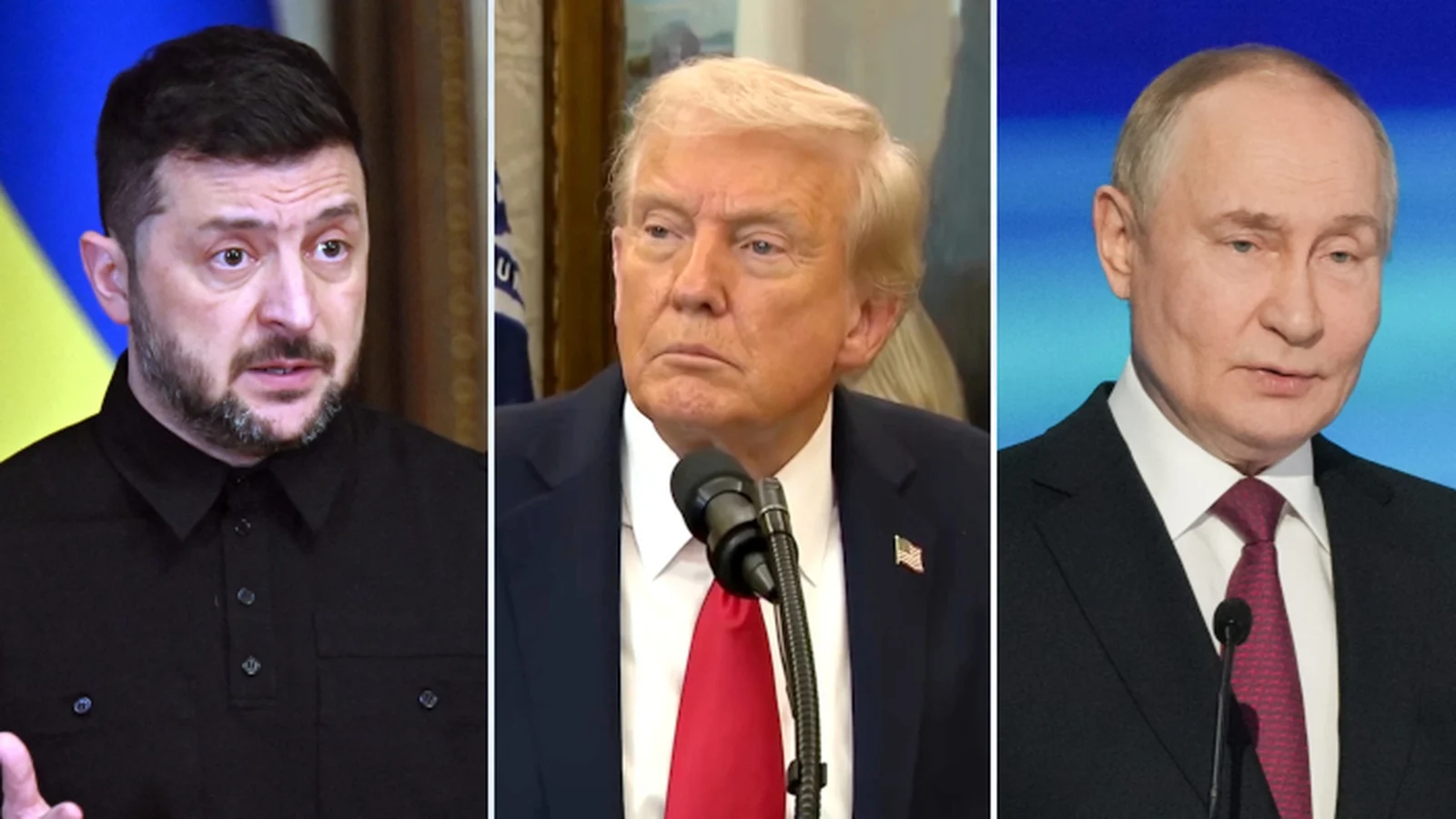
As Volodymyr Zelensky arrived in Brussels this week, he carried two urgent problems into the EU summit: a fresh rupture with Donald Trump and a widening budget hole that threatens Ukraine’s ability to sustain the war next year.
Both crises hung over the meetings in the Belgian capital.
The earlier Oval Office episode 18 months ago was, by Zelensky’s account, a blunt public humiliation administered by the US president and JD Vance. Now, after Ukraine baulked at calls to stop striking Russian oil refineries, Trump’s anger has been felt in far more lethal ways on the battlefield.
The White House, Ukraine says, withheld intelligence on impending Russian ballistic missile strikes and also obstructed access to the Starshield satellite system. The result was immediate: Ukraine’s defence interceptor drones were limited to 70kmh, leaving them unable to catch Russia’s jet-powered Shahed drones, which travel at 400kmh.
Russia has been launching waves of the Shahed drones since the summer, and the human cost is mounting. More than 150 civilians have been killed over the past 10 days.
As President Zelensky met EU leaders in Brussels, a Russian drone struck a flea market in Kharkiv, killing two people.
The escalation is now hitting Ukraine’s finances as well as its cities.
In September alone, Ukraine recorded 3,900 Russian air attacks nationwide — a 65% jump from a year earlier. Seventy percent targeted residential buildings, and there were 145 strikes on energy infrastructure.
They are destroying our logistics first
Ukraine says the widening target set now includes civilian neighbourhoods and infrastructure, alongside mobile phone networks, passenger trains, petrol stations, grain silos, storage depots, substations and shipping.
The economic consequences are stark. Grain and oilseed exports — pillars of Ukraine’s economy — have fallen by 30% over the past year, with more shipments forced onto trucks, a far costlier alternative that has further squeezed revenues.
The country’s industrial base has also been hollowed out. Before Russia’s intervention in 2014, Ukraine had 12 metallurgical and steel-making plants. Only one is still operating today, and even that facility may soon shut down. The plants have been major employers and important sources of income.
“They are destroying our logistics first,” finance minister Sergii Marchenko told a recent European Policy Centre (EPC) seminar in Brussels. “Second, they destroy our retail storage. Then they destroy our fuel stations. Now they are specifically targeting our data centers, mobile operators.”
A resident surveys the damage after a Russian air strike in Kramatorsk
Officials in Kyiv say the country is running out of money as it tries to defend itself against intensifying attacks — and as Russia’s pressure on the economy restricts Ukraine’s capacity to raise funds at home.
“It’s the first time since 2022 that we have had an underperformance in tax and customs administrations,” Marchenko said.
“In September, we expected to have around an underperformance of €400 million, and if we make a projection to the end of the year, it could be several billions.”
For years, Ukrainian officials pointed to steady tax and customs collections, even under wartime conditions, as a sign of resilience. Now, those revenues are showing strain — a result, Kyiv argues, that aligns with the Kremlin’s strategy of grinding pressure through sustained bombardment.
Vladimir Putin, Ukrainian officials and European diplomats say, is also testing Europe’s psychological endurance. In countries already grappling with high living costs, continued spending to keep Ukraine afloat risks becoming ever more politically toxic.
The higher the economic cost of mass bombing, the more Europe is pushed toward stepping in — and the more far-right figures such as Marine Le Pen in France and the AfD’s Alice Weidel in Germany can argue that Ukraine should be left to fend for itself.
That dynamic is sharpening into a test of political will for EU leaders, who are also looking ahead to 2027 elections that could bring more eurosceptic and Russia-sympathetic parties into government.
In December, EU leaders agreed a €90 billion loan to cover Ukraine’s budgetary and military needs for two years.
That package no longer looks sufficient.
Ukraine’s finance ministry says the country will need €70bn to meet its defence requirements in 2027 — and €40bn of that sum has not yet been funded.
Kristen Michal, Estonia’s prime minister said Europe had to continue to provide financial support to Ukraine
Estonia’s prime minister Kristen Michal underscored the stakes in comments to Reuters on Friday. “European financial assistance has to be there. Financial assistance in the war of attrition is the alpha and omega. You have to keep it up… That has to come from the European Union,” he said.
The European Commission is now evaluating Ukraine’s financing needs. Beyond the €90bn loan agreed in December, the EU has also pledged a further €100bn in support via its long-term budget for 2028-2034.
On the sidelines of the IMF and World Bank Annual Meetings in Bangkok, G7 finance ministers and central bank governors also promised additional backing — an amount that could climb to $25bn by the end of 2026.
Yet with a looming gap in next year’s funding, attention is again turning to immobilised Russian assets.
Roughly €210bn in Russian central bank assets were immobilised days after the February 2022 invasion. About €185bn of that total is held at Euroclear, the Belgian securities depository.
Last autumn, the European Commission floated a plan to use those assets to underwrite a loan to Ukraine, with repayment to come from Russia as part of war reparations if a peace agreement is reached.
Belgium pushed back, arguing that using the assets in that way could expose the country to aggressive Russian legal action and potentially leave it facing liability worth tens of billions of euro.
EU leaders tried in December to bring Belgium on side. But the financial guarantees sought by prime minister Bart de Wever were deemed too costly, and the bloc opted instead for a standard loan backed by headroom in the EU budget.
By this summer, as Russian attacks intensified and Ukraine’s balance sheet deteriorated, senior European Commission figures were privately discussing a return to the question of the frozen Russian Central Bank Assets.
Replaying last year’s approach appeared futile, but alternatives were scarce.
Last month, a group of economists, a French MEP and a former German defence minister launched an initiative called The Russian Transfer.
The group’s idea is to move the Russian assets out of Euroclear and into a European Union vehicle, insulating Belgium from legal exposure.
The proposal draws on Bart de Wever’s remark last year that he would be content for someone else to “take the entire Euroclear balance…. and…sign for all the risks”.
Hugo Dixon, a columnist and campaigner, said the concept is to remove the immobilised Russian assets from Euroclear — and other depositories on European soil — as a first step, without directly transferring funds to Ukraine.
The mechanism would shift the Euroclear Russian accounts, including liabilities and Euroclear’s obligations to the Central Bank of Russia, into a new “European Union instrument”.
Volodymyr Zelensky (C) attended the European Council summit in Brussels this week
Under this approach, the European Union would shield Euroclear and Belgium — and any other institution holding Russian assets — via a legal regulation.
That would mean any financial liability arising from a successful Russian legal case would fall on the EU rather than Belgium or Euroclear.
Dixon said there was a precedent: after Saddam Hussein fell, the Iraqi government transferred its central bank assets to an external vehicle so they could be used to rebuild the country.
“We’re not trying to pretend that this is an exact parallel to the situation that we face here,” Dixon said, “and we’re certainly not trying to suggest that it can be used to justify a second step, which would involve using the Russian accounts to help Ukraine.
“But we do think it’s very relevant for the first step, which is the transfer itself.”
The proposal met sharp criticism from Wim Schoutens, a financial engineering specialist at KU Leuven University.
Schoutens argued that, regardless of any technical finesse, markets would view the move as confiscation — potentially undermining confidence in the euro.
“Under the proposal, it will be conceived that a high-value, unconditional claim of the Central Bank of Russia against Euroclear is replaced by a conditional claim on Russia paying an equivalent amount in reparations to Ukraine,” he told the EPC seminar, “and this is actually replacing the high-value claim by something conditional, almost worthless”.
He also questioned the relevance of the Iraq case, noting Iraq was under a UN mandate at the time and the United States and Iraq had been at war, while the EU is not officially at war with Russia.
Dixon countered that although the EU was not at war with Iraq either, it still implemented the mandatory transfer of Iraqi accounts — and he argued that the bigger threat to the euro would be a Russian victory in Ukraine, not investor doubts.
It remains unclear whether the European Commission has scrutinised the plan in detail, but it has attracted backing from 122 MEPs and several member states.
Ukraine needs this money right now
Senior officials say it may only be a matter of time before Russian assets return to the centre of the debate.
Denmark, Finland and Sweden raised the subject during the summit. “We have agreed that we will not return the frozen assets unless Russia pays reparations for Ukraine,” the EU’s foreign policy chief Kaja Kallas told reporters on Friday.
“Ukraine needs this money right now.”
Nathalie Loiseau, a French MEP from President Emmanuel Macron’s party and a participant in The Russian Transfer initiative, said Europe’s backing for Ukraine is rooted not only in morality but also in self-interest and security.
She recalled that when Russian assets were frozen soon after the 2022 invasion, critics warned “it was illegal, that it was financially unsound, and that the seven plagues of Egypt would fall on Europe. And it didn’t happen”.
She added: “Putin threatened to sue. He did, and he lost. He threatened to sue the decision to use windfall profits. He did it and he lost again. So, threats are one thing; legal reality is another.”
In a notable development, Zelensky held a bilateral meeting with Belgium’s Bart de Wever in Brussels on Thursday evening.
The discussion centred largely on Belgium’s commitment to provide ten F16 fighter jets — aircraft seen as highly effective against jet-powered drones. But the frozen Russian assets were also clearly raised.
On Friday, Zelensky weighed his words. “The main thing,” he said, “is that Russia does not have the opportunity to influence these assets. We know very clearly that they want to bring these assets back – it’s one of Russia’s aims.”
Belgian Prime Minister Bart De Wever (R) held a bilateral meeting with President Zelensky in Brussels
Zelensky said he wants Ukraine to gain control of the assets before Russia can reclaim them.
De Wever, for his part, pointed only to the unanimous decision taken by EU leaders in December: that the Russian assets would remain immobilised indefinitely.
“My personal view,” he told reporters, “is that if you have immobilised assets, in every war – even in the Second World War they were never touched – at the end of the conflict there’s always a peace deal. Part of this peace deal will be the use of immobilized assets.”
But there is no sign of a peace deal — not while Putin, as European officials see it, continues to bet that a weary, financially stretched West will gradually step back from supporting Ukraine.
For Putin, ending the war could threaten the survival of his long rule; for Ukraine, surrender would carry a far higher price — the destruction of its culture, language and economy.
For Europe, the risks include a potential surge of refugees fleeing either a militarised Russian vassal state or a failed state on the EU’s doorstep.