Missiles and drones sent from Iran toward Gulf bases — and a disputed account of a deadly wedding strike — have pushed the United States and Tehran into a new round of confrontation, even as Washington insists it is still assessing what happened.
Iran said it struck US military bases in Kuwait and the UAE, promising retaliation for a wedding attack it blamed on Washington, while US Vice President JD Vance said the alleged strike was under investigation.
The latest escalation follows US raids on Sunday and further entrenches a six-month war that has left Iran maintaining a stranglehold on the strategic Strait of Hormuz, as Washington presses ahead with a counter-blockade of Iranian ports.
Kuwait’s army said today it intercepted an Iranian missile and drone assault, even as Iran’s army claimed it hit “the Ahmad al-Jaber Air Base in Kuwait”.
Kuwait condemned the barrage as a “grave breach of the rules of international law”.
Iran’s army also said it struck Al Minhad Air Base in the United Arab Emirates, though the Gulf state said no such attack took place.
The exchanges came after Iran’s Red Crescent reported that a missile attack on a wedding in the coastal town of Kuhestak killed four people on Tuesday night — including a child — and wounded more than 50.
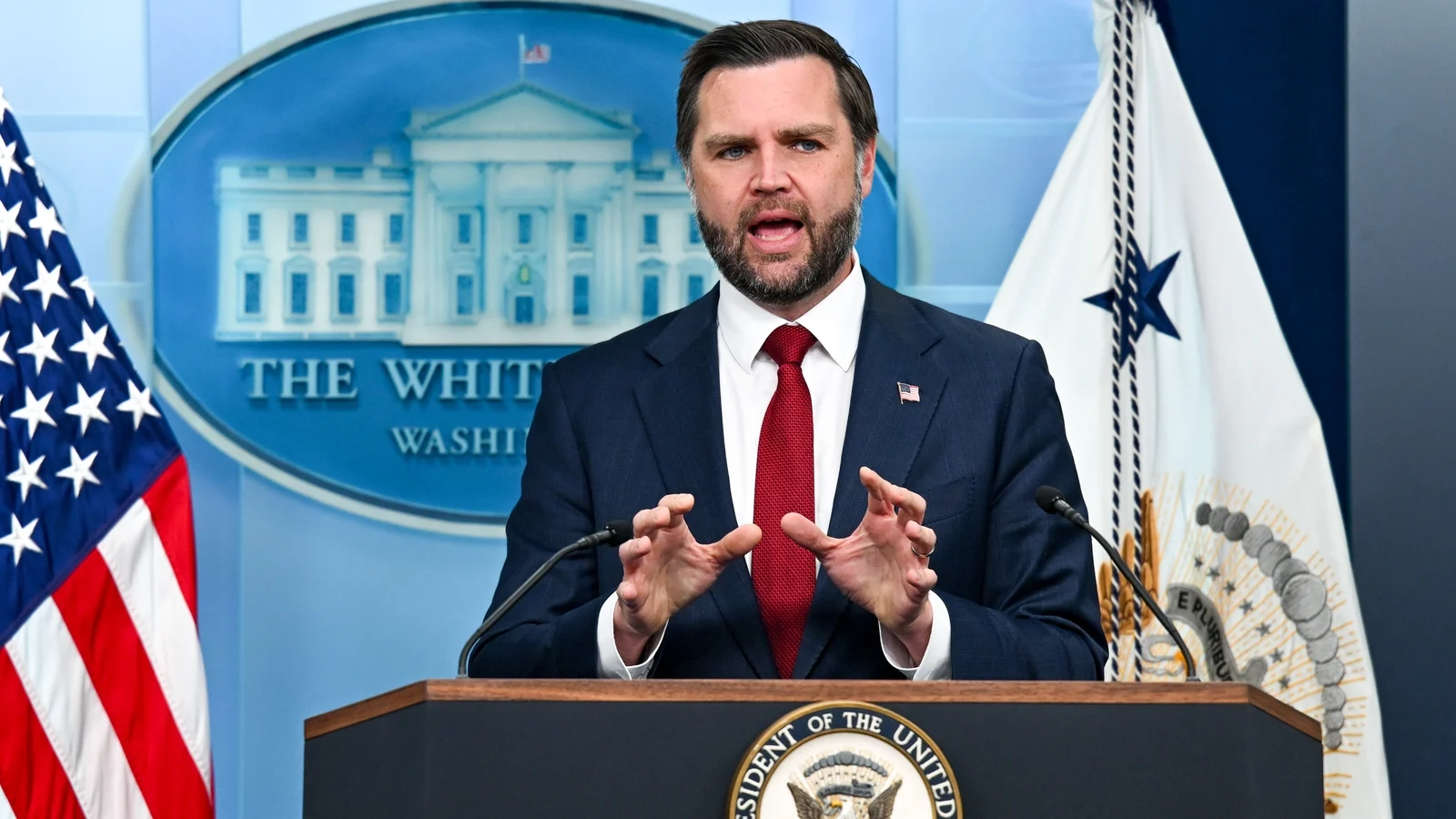
Mr Vance said Washington was examining the allegation but questioned the reliability of accounts coming from Iran.
“I know that we’re investigating,” he told a White House briefing.
“I will say that the Iranian state media has not been a very good scribe about what’s happened in the conflict thus far. So I’m extremely sceptical of this,” he added.
JD Vance was speaking at a new conference in the White House
Mr Vance also told reporters he would not label the Iran conflict a war, despite the ongoing flare-ups and exchanges of fire.
“I wouldn’t call it a war. Right now, there is no active shooting,” Mr Vance said when asked whether the war would be over by US midterm elections in November.
Mr Vance added: “I recognise there have been places where this has flared up” but said major combat operations only lasted for six weeks after the US-Israel war started on 28 February.
“But when you ask when will this end, you’re asking me a question like when will the Iranians stop shooting at ships? I think the reality is I don’t know the answer to that question. You would have to ask the Iranians,” he said.
He said the United States would not return to talks with Iran unless Tehran halted attacks on commercial shipping.
Earlier, Iranian mourners carried caskets at a funeral for the victims of what officials described as a strike on the wedding party.
In the late afternoon, mourners gathered outside the village of Kuhestak in Sirik County, along the Strait of Hormuz coastline that was struck by heavy US air raids late on Tuesday.
“This is the body of Martyr Amir-Mohammad Karimi, a 4-year-old child who was martyred in an attack on the country’s south by the criminal American regime,” a reporter from Iran’s Mehr news agency said in footage filmed in front of a pickup truck carrying a flag-draped coffin beneath a canopy of palmfronds.
Other funeral footage showed petals tossed into the air as somber music played from a loudspeaker, while a casket passed a line of soldiers standing at attention with rifles.
“If it was a military location, it wouldn’t be so painful.This was a wedding ceremony, but they turned people’s joy into mourning,” the semi-official Tasnim news agency quoted a local man as saying.
Revolutionary Guards chief Ahmad Vahidi vowed payback for the deaths tied to the wedding strike.
“The pure blood of these oppressed martyrs… will not go unanswered,” he said.
US Central Command (CENTCOM) spokesman Tim Hawkins said “the US military never targets civilians, unlike the IRGC”, referring to Iran’s Guards.
Latest Middle East stories
Beyond the battlefield, Washington has also moved to squeeze Iran economically, warning it is prepared to punish countries that continue doing business with Tehran.
Secretary of Energy Chris Wright said an expanded sanctions drive aimed at Iran’s economic partners would impose “absolutely maximum pressure”.
President Trump floated the idea of renaming the Strait of Hormuz — a vital shipping route Iran has effectively closed for six months — as “Trump Strait”.
He later suggested the proposal was not meant seriously.
“Now that we have it under U.S.A. control, should we change the name Hormuz Strait to TRUMP STRAIT???” he wrote on Truth Social.
Iran’s latest strikes on US military targets around the region followed the American missile attack that Iran says struck a wedding in the country’s south, a claim that has inflamed anger in Tehran.
The Iranian Red Crescent said shrapnel from the strike in Kuhestak killed four people, including a child, and wounded more than 50.
US ‘acts like Satan’ – Iran
Iran’s top negotiator Mohammad Bagher Ghalibaf condemned the US, calling it “Satan”.
“If a power acts like Satan, picks targets like Satan, and kills like Satan, it’s Satan,” he posted on social media.
Among Iranians, the renewed violence drew expressions of sorrow over a return to hostilities.
A video circulated by an Iranian government account showed rubble and damage at what it described as the wedding site in Kuhestak after the strike, with screams audible in the background.
“It is a very saddening incident,” Ali Mallahi, father of the bride and owner of the building that was hit, said in a video carried by state television.
“Thank God the casualties were not higher.”
In Israel, defence minister Israel Katz said his country was ready to respond “with great force” if Iran targets it during the Jewish high holiday season, which begins mid-month.
“For now, they are striking throughout the region except us,” Mr Katz told a conference hosted by Israeli media outlets.
Trump claims he saved UK from nuclear attack by attacking Iran
President Trump said he had spared the UK from the risk of a nuclear attack by waging war against Iran, and again criticised Britain for not joining the fight.
Explaining his stance in an interview with UK broadcaster GB News, Mr Trump said: “I’m saving your country from the threat too.
“Because if Iran had a nuclear weapon, they’re more likely to use it in Europe, where they do have missile capability, than they are in America, where they don’t.
“I’m saving your country from a problem because they would use it.”
Mr Trump also renewed his criticism of Britain’s reluctance — under former prime minister Keir Starmer — to be pulled into the Iran conflict, and suggested the US could reconsider support for the UK over the Falkland Islands in response.
He said: “Don’t forget, you get a big percentage of your oil from the Strait of Hormuz, and you weren’t there to help me.”