Skyfire and Silence: What Happened Above Mountain Home During the Gunfighter Skies Air Show
On a bright Idaho afternoon that had promised the familiar thrill of jets carving the sky, the crowd at Mountain Home’s Gunfighter Skies Air Show watched a dramatic tableau unfold—only this time the story ended with ejection seats and an urgent hush rather than applause.
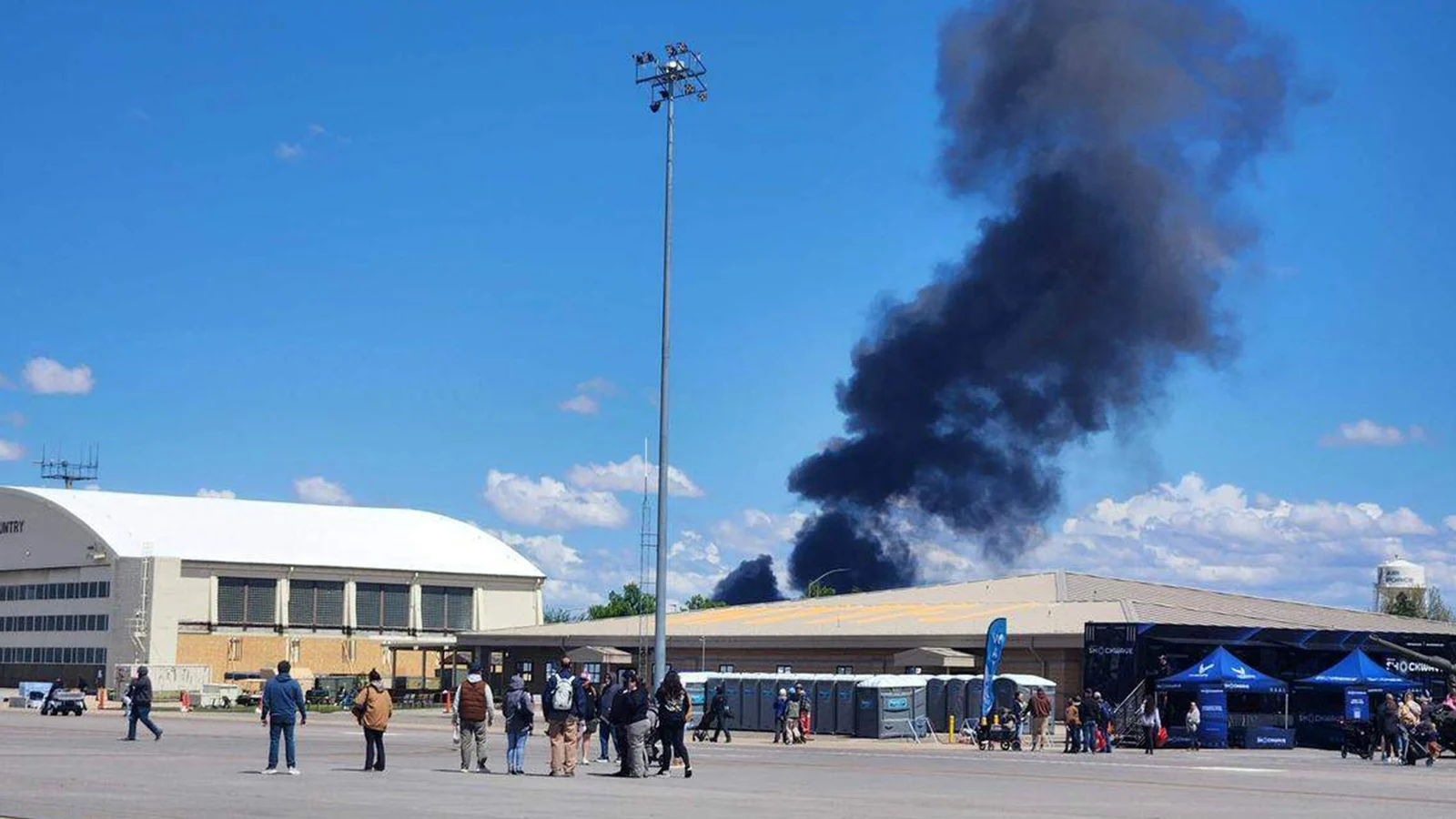
About three kilometres from Mountain Home Air Force Base, two E/A-18G Growler jets—sleek, thunderous machines built for electronic warfare—collided in mid-air while performing a demonstration. Miraculously, all four crew members escaped the wreckage by ejecting and were reported to have landed safely. The US Navy confirmed the aircraft were assigned to Electronic Attack Squadron 129, based on Whidbey Island in Washington.
The moment the sky changed
“I was standing by the food trucks when the formation came over,” said Jenna Morales, a local teacher who has attended air shows for years. “It sounded like a bass drum, then a second later something went wrong—two loud bangs and then these orange streaks. People froze. For a few seconds nobody moved.”
That freeze, that held breath of a gathered crowd, is the sharpest image from eyewitnesses: pilots ejecting into open air, parachutes blossoming against Idaho’s high blue, emergency vehicles racing toward a scene some had only moments earlier applauded. Organizers called the incident a priority for emergency response teams, and portions of State Highway 167—near where debris fell—were closed for several days as investigators combed the area.
Official response and the investigation
Commander Amelia Umayam, a spokesperson for Naval Air Forces, U.S. Pacific Fleet, confirmed the collision and said the four crew members “ejected safely.” She added that the incident is under investigation and that more information will be released as it becomes available. Military investigations into aviation accidents typically involve squadron-level safety officers, higher naval safety centers, and sometimes interservice coordination; findings can take weeks or months to emerge.
“The priority right now is ensuring everyone is safe and that the area is secured so investigators can do their work,” a base official told local media, underscoring the careful choreography that follows any mishap involving military hardware and public spaces.
Why the Growler matters—and what it does
The E/A-18G Growler is not a standard fighter; it’s an electronic attack aircraft, a technological workhorse whose job is to deny an enemy the use of their radar and communications. A typical Growler team consists of two crew members: a pilot and a naval flight officer. The plane’s demonstrations at air shows are meant to showcase precision flying and rapid-response capabilities, a reminder of both spectacle and function.
Introduced into service in the late 2000s, the Growler represents a shift in modern aerial warfare—less about sheer speed and more about controlling the electromagnetic spectrum. That makes its appearance at a public demonstration a vivid lesson in contemporary military power. When things go wrong, however, the risks become painfully visible to those below.
Local color: Mountain Home on a day like this
Mountain Home itself is a small city with deep ties to the base—cafés and hardware stores that greet airmen and their families like old friends, a rhythm set by deployments and training schedules. For many residents, the Gunfighter Skies show was more than entertainment; it was a reunion, a reminder of the relationship between the town and the Air Force.
“We come down to support the base and to watch these pilots show what they do,” said Tom Rivera, who runs a barber shop a couple of blocks from Highway 167. “You don’t expect to see them falling out of the sky.”
The 2024 event marked the first Gunfighter Skies Air Show in eight years. The last time the festival darkened the calendar—in 2018—the community also felt the sting of tragedy: a hang glider pilot was killed in a crash during the show. Those memories linger when the roar returns.
Safety, spectacle, and the calculus of risk
Air shows are spectacular by design. They draw tens of thousands of people to fields and grandstands, fuel tourism dollars for host towns, and serve as public diplomacy for the armed forces. In the U.S., military aerial demonstrations follow rigorous safety protocols and rehearsals; yet the combination of human judgment, mechanical complexity, and aerobatic daring means accidents, while rare, are part of the history.
“Pilots train for years to handle split-second decisions,” said a retired naval aviator who asked not to be named. “But when you put two high-performance aircraft in close proximity during a maneuver, even a small miscalculation or mechanical failure can produce catastrophic outcomes. The fact that these crews survived their ejections is a testament to both equipment and training.”
Data on airshow safety show overall improvement over decades, but periodic incidents—some fatal—keep safety practices under continuous review. Each accident sets off an intense, methodical inquiry aimed at understanding human factors, systems failures, and environmental conditions that contributed to the event.
What the investigation will likely examine
- Flight data and cockpit voice recorders (where available) for both aircraft
- Maintenance logs and recent mechanical issues
- Weather conditions and visibility at the time of the demonstration
- Pilot training, rehearsals, and communications between aircraft
- Any potential third-party or ground-based factors
After the smoke clears: community and reflection
The physical cleanup and formal inquiries will take time. The stretch of State Highway 167 closed by authorities will remain shuttered as teams sift through debris and evidence. For the residents of Mountain Home, though, the more lasting work is emotional—answering questions about a spectacle many view as part of communal life.
“You go to these shows to be inspired, to feel small under a big sky,” Jenna Morales reflected. “Today, we were reminded how fragile that beauty can be.”
What does it mean for communities and the military to balance public outreach with safety? How should the spectacle of power be displayed in a world more attuned to risk and accountability? Those are questions this incident forces us to ask anew.
In a wider frame
Beyond Mountain Home, the episode touches on broader themes: the modernization of military hardware, the intimacy between bases and their host towns, and the public’s appetite for demonstrations of power—and the price that can sometimes entail. As investigations unfold and officials release findings, one thing is clear: the line between theater and hazard is thin, and it takes a lot of invisible labor—maintenance crews, safety officers, and disciplined airmen—to keep that line intact.
For now, we wait for answers. We give thanks that four lives were spared. And we watch, perhaps differently, the next time those engines scream and the sky goes alive.
What would you want to know if you’d been there? How should communities reckon with both the awe and the risk of these public displays of military skill? Share your thoughts—these conversations matter as we look to learn from the near-miss above Mountain Home.