Russia’s vast Far East was first to head to the polls, setting in motion a tightly choreographed three-day parliamentary election that President Vladimir Putin’s ruling party is widely expected to win as the war in Ukraine enters its fifth year.
The vote is the country’s first election for the national parliament since Moscow launched its full-scale invasion of Ukraine in February 2022 — a conflict that has since killed hundreds of thousands.
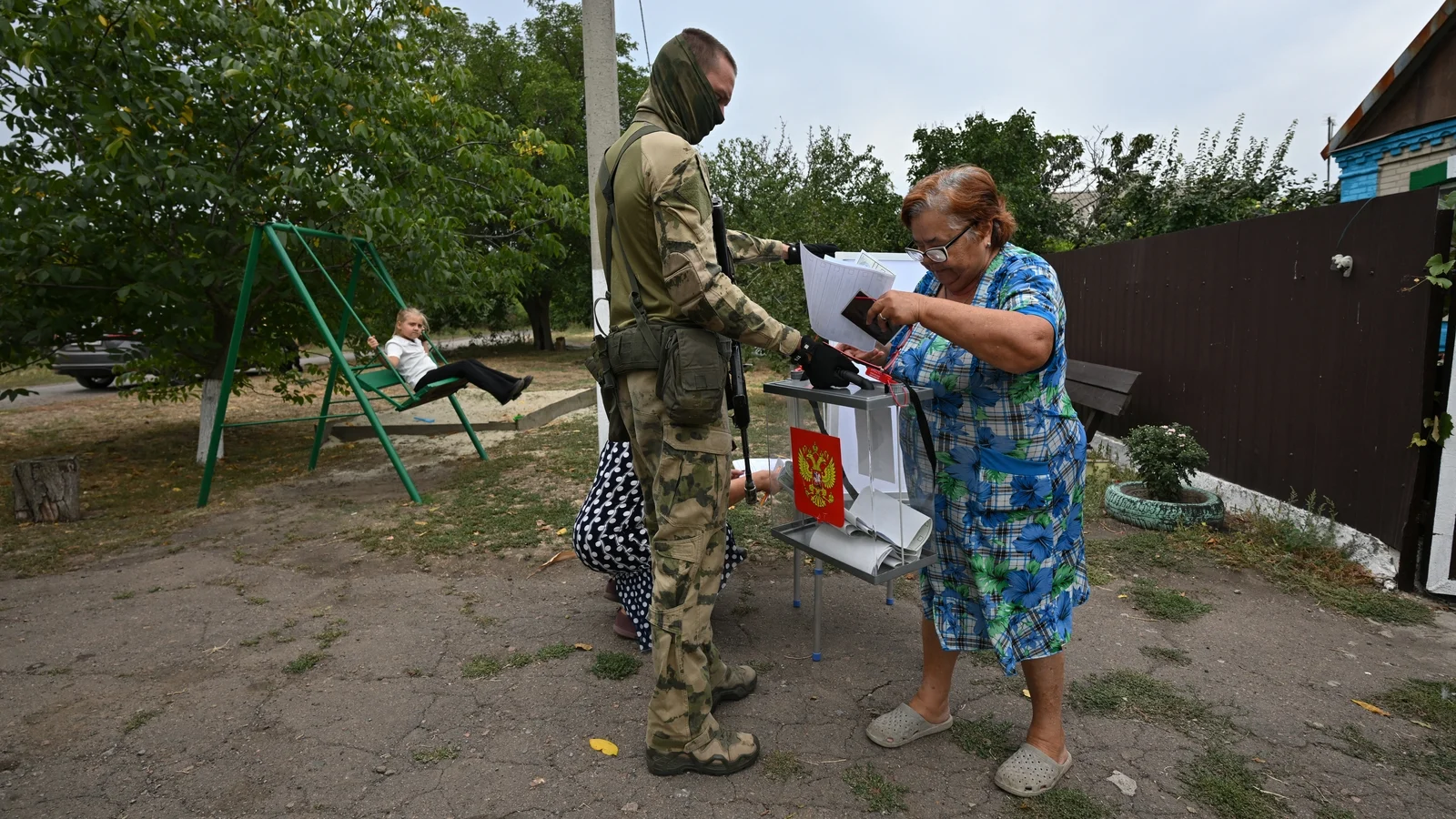
Only parties aligned with Mr Putin and the Kremlin’s prolonged military campaign have been allowed to compete, and Moscow has also arranged voting in parts of occupied Ukraine.
With few Russians expecting any upset against United Russia, the ballot nonetheless offers the Kremlin a way to measure the public mood about the war — especially as its impact has felt closer to home than at any point this year.
The fighting underscored itself overnight in Moscow. Mayor Sergei Sobyanin said Russia intercepted dozens of Ukrainian drones aimed at the capital.
“More than 350 UAVs flew towards the Moscow region between 8pm (local time) on 17 September and 7am (local time) on 18 September,” he said on Telegram, adding that most were destroyed at an outer defensive perimeter and some 64 were shot down as they were approaching the sprawling city.
People casting their ballots at a polling station in Moscow
Voters are choosing who will fill all 450 seats in the State Duma, the lower chamber of parliament, with polling due to continue until 7pm on Sunday.
The first ballots were cast in Russia’s Kamchatka peninsula and in Chukotka on the Pacific coast, the earliest of the country’s 11 time zones to open voting.
Mr Putin has led Russia since New Year’s Eve 1999, while United Russia has been the dominant force in national politics since the early 2000s.
Criticism of the Ukraine campaign has been outlawed, and elections — closely managed by the Kremlin — are offering little in the way of suspense.
United Russia’s challengers are parties that broadly endorse Mr Putin’s direction and the war: the Communist Party, the nationalist LDPR, A Just Russia and New People.
Yabloko, which urged an end to the fighting, was blocked from taking part shortly before the vote. One of its best-known figures, Lev Shlosberg, was jailed for criticising the war.
Opposition politician Alexei Navalny died in an Arctic prison in 2024
Tatiana Stanovaya, a France-based Russian political expert, said Mr Putin liked to “compare his political situation” to those in European countries.
“So he can always say, look, we had an election. I benefit from such significant support of Russians,” she said.
“So for him it’s personally, emotionally, politically very important,” she said.
Before voting began, the 73-year-old leader urged Russians to cast ballots as a show of solidarity with troops, saying that “behind our fighters stand millions of people” and that the vote should signal a “common answer to those who want to weaken Russia”.
The war has shattered Moscow’s relations with the West, which has imposed sweeping economic sanctions on Russia.
Vote to serve as barometer of public frustation with war
With public debate absent and demonstrations prohibited, the election is expected to function as an internal barometer for the Kremlin, testing how much frustration has built up around a war with no end in sight.
In 2024, the conflict has pressed in on daily life more sharply, with Ukrainian strikes extending to the Urals and Siberia, inflicting billions of rubles in damage and causing civilian deaths far from the front lines.
Mr Putin’s political opponents have largely been forced abroad, and his most prominent rival, Alexei Navalny — who once drew thousands into the streets during election periods — died in an Arctic prison in 2024.
Russia’s opposition in exile has urged anti-Kremlin voters not to stay home, but instead to vote “against Putin’s party”, issuing region-by-region recommendations on whom to support.
Mr Navalny’s widow, Yulia Navalnaya, also appealed to anti-war Russians to arrive at polling stations at the same moment — noon on Sunday.
Yabloko, however, rejected that approach and said the better course was not to vote.
“You are suggesting that we once again go, like sheep, dancing to their tune, and vote for those who have caused the deaths of people in Russia and Ukraine?” its chairman Nikolay Rybakov said at a party meeting in Saint Petersburg this week.
Beyond the immediate outcome, some worry the days after the vote could bring another military call-up, echoing 2022, when Mr Putin ordered the mobilisation of 300,000 reservists.
That deeply unpopular step sparked a rush of draft-age men leaving Russia.
Ukrainian President Volodymyr Zelensky has accused the Kremlin of preparing a new mobilisation drive “this autumn”, a claim Mr Putin has denied.