Voyager 1 transmits update after crossing one light-day distance milestone
 Caalamka
From the cold frontier beyond the sun’s reach, NASA’s Voyager 1 has delivered a message that underscores its place in history: the spacecraft has successfully “phoned home” from a full light-day away, a first for any human-made emissary in interstellar space.
Flight controllers received the transmission precisely 24 hours after Voyager 1 sent it.
The delay reflects the sheer scale of the milestone — it takes that long for a radio signal moving at the speed of light to span more than 26 billion kilometres.
“Travelling a light-day is a singular feat for a spacecraft, but Voyager is so much more than a distant traveller,” NASA’s Heliophysics Division Director Joe Westlake said in a statement.
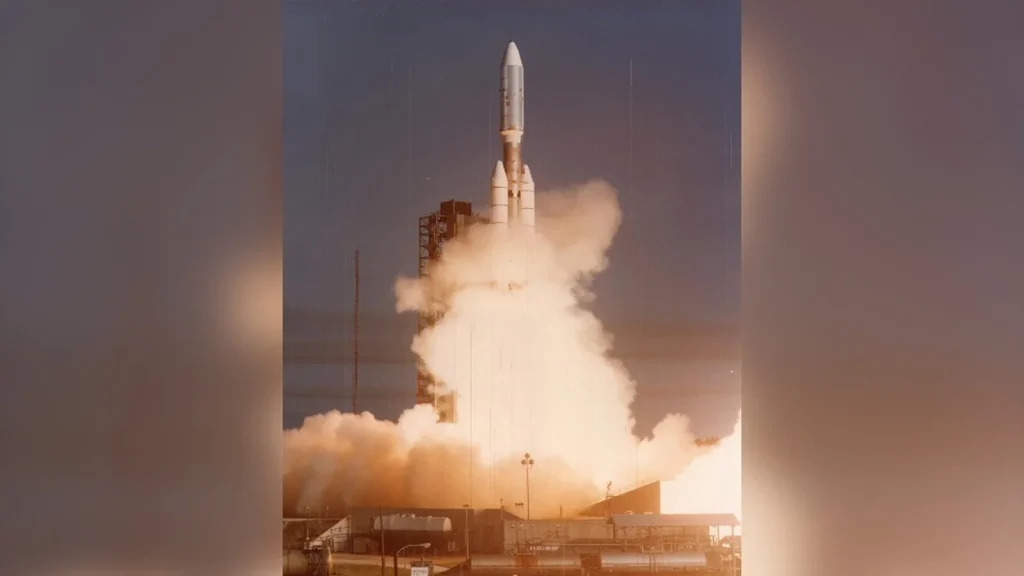
The moment adds a fresh chapter to the long-running saga of Voyager 1, which first left Earth in 1977.
It flew by Jupiter in 1979, then went on to Saturn in 1980.
Along the way, Voyager 1 captured the farthest-ever image of the “Pale Blue Dot” in 1990, became the most distant human-made object in 1998, and in 2012 crossed from the sun’s sphere of influence into the wide emptiness between stars.
NASA said it could not verify the latest distance benchmark until the signal itself arrived at the control team at California’s Jet Propulsion Laboratory (JPL).
Even so, the agency marked the occasion online, posting a seasonal greeting: “Happy Voyager light-day … day!” on social media.
“Voyager 1 crossing the light-day threshold is yet another historic feat on an extraordinary voyage of discovery,” JPL Director Dave Gallagher said in a statement.
Voyager 1 and its twin craft, Voyager 2, remain NASA’s longest-operating space missions, still returning information even as engineers have powered down many instruments to conserve energy and extend their exploration.
Voyager 2 launched two weeks before Voyager 1.
But its broader itinerary — including flybys of Jupiter and Saturn and then Uranus and Neptune — took a slower, longer path, and the spacecraft did not enter interstellar space until 2018.
NASA said Voyager 2 is not expected to hit the one-light-day distance until 2035.
Despite being 49 years old, both spacecraft continue to perform strongly, racing through space at more than 60,000 km/h and relying on plutonium as a power source.
They stopped taking pictures years ago, yet they still typically transmit rare measurements almost daily from a region no spacecraft had sampled before.
No science or engineering information have been received from Voyager 1 since Saturday, according to NASA.
Still, its carrier signal — the steady transmission that normally bears that data — continued to reach Earth and, combined with flight path calculations, enabled the mission team to confirm the light-day achievement.
NASA said controllers are now working to determine what caused the science and engineering data stream to go quiet.
Both Voyagers also carry a so-called Golden Record filled with the sounds of Earth.
The effort was led by the late Cornell University astronomer Carl Sagan, who also coined the phrase “Pale Blue Dot” for Voyager 1’s final look back at Earth.
NASA expects the gold-plated phonographic records, intended as time capsules for any future discoverer, to endure for more than one billion years.