Serbia has delivered one of its most decisive political upsets in years, handing a sweeping parliamentary victory to the student-led Student List movement after it campaigned on a blunt anti-corruption message and toppled the party of former president Aleksandar Vučić.
Now the question shifts from the ballot box to the cabinet table: who will actually lead the new government, and how quickly can it translate protest demands into policy?
In last Sunday’s parliamentary election, voters gave the Student List movement a clear mandate, choosing it over Mr Vučić and his United Serbia coalition.
Pre-election polling had suggested a tight contest, typically putting Student List ahead by only one or two points.
Instead, the movement opened a wide gap, finishing more than 13 percentage points in front with 53% of the popular vote — enough for 140 of the 250 seats in the Serbian national assembly.
Mr Vučić, who has held power as either prime minister or president since 2014, saw his party take about 39% of the vote, leaving it with 104 seats and moving it into opposition.
The Student List first took shape in November 2024, after a concrete canopy collapsed at a renovated train station in the northern city of Novi Sad, killing 16 people, including two children.
Protesters argued the deadly failure was the product of endemic corruption and opaque public contracting.
Those initial demonstrations quickly widened, drawing in people from a range of professions as rallies spread nationwide. They called for an end to corrupt practices, greater transparency from state bodies, and the resignation of then-president Vučić and the political establishment around him.
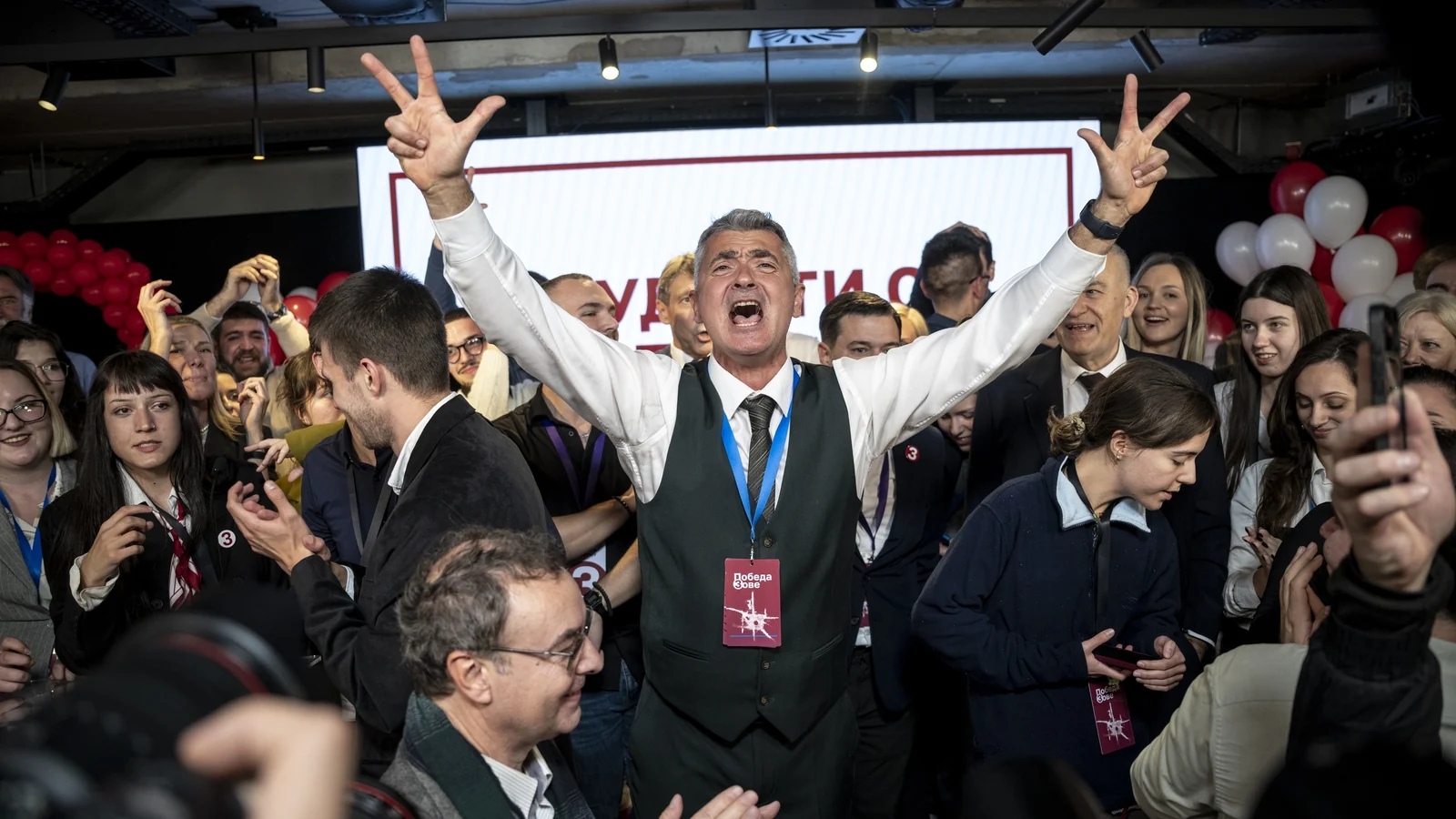
Student List supporters celebrate their election victory in Belgrade last Sunday.
Nearly two years on, the movement born from that tragedy is preparing to govern.
Yet it is doing so in an unusual way. Unlike Hungary’s Tisza party — which fought its campaign under a clearly identifiable leader, Péter Magyar — Student List has operated without a single figurehead. From the start, it has emphasised collective decision-making through debates, assemblies and votes.
Serbia’s Electoral Commission has not yet published the official results, but once it does, newly elected MPs will have 30 days to form a government.
If that deadline is missed, the timeframe can be extended to 90 days.
According to Serbian political scientist Ivan Vejvoda, the new administration’s early agenda will focus on restoring the rule of law, adhering to the constitution and, as he put it, “putting the house in order”.
“The first order of business will be reforming the security services,” Mr Vejvoda told RTÉ News. He is also a co-founder of Europe’s Futures Initiative, a Vienna-based civic organisation focused on promoting democracy across Europe.
He characterised Serbia during the Vučić era as “a captured state where democracy had backslid.”
Student List ran under the slogan “Serbia or the mafia” and pledged to build independent police bodies to investigate corruption — replacing the current approach in which cases are channelled directly to the interior ministry.
It also promised to strengthen judicial independence and depoliticise public institutions by removing senior officials appointed by the former government led by the Serbian Progressive Party (SNS).
Earlier this week, newly elected MP Jovo Bakić told Serbian newspaper Danas: “We must sever all the state’s connections with organised crime, and then suppress organised crime, which can never be completely eradicated, to the greatest extent possible.”
While overhauling the judiciary and security services is widely seen as a long-term task, Student List’s pledge to reform public media could move faster.
Serbia’s public television broadcaster, RTS, largely maintained a pro-SNS editorial line during the years the party held power. Several recent independent assessments — including a European Commission report published in 2024 — concluded that RTS offered limited airtime to opposition views.
In an open letter issued last Tuesday, Student List called for the resignation of the broadcaster’s director-general and senior editorial leadership.
“Citizens have the right to truthful, complete, impartial and timely information on matters of public importance. When a public service broadcaster subordinates the exercise of this right to the interests of political power, it undermines public trust, deepens social divisions and deviates from its primary role,” the statement said.
A day after the election, a news anchor at regional public broadcaster RNS apologised to viewers live on air, saying the station had “remained silent, turned a blind eye, provided one-sided information, reported uncritically, failed to ask the right questions, or asked no questions at all”.
Aleksandar Vučić had been Serbia’s prime minister or president since 2014.
Before any institutional changes can begin in earnest, Student List must first choose a prime minister from within its own ranks and nominate cabinet ministers.
Many of its MPs are political newcomers.
Almost half of the 250 Student List candidates who ran for office came from academic or education-related backgrounds.
The new parliamentary cohort also includes doctors, lawyers, engineers, journalists and agricultural experts.
Three names have so far emerged as leading contenders to become prime minister:
Ilija Srdanović, a cardiologist and professor from Novi Sad — the city where the 2024 disaster took place.
Speaking to Radio Free Europe earlier this week, Mr Srdanović said Student List remains “committed to European integration” and that a new government would “fully align” Serbia’s domestic policy with EU rule-of-law standards and human-rights legislation.
He backed continued dialogue with Kosovo and said the government would honour agreements signed by previous Serbian administrations.
However, he did not say whether the new government would implement the Brussels Agreement, the EU-brokered 2013 accord designed to set a framework for normalising relations between Belgrade and Pristina.
Student List rejects Kosovan independence and considers Kosovo an integral part of Serbia — a stance that risks putting it on a collision course with the European Union.
Serbia began formal EU accession negotiations in 2014, but the process has stalled amid limited progress on rule-of-law reforms and worsening relations with Kosovo, which is also viewed as a potential candidate for membership.
Thousands celebrated the Student List’s victory in central Belgrade
Another contender is Dejan Šoškić, a former governor of the National Bank of Serbia and a university professor.
He stepped down from the central bank in 2012 after the SNS-led government at the time passed a law curbing the bank’s independence and placing it under closer parliamentary control — a move that drew EU criticism.
If Mr Šoškić does not become prime minister, he appears a natural candidate for finance minister, given earlier international experience working with the World Bank, the IMF and the European Union.
A third prominent figure is Dejan Bodiroga, a former professional basketball player.
Like others in the movement, he has not previously served in government, but he is among Student List’s most widely recognised faces.
Whoever is ultimately selected as prime minister will head a technocratic administration built around specialists.
Economists, finance professionals, and professors in engineering and agriculture are expected to feature among the cabinet.
With such a large mandate, Student List will face immediate pressure to begin delivering on promised reforms from day one — and voters are unlikely to be patient.
Still, the movement will be stepping into an environment familiar to other post-election reformers: as Poland and Hungary have shown, reshaping public institutions long staffed by senior appointees loyal to a previous government can be slow, complicated and contentious.