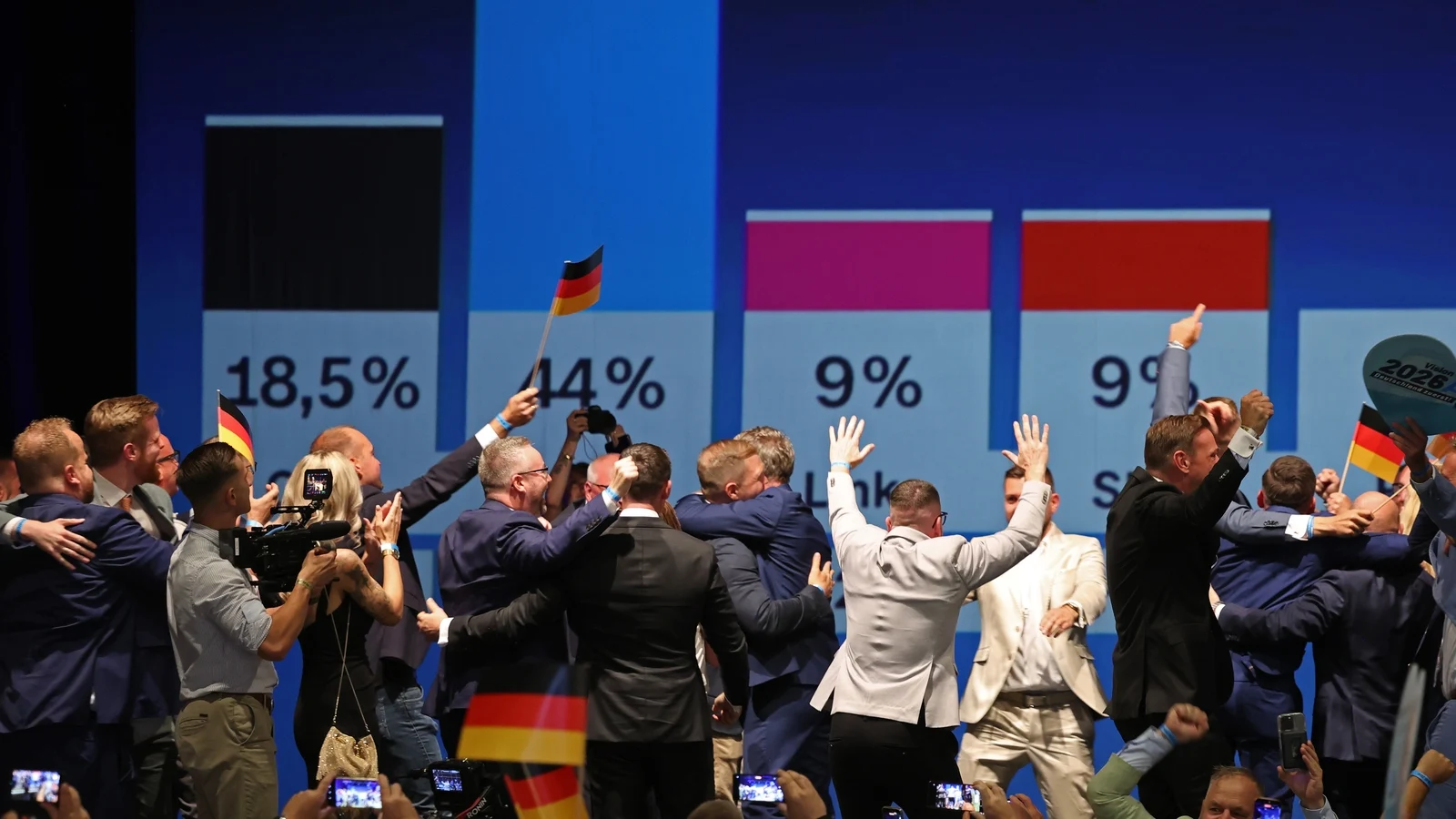
With Germany heading into a pivotal election, one number has hovered stubbornly in the background: in the weeks leading up to the vote, the far-right Alternative für Deutschland (AfD) has repeatedly polled at around 20%.
That level of support has pushed the party into new territory, testing mainstream Germany’s long-running strategy of keeping the far right politically isolated.
The AfD’s ascent is all the more jarring in a country marked by the trauma of authoritarianism and National Socialism in the 1930s and 1940s. For decades after the war, far-right groups were broadly stigmatised, treated as pariahs and largely locked out of serious political influence.
Political elites, established parties, major media and civil society organisations helped enforce that boundary, effectively marginalising far-right actors and restricting their electoral prospects.
The party’s breakthrough at the 2017 federal election upended that arrangement. With 12.6% of the vote and 94 seats in the Bundestag, the AfD became Germany’s third-largest party — and, for the first time in the postwar era, opened up viable political space to the right of the centre-right CDU/CSU.
The AfD began in 2013 as a project launched by disaffected CDU members, among them economics professors Bernd Lucke and Joachim Starbatty and conservative journalists Konrad Adam and Alexander Gauland. Initially it was built around a single issue: opposition to the euro, including a call for Germany to leave the Eurozone.
Nicknamed a “party of professors”, it drew early credibility from academics and former mainstream politicians, giving the movement an “unusual gravitas” for what was, at heart, a protest party.
Although nativist strands were arguably visible from the outset, the AfD did not originally present itself as a far-right organisation.
When it first contested a Bundestag election in 2013, its manifesto ran to four pages and focused entirely on dismantling the Eurozone.
At that stage it endorsed political asylum for the persecuted and largely steered clear of strident anti-immigrant or anti-Islam rhetoric, cultivating what was seen as a more “bourgeois” profile.
That early posture helped create what political scientist Elisabeth Ivarsflaten has described as a reputational shield — a legacy the party has used to deflect social stigma and accusations of extremism.
Party adopted a more hardline position
In its early years, the AfD even made a point of distancing itself from far-right parties in neighbouring countries.
But a series of leadership shifts between 2015 and 2017 pulled the party in a tougher direction, particularly on immigration, Islam and national identity.
By 2016, much of its platform resembled that of populist radical right parties elsewhere in Europe.
Today, the party can unequivocally be classified as far right.
The term captures the increasingly blurred connections between “(populist) radical right” (illiberal-democratic) and “extreme right” (anti-democratic) parties and movements. Ideologically, the far right is commonly defined by nativism and authoritarianism.
Placards that show Ulrich Siegmund, lead candidate of the far-right Alternative for Germany (AfD)
Nativism is a xenophobic form of nationalism that frames non-native elements as a threat to a homogeneous nation-state.
In Germany, nativism carries a heavy historical inheritance. “Völkisch nationalism” — influential in the 19th and early 20th centuries — was widely absorbed by National Socialism to justify deportations and, ultimately, the Holocaust.
At its core, völkisch ideology rests on an essentialist belief that the German people are inseparable from the soil itself, implying that others cannot truly belong to the völkisch community.
Party radicalised its position
The AfD’s transformation into a far-right party has unfolded through a steady radicalisation of its positions. It has functioned like a Trojan horse, carrying völkisch nationalist ideas into parliament and the broader public arena — spaces once protected by the gatekeeping mechanisms of German democracy.
The party cemented a distinct niche by demanding tougher anti-immigration policies, particularly after the so-called “refugee crisis”, when then-Chancellor Angela Merkel accepted more than a million asylum seekers into Germany.
At its January 2025 campaign kickoff rally, AfD chancellor candidate Alice Weidel promised “large-scale repatriations” — also referred to as “remigration” — of immigrants.
The party also argues for a return to blood-based citizenship, maintaining that, apart from very limited exceptions for well-assimilated migrants, citizenship should be determined by ancestry and bloodline rather than birthright.
Alongside this, it promotes the white, nuclear family as an ideal and has vowed to dismiss university professors accused of advancing “leftist, woke gender ideology”.
On foreign policy, it calls for sanctions against Russia to be lifted immediately and rejects weapons deliveries to Ukraine.
Leader of the Alternative for Germany (AfD) Ulrich Siegmund at a news conference in Berlin
In recent years, the party has leaned into a familiar far-right tactic: saturating the media and public debate with controversy, misinformation and inflammatory rhetoric in order to seize attention and break long-standing political norms.
One of the starkest examples came in 2018, when former AfD leader Alexander Gauland said the 12 years of Nazi rule were “mere bird shit in over 1,000 years of successful German history”.
The remark sought to recast modern Germany as a continuation of its pre-1933 past while minimising the weight of the Nazi era.
For much of the postwar period, mainstream parties consistently excluded the far right, rooted in a founding belief of the old Federal Republic of Germany: democratic forces do not cooperate with far-right actors.
At least in parliament, that cordon sanitaire largely held, forming part of Germany’s concept of “militant democracy”.
Yet the political firewall — the Brandmauer — has begun to weaken.
The AfD has since marked a milestone by winning its first mayoral posts at the local level.
Its momentum has been driven in particular by the story line of a “refugee crisis” in Germany. Sharper rhetoric about migration has aided the party’s electoral advance, as has the mainstream adoption of some of its positions.
Paradoxically, AfD support is strongest in rural and remote areas where migration levels are low, while the party struggles in more globalised, university-oriented urban centres.
In the run-up to the 2025 elections, CDU lead candidate Friedrich Merz crossed a long-standing taboo when a proposal from him to tighten asylum policies narrowly passed the Bundestag with AfD support.
At the same time, German media have increasingly treated AfD figures as legitimate political competitors.
Once sidelined in major political debates, they now appear regularly on talk shows.
They have also gained a measure of international validation from prominent voices including US vice-president J.D. Vance and X owner Elon Musk.
This election may offer a clearer sense of just how far the AfD’s normalisation will extend — and what that could mean for Germany’s political future.
Beyond the results at the ballot box, a central question is how much far-right thinking mainstream parties will absorb into their own agendas.
What is already evident is that Germany’s political terrain has shifted. The lines that once kept the far right on the margins are no longer as solid as they once seemed.