A late-afternoon rumble: Northern Japan braces as sea rises
It was the kind of late-April light that softens the jagged edges of the Sanriku coast — fishermen mending nets, schoolchildren on their way home, shopkeepers stacking the last of the day’s bento boxes — when the earth rolled. At 4:53 pm local time, a 7.5‑magnitude earthquake struck offshore of northern Iwate Prefecture, the Japan Meteorological Agency said, and within minutes a chilling word threaded through the airwaves: tsunami.
For people who live on Japan’s long, serrated coastline, that single syllable carries memory and muscle memory. Evacuation sirens blared. Text alerts rattled pockets. “Evacuate immediately from coastal regions and riverside areas to a safer place such as high ground or an evacuation building,” the agency warned, urging residents not to return until it was safe.
What happened — and what we know
The quake was powerful enough to be felt as far away as Tokyo, hundreds of kilometres to the south, shaking panes of glass and causing commuters to grip train rails a little longer than usual. Roughly 40 minutes after the tremor, an 80‑centimetre tsunami was observed at Kuji port in Iwate. Initial warnings from the JMA said waves could reach as high as 10 feet (about 3 metres) in some places, and cautioned that multiple waves can arrive over hours.
National broadcaster NHK’s live footage showed busy ports and fishing harbors in Iwate with no immediate, visible devastation — fishing boats bobbing, breakwaters intact — but that calm can be deceptive. A JMA official told viewers in a televised briefing that the aftershocks could continue and urged vigilance. The prime minister’s office mobilised a crisis management team to coordinate rescue, information and logistics.
Voices from the coast
“We felt the floor lift under our feet like the sea had come inside the house,” said Akiko Tanaka, a shop owner near Kuji harbor, who climbed the stone steps behind her storefront with her elderly neighbour. “My neighbour’s cat refused to leave, so she wrapped it in a futon and we carried it up. It takes less than ten minutes to reach the evacuation shelter — but those ten minutes feel like an hour.”
At a hilltop evacuation site, fishermen huddled under raincoats, cigarettes burning between nervous fingers. “We’ve seen tsunamis here before,” said Hiroshi Sato, his face browned from a life on the water. “The sea changes in a heartbeat. Tonight we watch, we wait, and we do not go back down until the all-clear.”
Emergency workers and local officials spoke with a different cadence — precise and procedural. “We have dispatched teams to check the shoreline and coastal infrastructure,” said one prefectural official on condition of anonymity to focus on operations rather than headlines. “Communication is our priority: letting people know where to go and making sure vulnerable residents get lifts.”
Why Japan feels every rumble
Japan’s archipelago sits at a busy, bruised crossroads of tectonic plates. The country is on the edge of the Pacific “Ring of Fire,” where the Pacific, Philippine Sea, Eurasian and North American plates interact. The JMA and seismologists note that Japan experiences roughly 1,500 quakes a year and accounts for about 18% of the world’s earthquakes. The population of the islands hovers at approximately 125 million, concentrated in coastal plains and river deltas that have historically fed both prosperity and peril.
The scars of history remain vivid. Many residents still carry the memory of the 2011 Tohoku disaster — a magnitude‑9.0 undersea quake and tsunami that killed around 18,500 people and triggered the catastrophic meltdown at the Fukushima Daiichi nuclear plant. “You don’t forget that sound,” an older resident in Iwate told me years ago — the same resident who, tonight, stood again on higher ground watching the lighthouse blink against the dark.
Authorities have been transparent about worst-case scenarios: the government has warned that a major rupture along the Nankai Trough — an 800‑kilometre undersea trench where the Philippine Sea Plate subducts beneath Japan — could potentially kill up to 298,000 people and cause as much as $2 trillion in damage. Those stark numbers catalyse policy and practice: everything from reinforced seawalls and evacuation drills to the national “disaster science” curriculum in schools.
Preparedness, culture and anxiety
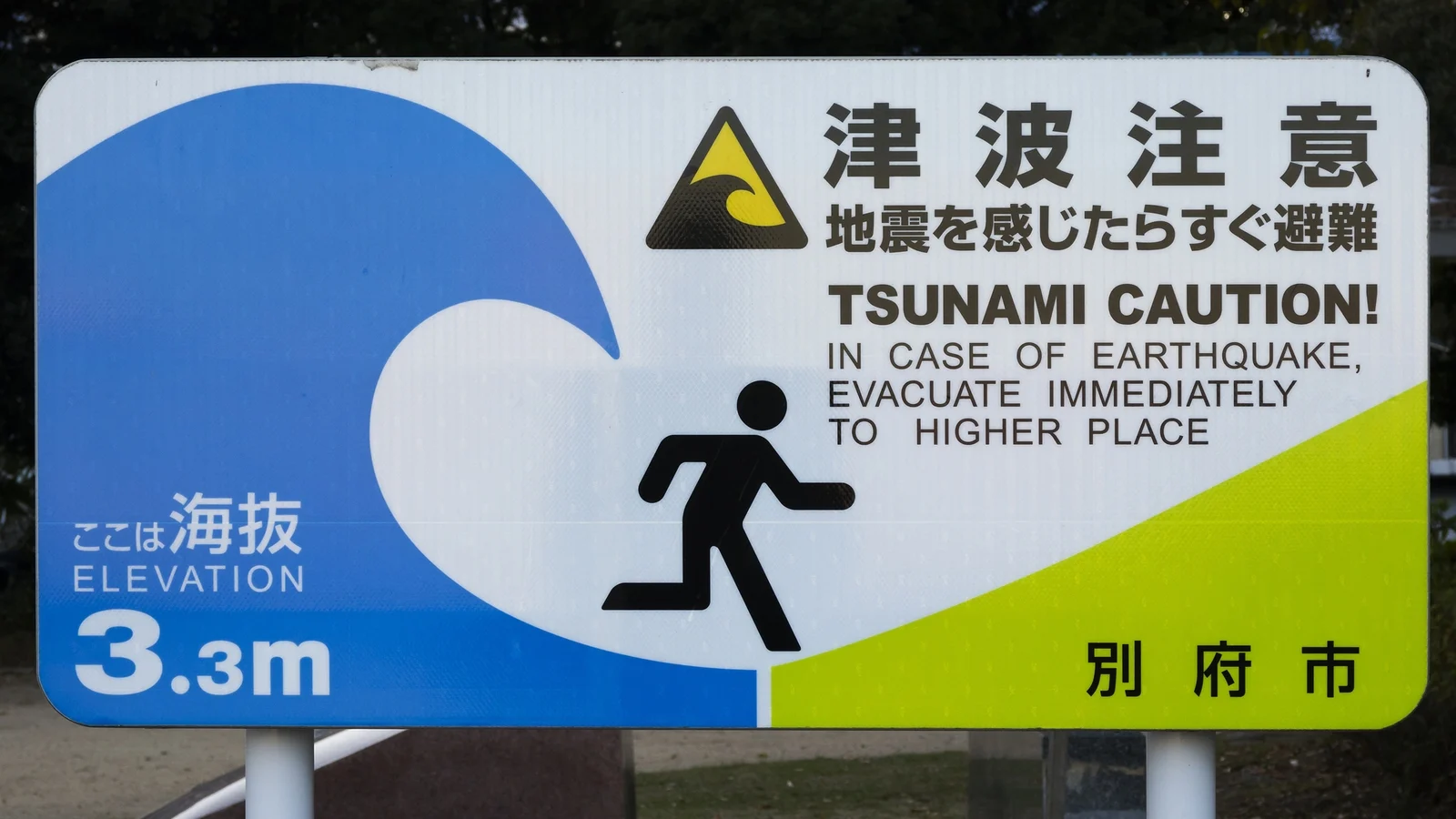
Japan’s disaster readiness is baked into daily life. Yellow-and-black evacuation signs mark pedestrian routes to hills and temples. Monthly drills are normal. Radio channels test sirens. But preparedness does not erase anxiety. In 2024, when the JMA issued a special advisory about a possible “megaquake” along the Nankai Trough, grocery stores saw panic-buying, rice disappeared off some shelves, and families rearranged travel plans. A week‑long advisory in December 2025 followed a 7.5 magnitude tremor off the northern coast; waves of up to 70 centimetres were recorded and dozens were injured, though damage was limited.
“Drills keep us alive,” said Professor Naomi Ishikawa, an urban resilience expert at a university in Sendai. “But living under a tectonic sky is also a social and psychological burden. Governments can build walls and sirens, but communities carry the intangible work of preparation — the conversations, the mental maps, the plans for elderly family members.”
Beyond the immediate: what this quake tells us
Moments after the tremor, volunteers mobilised, NGOs dusted off contingency plans, and local councils opened gyms and school halls as temporary shelters. The scenes are familiar — and instructive. They reveal the strengths of Japan’s civil defence fabric and the gaps that remain: the need to speed communications to remote hamlets, ensure backup power for hospitals, and keep evacuation routes accessible in time of night and storm.
There are also broader questions. How do densely populated coastal cities reconcile economic lives bound to the sea with the existential risk it sometimes brings? How do governments balance investment in hard infrastructure — seawalls, automated gates, elevated shelters — with “soft” resilience such as social networks, local leadership, and mental-health support after disasters?
What you can take from this
If you are reading this from afar, consider how disaster preparedness is not merely a local concern but part of a global conversation about urban planning, climate resilience and social cohesion. Japan’s experience — its drills, its technology, and its scars — offers lessons for coastal communities worldwide.
And if you have connections in the affected area, one small thing can matter: reach out. A message, a phone call, a check-in. Human contact helps steady the nerves when the ground won’t.
So tonight, under starlight and sodium lamps, people in northern Japan sleep in clusters of blankets, or stay awake listening for the ocean’s steps. They follow the ancient practice of looking to high ground, while science and state do the hard work of counting aftershocks and checking damage. They hold fast to ritual and community — the slow, stubborn work of staying alive in a place where the earth keeps reminding everyone who rules.
What would you take if you had ten minutes to get to safety? How would your community respond? These are the questions we should ask before the next siren sounds.