They Came for Renee — and for Something Bigger
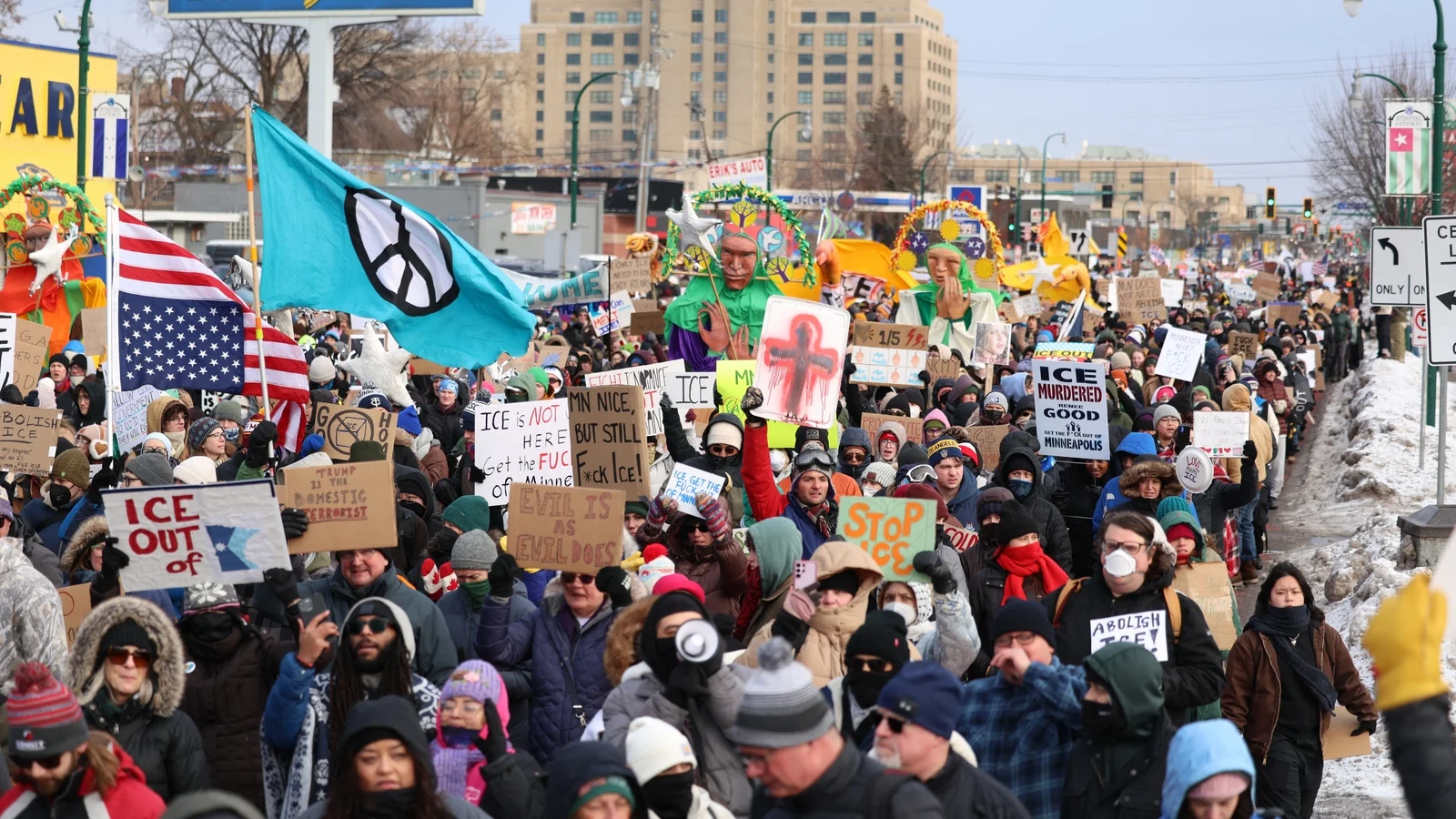
The air in Minneapolis felt like glass: brittle, clear, and cold enough to make conversations short and fierce. Even so, thousands of people pushed through snow-packed streets and clutched signs with mittened hands, chanting a name that had become, in the span of a few days, both a grief and a rallying cry — Renee.
It wasn’t just a city on edge. It was a nation watching as a single, raw moment splintered into a thousand protests. Organizers reported more than 1,000 events planned across the United States under the banner “ICE, Out for Good” — a slogan that fused anger at a federal agency with the human face of loss: Renee Good, a 37-year-old mother who was killed by an agent from Immigration and Customs Enforcement in Minneapolis.
“People came because they felt they had to,” said Marisol Hernández, a community organizer who helped coordinate a march from a neighborhood meeting hall to a snow-swept park near the scene. “This isn’t just about one death. It’s about what we let happen in our names. People are tired of silence.”
Contours of a Controversy
The story unfolded in a way that’s become painfully familiar: competing narratives, grainy footage, and accusations traded between local officials and the federal government. The White House pointed to video clips from the scene as support for the agent’s claim of self-defense. Local leaders countered that the footage, which does not clearly show the moment of the shooting, suggests Renee’s car was turning away and did not pose the immediate threat officials described.
Someone captured a distressing, intimate sequence on a phone. An officer can be heard calling Renee a profane slur, and audio captures the exchange before the shots. “I’m not mad at you,” Renee says in the clip as the agent circles her vehicle. Moments later, another agent orders her to exit the car. Then, people on the recording say they heard gunfire.
That clip — incomplete, disputed, and searing — has become the fulcrum of public outrage. It has stripped away layers of politeness and forced a blunt question: how do we weigh official accounts against the messy, often partial evidence that surfaces in these moments?
A City That Remembers Winters and Reckonings
Minneapolis knows cold. It also knows protest. The city has been a crucible for the national debate over force, accountability, and the reach of federal agencies into local communities. On this day, demonstrators moved past shuttered storefronts, halting traffic and forming human barriers with their bodies and placards. “ICE Out of Minnesota,” read one sign. “We won’t be silent,” read another.
“This is about our neighbors,” said Jamal Owens, who works at a nearby grocery and joined the march because “you never know who could be next in the crosshairs of a system that criminalizes people instead of protecting them.” Owens is Black; many attendees described the rally as a multiracial coalition of immigrants, activists, students, and ordinary residents linked by concern and grief.
From Minneapolis to Main Streets Across America
The ripples spread quickly. In Philadelphia, soggy but determined crowds marched from City Hall toward the local ICE field office. New York, Washington, Boston — cities big and small hosted gatherings, some numbering in the hundreds, others in the thousands. The “No Kings” network, a constellation of left-leaning groups that has organized previous national protests, amplified calls for action.
“When you see a pattern — a federal agency reaching into our communities with fear rather than care — you mobilize,” said Laila Khan, a lawyer who has represented immigrants in detention. “Protests are both an indictment and an invitation: an indictment of current practices, and an invitation to imagine something better.”
What Protesters Are Demanding
The crowd’s signs and chants coalesced around a few clear demands. These were not abstract slogans; they were practical, immediate requests the community wanted to see enacted.
- Independent investigations into the shooting and into ICE practices generally.
- Greater transparency around the use of force by federal agents.
- Stronger local limits on ICE operations and more oversight at city and state levels.
- Policy changes to curb mass deportations and prioritize humane alternatives.
The Human Ledger
Behind each demand was a human ledger: a mother mourning a child, a worker anxious about a knock on the door, a community grappling with the fear of routine raids. “It’s not only about Renee,” said Ana Delgado, whose cousin was detained two years ago. “It’s about the people we love. It’s about whether we can walk our streets without feeling hunted.”
Numbers, Power, and the Broader Context
ICE, established in 2003 in the aftermath of the 9/11 attacks, has grown into a powerful arm of federal interior enforcement. It manages detention facilities, conducts removal operations, and operates a broad investigative arm. Critics argue the agency’s mandate and resources have allowed it to operate with insufficient local oversight and too much discretion.
Under recent administrations, immigration enforcement has swung between different priorities — from focusing on serious criminality to broader interior enforcement — shaping thousands of deportations and detentions each year. That ebb and flow of policy has real consequences for families and communities across the country, feeding both fear and resistance.
Accountability in an Age of Video
Video and smartphone recordings have reshaped how the public witnesses confrontations, but they also complicate the search for truth. A clip that captures a slur and a tense exchange may not capture the critical second when a gun is fired. Yet images wield power — they can force official reviews, spur policy changes, and sustain public attention.
“Video is a tool, not an answer,” said Elliot Park, a criminal justice scholar. “It can open an investigation and shift public perception, but it doesn’t replace rigorous, independent inquiry.” Park urged both patience and urgency: “We need expedient investigations that follow evidence, not spin.”
What Does Justice Look Like?
Answers to that question will vary depending on whom you ask. For some, justice means criminal charges and firmer oversight of federal agents. For others, it demands wholesale policy change to an immigration system critics call punitive. For communities like the one that gathered in Minneapolis, justice looks at once both narrow and expansive: accountability for a death and a reimagining of how the state treats vulnerable people.
On a park bench cleared of snow, an elderly woman named Ruth — who declined to give her last name — folded her sign and said simply, “We can’t let this go. We can’t keep bargaining our humanity away.” Her voice, small but stubborn, echoed the mood of the day: sorrow braided to outrage, grief braided to resolve.
What Now?
Investigations will proceed. Officials will release more statements. Protests will ebb and flow. But the image of people standing together in the teeth of winter — chanting, warming their hands over mugs of coffee, refusing to let a single life be swallowed by a bureaucratic incident — is the kind of civic memory that can shape policy and politics alike.
So ask yourself: when a system that promises security causes harm instead, what do we do? Who do we trust to hold power to account? And what kind of community do we want to be in the face of fear?
The answers are neither easy nor immediate. But in the streets, beneath the low winter sun, people were trying to begin that conversation — loudly, visibly, and together. They came for Renee, and in doing so, they came for something larger: a claim on the kind of society they want to inherit and hand down.