A Rain of Currency and Metal: The Day a Military Plane Fell into El Alto
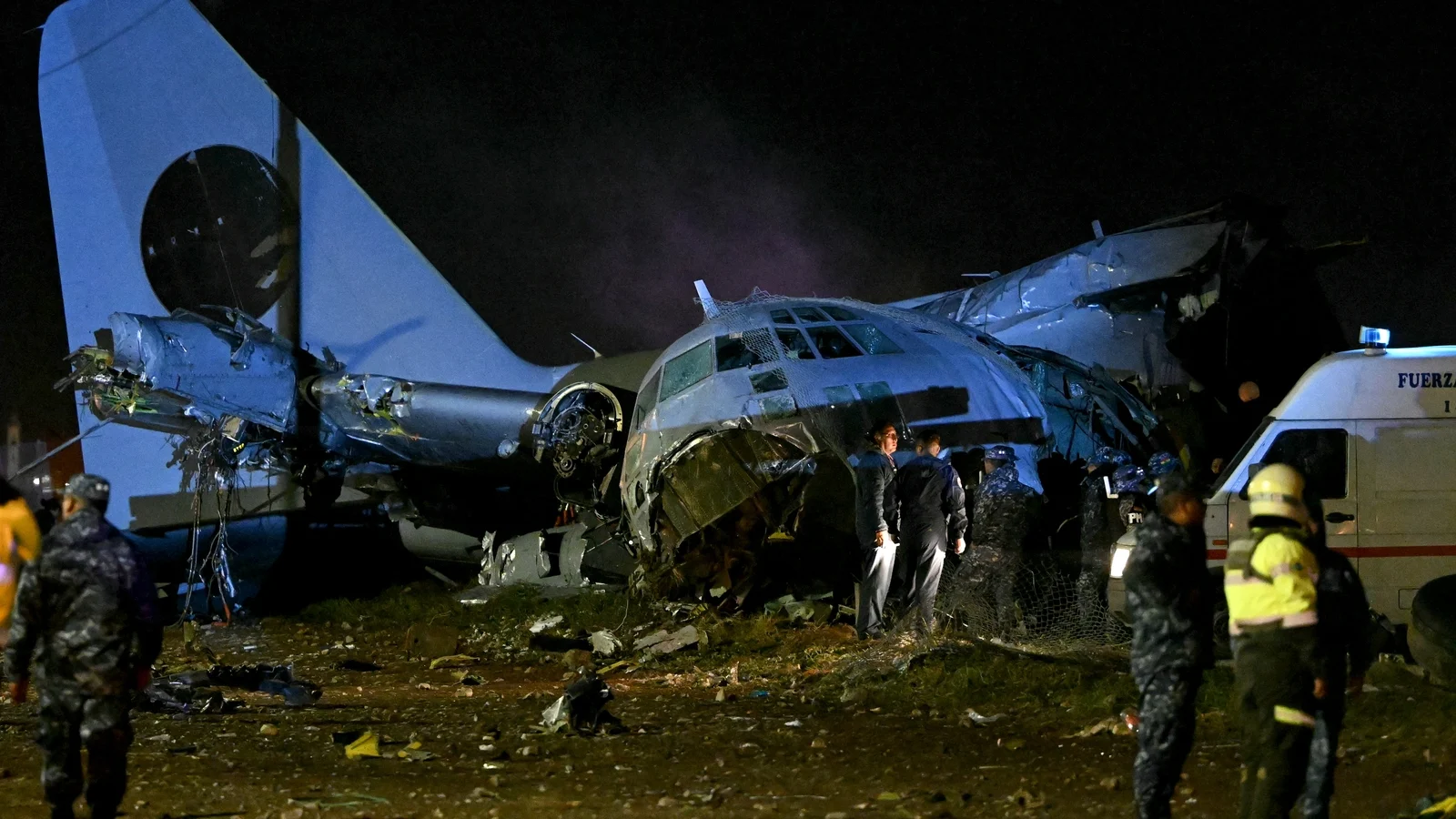
The morning sky over La Paz split open with a hailstorm the color of gravel. Lightning laced the high plateau, and then a C-130 Hercules — a hulking, familiar silhouette in military service the world over — came down not on a runway but on a crowded avenue, scattering banknotes, twisted metal and human life across the asphalt.
It was one of those moments that feels mythic and unbearably ordinary at once: a machine born for cargo and conflict reduced to a mangled heap beside a taxi rank; bills fluttering like wounded birds; bystanders grappling with both grief and opportunity. Rescue workers counted the dead; hospitals prepared for the wounded; and the streets of El Alto, perched above La Paz at roughly 3,650 metres, filled with smoke, confusion and the sharp tang of tear gas.
What happened
According to officials, at least 15 people lost their lives and dozens more were injured when the military transport plane veered off the runway at El Alto International Airport and slammed into a busy thoroughfare. Local hospitals later reported nearly 30 injured, and emergency teams described a chaotic scene strewn with crushed cars and the torn skin of aircraft parts.
“We carted bodies from both the airport grounds and the avenue,” Colonel Pavel Tovar of the National Fire Department said at a press briefing. “There are between 15 and 16 deceased who have sadly perished in this accident.”
The aircraft had departed from Santa Cruz, in Bolivia’s lowlands, and officials say it was carrying cash. Witnesses filmed piles of notes skittering across the wet road. Within minutes, people — some desperate, some opportunistic — rushed in. Police pushed crowds back with tear gas; later, authorities gathered the banknotes and burned them in a bonfire, saying the currency had no official serial numbers and therefore no legal value.
Voices from the scene
“It sounded like the sky broke,” said Rosa Mamani, a market vendor in her 40s whose refrigerator truck was flattened beneath the plane’s wing. “One moment I was covering the vegetables, and the next my cart was on fire. People ran with notes in their hands. I saw a girl crying because her father was under a car.”
“The tire fell onto our pickup,” added 60-year-old Cristina Choque, nursing a head wound her daughter received when glass shattered. “We stayed inside because the crowd was taking everything. Who would not be frightened?”
Prosecutor Luis Carlos Torres said several arrests had been made amid reports of looting that took advantage of the disorder. “Twelve people have been detained for questioning related to pillaging and other criminal acts,” he told reporters.
Why the cargo mattered — and why it was burned
Military and airport authorities explained that the notes being transported were not standard legal tender for general circulation. The Defence Ministry later issued a statement stressing that the bills lacked official serialisation and thus had no purchasing power — making their possession or use a criminal offence. For many watching, however, the sight of currency raining into the street was a provocative, almost cinematic image.
“When people see money on the ground, the impulse is immediate — to reach,” said Ana Valdez, a sociologist at Universidad Mayor de San Andrés. “But the context here is crucial: El Alto is a city of informal economies and thin safety nets. The sight of cash can trigger a survival response.”
The weather, the machine, and the questions that remain
Witnesses described a ferocious storm at the time of the crash: hail, low visibility and lightning. High-altitude airports like El Alto — which serves La Paz and is one of Bolivia’s busiest, sitting above 3,600 metres and serving a metropolitan area of more than a million people — present pilots with thin air and tricky aerodynamics that demand special procedures.
Dr. María Gutiérrez, an aviation safety expert who has studied mountain operations across South America, cautioned against quick conclusions while acknowledging the obvious complicating factors. “Heavy hail, wind shear and poor visibility can all create a very narrow margin for safe landing,” she said. “The C-130 is rugged and built for difficult fields, but nothing is immune to the weather or to the cumulative effect of mechanical, human and environmental stressors.”
Lockheed Martin’s C-130 series has been a backbone of military airlift since the 1950s, with variants designed to carry up to around 20,000 kilograms of cargo in some configurations. The model’s durability is storied — and that makes this crash all the more striking.
El Alto in focus: a city of altitude and urgency
The crash has thrown a spotlight on El Alto’s unique social geography. Once a satellite town, it grew into a sprawling, energetic metropolis on the plateau’s edge. Street vendors in layered pollera skirts sell hot empanadas outside markets; minibus drivers push fares; families work multiple informal jobs. In the context of Latin American inequality, El Alto is a place of hard-won survival and communal solidarity.
Hospitals in the area mounted an immediate blood donation appeal to treat the injured. The airport — Bolivia’s second most important — suspended operations, an interruption with economic as well as human consequences. Local street life that is normally loud and stubbornly busy was rendered still in the wake of a calamity that felt both local and symbolic.
Numbers to hold in mind
- At least 15 people killed, roughly 28 injured (official tallies reported by emergency services and the health ministry).
- About a dozen arrests reported in connection with looting and disorder.
- El Alto sits at approximately 3,650 metres above sea level; the metropolitan area is home to over a million residents.
- The C-130 Hercules, built by Lockheed Martin, is a long-serving transport aircraft with a maximum payload in the tens of thousands of kilograms depending on variant.
What this moment asks of us
When an aircraft filled with cash becomes a bonfire, what do we make of it? Is it a story about aviation safety, a grim accident that will be dissected by investigators? Certainly. But it is also a human story that touches on economics, security, and the brittle edges of daily life.
At a makeshift memorial on the avenue, a man in a neon vest laid a single white candle beside a shattered side-mirror. “It could have been me,” he murmured. “Everyone has a story of loss today.”
Investigations are under way. The Defence Ministry has promised a thorough probe; airport authorities and prosecutors are collecting debris and testimony. In the meantime, families mourn, hospitals treat, and a city high in the Andes tends to the wreckage of an afternoon when metal and money fell out of the sky.
As you read this, consider: if you found yourself on a street where money was raining down, would you pick it up? And when emergency forces tell you not to — when they say the bills are worthless, illegal, potentially dangerous — how would a community balance impulse, need and the rule of law?
The answers will unfold in courtrooms, accident reports and the quiet conversations of grief. For now, El Alto’s streets bear the scars of a terrible collision between the mechanical and the human — and the rest of Bolivia, and the world, watches and waits for the reasons behind it.