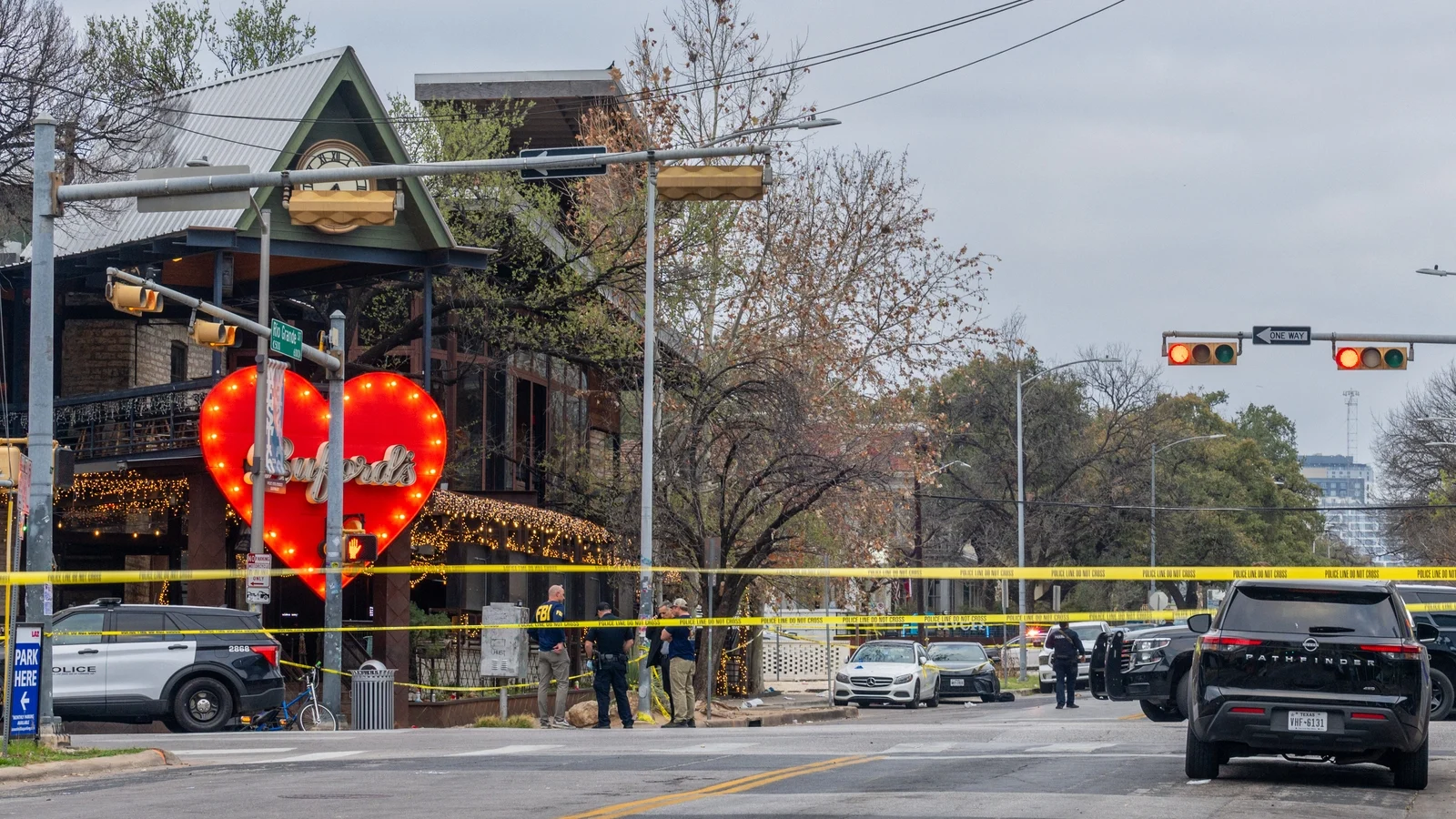
Nightfall in Austin: A Quiet Street, A Burst of Violence, and the Echoes That Follow
There are cities that sleep with music in their bones. Austin is one of them—sixth‑street neon, a drumbeat of live bands, tattooed bartenders wiping down brass taps, and late‑night laughter that slides down alleys like warm air. So when the stillness of a humid Texas night was shattered by gunfire just after 2am, it landed like a blow to the city’s collective chest.
According to local authorities and monitoring agencies, a gunman opened fire near Buford’s Backyard Beer Garden in downtown Austin, killing two people and wounding fourteen others before officers returned fire and killed the suspect. The shooter has been identified by the SITE Intelligence Group as Ndiaga Diagne, a U.S. citizen of Senegalese origin; officials say social media activity suggested “pro‑Iranian regime sentiment.”
“We responded as quickly as humanly possible,” Austin police chief Mr Davis told reporters at a tense, late‑night briefing, his voice tight with fatigue. “Three of our officers engaged the suspect after he emerged from his vehicle and fired on civilians. Our first priority was stopping the threat and getting victims to safety.”
A terrifying sequence
Witnesses described a surreal, horrifying sequence: a pistol firing from inside a car at people seated at outdoor tables, then the vehicle pulling over, its driver stepping out with a rifle and spraying bullets at passersby.
“One moment we were listening to this band, the next there’s popping—like fireworks, but not right,” said Marisol Hernandez, 28, who escaped with minor injuries. “People were screaming, ducking under picnic tables. I’ll never forget the sound of shoes on the pavement, everyone running.”
Three victims remain in critical condition, officials said. Emergency crews worked through the night to treat the wounded and secure the scene. The FBI’s Joint Terrorism Task Force has joined local investigators. FBI special agent Alex Doran warned that while a definitive motive is not yet established, “there were indicators on the subject and in his vehicle that indicate a potential nexus to terrorism.”
Context: a charged atmosphere and the global tinderbox
For those trying to make sense of the violence, it helps to see it against a broader, more febrile backdrop. American cities have already been on heightened alert after reports of U.S. and Israeli air strikes against Iranian targets—strikes that, according to some official statements and media reports, killed Iran’s supreme leader and several senior officials. Whether those reports will stand up under independent verification, and what they mean for a volatile Middle East, is still being argued in diplomatic rooms and on social media.
“When tensions spike overseas, they ripple here,” explained Dr. Leila Haddad, a counterterrorism researcher. “People watch, they interpret, and sometimes that interpretation is channeled through violence. We’ve seen cases where foreign policy actions are used as justification—or apparent justification—for attacks on U.S. soil.”
How often does that happen? Precise numbers are hard to pin down; terrorism‑related incidents in the U.S. are comparatively rare, yet they carry outsized impact. For decades, the U.S. has grappled with the twin realities of frequent gun violence and intermittent politically or ideologically motivated attacks. The statistics are sobering: in recent years, roughly 40,000 Americans have died annually from gun‑related injuries, a mix of homicides, suicides, and accidents. Mass shootings—while representing a tiny fraction of those fatalities—loom large in public attention and policy debate.
On the ground: voices from downtown Austin
Downtown Austin the morning after looked like a city trying to shake off a nightmare. Crime‑scene tape fluttered from lamp posts. Nearby bars posted messages on their windows: “We love our community.” Paramedics and detectives moved with quiet purpose. Locals, still in pajamas and sandals, gathered near portable coffee carts, whispering, mourning, incredulous.
“I walk these streets every night—this is where my neighbors are,” said Daniel Mbaye, who runs a late‑night sandwich truck across from Buford’s. “I’m scared today. Not just of the shooting, but of being seen as something else, of people jumping to conclusions about who we are.” Mbaye is of Senegalese origin, like the man authorities have named. “I love Austin. My customers are my friends.”
Buford’s owner, who wished to remain anonymous, wiped a tear from a coffee‑stained face. “We’ve always tried to be a safe, joyful place—live music, community nights. Tonight that joy was broken. Families come here. It’s not supposed to end like this.”
Questions that won’t go away
If we peel back the immediate horror, several larger questions unfurl. How do local police and federal agencies coordinate when ideology and firearms intersect? What role does online radicalization play, and how can it be detected without trampling civil liberties? How should communities balance vigilance against scapegoating minorities?
“There’s a delicate balance between proactive investigation and preserving constitutional rights,” said Prof. Aaron Seidel, a civil liberties scholar. “We need robust intelligence work—but we also have to ensure that whole communities are not treated as suspect because of one individual’s alleged actions.”
And then there is the perennial American question: why are guns so lethal here? Public health experts point to a combination of high firearm availability, social stressors, and gaps in mental‑health services. “We can have all the situational awareness in the world,” said Dr. Haddad, “but unless policy addresses underlying access to weapons, these kinds of scenes will continue to appear on our streets.”
Timeline (as pieced together by authorities)
- ~2:00am: Shooter allegedly opens fire from vehicle near Buford’s Backyard Beer Garden.
- Shooter exits vehicle, reportedly armed with a rifle, and continues shooting at pedestrians.
- Responding officers engage; three return fire, killing the suspect.
- Multiple victims transported to area hospitals; three in critical condition.
- FBI Joint Terrorism Task Force joins local investigation; SITE Intelligence Group reports alleged social media indicators.
How to grieve, how to act
In the immediate aftermath, grief takes many forms. There are floral piles and candles, of course. There are also the quiet ways communities absorb trauma: counselors at local churches, emergency mental‑health hotlines being set up, and city officials promising transparent investigations.
“We will get answers,” Mayoral spokesman Rachel Ortega told reporters. “But answers don’t erase pain. We stand with the victims, their families, and everyone affected.”
What can readers—here, now, meters from the scene or oceans away—do? Stay informed through credible sources. Support local organizations helping survivors. Resist the urge to leap to attribution based on social media snippets. And ask your representatives about policies that address both violent extremism and the ease of access to assault weapons in this country.
In the end, the image that lingers is painfully intimate: people seeking refuge under a picnic table, a bartender’ s hand steadying a bleeding stranger, a city waking up to a hole where a normal night used to be. The questions are as much about public safety as about how we hold each other—how we mourn, how we protect, how we live together in fraught, connected times.
Can a city known for its music, food trucks, and open‑armed culture heal quickly from an act meant to terrorize it? The answer will be written in weeks and months—in courtrooms and hospital wards, in neighborhood meetings, in the way Austin remembers and rebuilds. For now, the wound is fresh, the questions raw, and the search for truth underway.