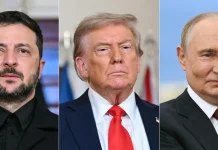
A president’s words, a continent holding its breath
On a cold morning that felt like the rest of the week in a Kyiv café — rain on the windows, a television tuned to rolling news, and the hum of conversation about cash, power cuts and the next aid convoy — a line from across the Atlantic landed like a stone in a pond.
“Zelensky, he has to get on the ball, and he has to get a deal done,” the American president told an outlet in an interview that rippled through diplomatic circles and kitchen tables alike. He added, of Russia’s leader, “I think Putin is ready to make a deal.”
Whether you call it counsel or pressure, the message was clear: the U.S. president cast Ukraine’s president as the principal obstacle to peace, suggesting that compromise was not only desirable but necessary — and that Vladimir Putin might be the partner to make it happen.
The scene in Kyiv: an uneasy mix of resignation and defiance
At the café, Larisa, who runs a plant shop three streets over, frowned as she stirred her tea. “People here read these things and they feel the weight,” she said. “We are not obstacles. We are living in our homes. We are dying in our homes. Suggesting we must ‘get a deal’ sounds like telling a neighbor to sell their house to stop a fire.”
Across the river, a volunteer medic who asked to be identified only as Andriy carried a box of bandages into a small clinic. “Negotiations are not about speed,” he said. “They are about conditions. You cannot ask someone to sign away their future because the clock is making you tired.”
These local voices matter because, even more than abstract geopolitics, the stakes here are the strip of land between front lines, the months and years of rebuilding, the children who may never return to their old schools. Since Russia’s full-scale invasion in February 2022, millions have been uprooted and tens of thousands have died — blunt numbers that become human stories when you walk Kyiv’s neighborhoods.
A president’s continuing playbook
This is not the first time the U.S. president has suggested that the path to peace lies in pressure on Kyiv. During his time on the campaign trail and in scattered interviews, he has called U.S. spending on Ukraine wasteful and praised, in varying degrees, the negotiating capacity of Russia’s leader.
“He’s always been focused on deals,” said Fiona Marshall, an expert on diplomacy at a Washington think tank. “Whether those deals reflect balance in the region or simply the shortest path to U.S. disengagement depends on how you measure success. For many in Europe and among Ukraine’s allies, success must include Ukrainian sovereignty.”
Across the globe, observers are parsing the rhetoric for signals. Does prioritizing a deal imply a readiness to cut back military assistance? Does it mean accepting territorial concessions as the price of peace? And crucially: what leverage does Kyiv have at a negotiating table where one side controls territory and has the backing of a nuclear arsenal?
Numbers that shape the calculus
To understand the backdrop: since 2021 the United States has provided more than $100 billion in military, economic and humanitarian assistance to Ukraine, according to public tallies by congressional offices and aid monitors. European partners have contributed tens of billions more, and NATO countries continue to supply equipment, training and intelligence support. Yet public patience and political will are not infinite.
Polling in recent years has shown a complex picture. Many Americans remain reluctant to commit to open‑ended military involvement abroad, and some surveys indicate waning support for large-scale financial commitments. In Europe, meanwhile, energy concerns, refugee flows and inflation have complicated policymaking — all factors that feed into leaders’ calculations about how long they can or will sustain a costly conflict.
What the language of “deal-making” misses
Language shapes perception. Calling one leader “the obstacle” shifts the story from aggression to bargaining. It invites questions that are not merely strategic: what concessions would be asked of a country defending itself? Would borders be part of the bargaining chip? Would the safety of millions be reduced to a line item at a negotiating table?
“Real peace requires justice and security,” said Olena Kovalenko, a legal scholar in Lviv who has worked on wartime protections for civilians. “There’s a danger when powerful outsiders assume they can broker peace without addressing the core harm. That’s not diplomacy; that’s damage control.”
On the other hand, some diplomats argue that only by engaging directly with all parties — including, in some form, Moscow — can a path to ceasefire emerge. “Negotiations are messy,” said a veteran European envoy who requested anonymity. “But refusing to recognize the other side’s agency doesn’t make it go away. At the same time, you can’t reward aggression.”
Beyond headlines: the longer arc
Readers, ask yourself: what does a “deal” mean to you? Is it the immediate cessation of artillery and drone strikes? Is it a long-term security guarantee for a sovereign nation? Or is it a geopolitical reset that redraws lines of influence? The answers reveal not just policy but values.
History offers cautionary tales. Ceasefires that paper over unresolved grievances often collapse. Agreements negotiated when one party is significantly weaker can breed resentment and new conflict down the line. Equally, isolation and endless attrition have their own human costs — a cost that shows up in refugee flows, in lives interrupted, in economies hollowed out.
What comes next
For now, the conversation continues across capitals and living rooms. In Washington, lawmakers debate budgets and strategic priorities. In Brussels, leaders weigh sanctions and support. In Kyiv and in towns nearer the fighting, people continue to shelter, teach, build, volunteer and mourn.
“We are tired,” said a teacher who runs a shelter out of a school gymnasium. “But tired is not the same as ready to give up.”
If world leaders truly want a durable peace, they will need more than sound bites and ultimatums. They will need a plan that centers the rights and security of the people who live on the front lines, accounts for the economic and social rebuilding that follows war, and confronts — frankly — the power imbalances that make fair negotiations so difficult.
In the end, perhaps the most important question is not who is the obstacle, but who will stand with those who must live with the outcome. Will the outcome be shaped by the loudest office in the room, or by the quiet insistence of citizens rebuilding their lives? The answer will determine not just the future of one nation, but the character of a world that claims to value both justice and peace.