The Day the Streets Remembered: A Nation—and the World—Speaks Back
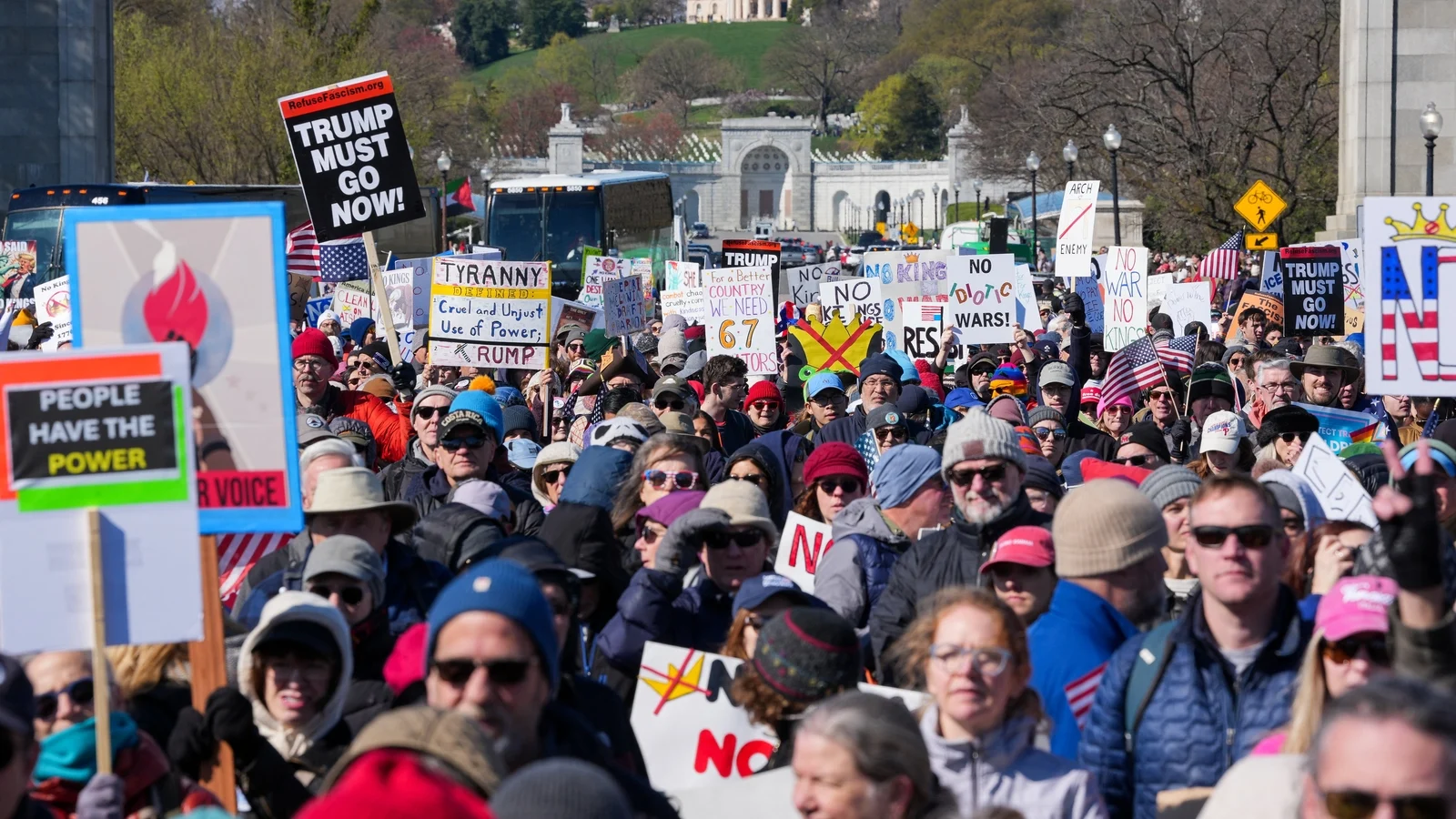
Just after dawn, a wind off the Potomac smelled faintly of exhaust and frying oil, the familiar tang of a city that never entirely shuts itself off. By midmorning, the bridge into the National Mall was a river of jackets, handmade signs and patient chants. Somewhere above them, the Lincoln Memorial—stone and stubborn—watched another chapter of public grief and defiance being written.
It is hard to describe the sound of a protest until you stand inside it: not just a chorus but a layered score of different lives insisting on being heard. A woman with a wool cap and a cardboard sign that read “We Are Losing Our Democracy” hugged a friend and said, “I came because I kept hoping the next election would fix it. It didn’t. Now I’m here, and I want my neighbors who stayed home to know they have to come out, too.” Nearby, a young man hoisted a banner that said “Trump Must Go Now!” and laughed nervously. “It feels like the country is on a hinge,” he said. “Either we swing forward or it breaks.”
No Kings, No Quiet
Three separate mass days of action in less than a year have done more than puncture the usual headline cycle. They have created a rhythm: No Kings, the grassroots coalition organizing the demonstrations, has turned public anger into choreography. The first nationwide day of protest last June—coinciding with President Donald Trump’s 79th birthday and a military parade in Washington—drew several million people from city sidewalks to small-town squares, according to organizers.
In October, organizers estimated turnout reached seven million. This latest round was billed as an attempt to surpass even those figures: more than 3,000 rallies were planned in cities and towns across the United States, and solidarity demonstrations appeared in Europe—from Amsterdam and Madrid to Rome—and as far afield as Portugal, where US nationals gathered in Lisbon’s Praça do Comércio to hold placards and exchange stories of exile and alarm.
What is at stake, according to the thousands who came out
- Concerns about an increasingly authoritarian style of governance, critics say, including ruling by executive order.
- Allegations that the Justice Department is being used to target opponents.
- Policy shifts on climate, racial and gender equity programs that activists call a rollback of basic rights.
- And, most urgently now, a controversial war with Iran conducted alongside Israel, with shifting goals and no clear endgame.
“This isn’t hobby politics,” said Jamal Rivers, a high school teacher from Detroit who traveled to the Lincoln Memorial. “It’s the accumulation of all the little things that add up to a different country. We used to assume institutions would hold. Now people are asking whether they still will.”
Across the Map: From Minneapolis to Kotzebue
In Atlanta, thousands gathered in a park, layering voices into a steady hum that made the trees tremble. In West Bloomfield, Michigan—near Detroit—protesters braved below-freezing temperatures, wrapped in donated blankets, holding homemade signs and trading thermoses of coffee. In St. Paul, Minnesota, the concert stage was set for a different kind of protest music: organizers had enlisted Bruce Springsteen, a longtime critic of the president, to play “Streets of Minneapolis,” a ballad reportedly written in memory of two citizens killed during demonstrations earlier this year. The song—raw and immediate—was meant to stitch mourning into resistance.
There was even a planned action above the Arctic Circle in Kotzebue, Alaska—a reminder that the political weather here extends to places where daylight can be scarce and supply boats infrequent. “If democracy is worth defending,” a Kotzebue organizer said by satellite phone, “then we’re part of that defense—even where the roads end.”
Why the World Listens
One striking detail: the movement no longer looks purely domestic. Rallies in European capitals, as well as gatherings in capitals of countries with sizable American expatriate communities, underlined how U.S. policy—especially when it involves military action—radiates outward. Protest signs in Lisbon blended English and Portuguese; a woman from Portugal who married an American veteran told me, “What happens in Washington becomes our news, our fear.”
Analysts say the current momentum matters far beyond the next ballot box. “When approval ratings dip below 40 percent, as they have for this administration in several polls, that is not just a number,” said a political scientist at a Midwestern university. “It reflects a breakdown in the tacit social contract. Large, sustained protests can either channel that energy into institutional change, or push the country further into polarization and legislative gridlock.”
Faces, Stories, and the Questions They Ask
Protesters came with different language, but a similar cadence of worry. There were grandparents who remembered the civil rights marches that passed through the same marble corridors decades ago. There were students who said the world their parents promised them—prosperity, security, a reasonable future—felt up for sale. “My mother marched for Roe,” said Ana Torres, twenty-four, showing a faded picture of her family at a demonstration three decades ago. “I never thought I’d be doing the same thing for everything else.”
Officials, too, were visible: some counseled restraint, others urged the crowds to vote rather than only shout. An elected city council member in Minneapolis told me, “Protest is essential. It operates like a diagnostic for democracy—revealing the wound. But protests need follow-through: policy proposals, candidates, civic infrastructure.”
The Long View: Democracy, Media, and Mobilization
What these gatherings illuminate is not merely opposition to a single leader. They expose fault lines in how people relate to power, truth and belonging. In a time of algorithmic news feeds and partisan lenses, mass street action becomes a counterweight: an insistence on shared public space where voices must be negotiated in person, not only in isolated columns of like-minded followers.
Are protests effective? The answer depends on what you measure. They force stories into the public square, sway undecided voters, and sometimes reshape policy. But they can also harden the other side, inflame rhetoric and distract from the patient work of coalition-building. Those who come out to the streets know both truths—why they chant, and why the real work continues at kitchen tables and in voter registration drives afterward.
After the Chants: What Comes Next
With midterm elections looming in November, political operatives are watching turnout models and polling margins as if the nation were a vast, fragile experiment. Organizers hope to parlay energy into ballots and candidate support; opponents hope to use the demonstrations as evidence of extremism. In the weeks to come, expect more marches, more speeches, and more music beneath the same stone faces and under the same gray skies.
So I leave you with this: when counted not in sound bites but in footsteps, what does democracy feel like? Is it the roar on a bridge, the hush outside a living room as a family debates whether to vote, the stubborn resilience of a small Alaskan town dialing in to a national conversation? The protests answer: all of it, at once. And if democracy is a practice, then these are the days when many are still learning to practice loudly.