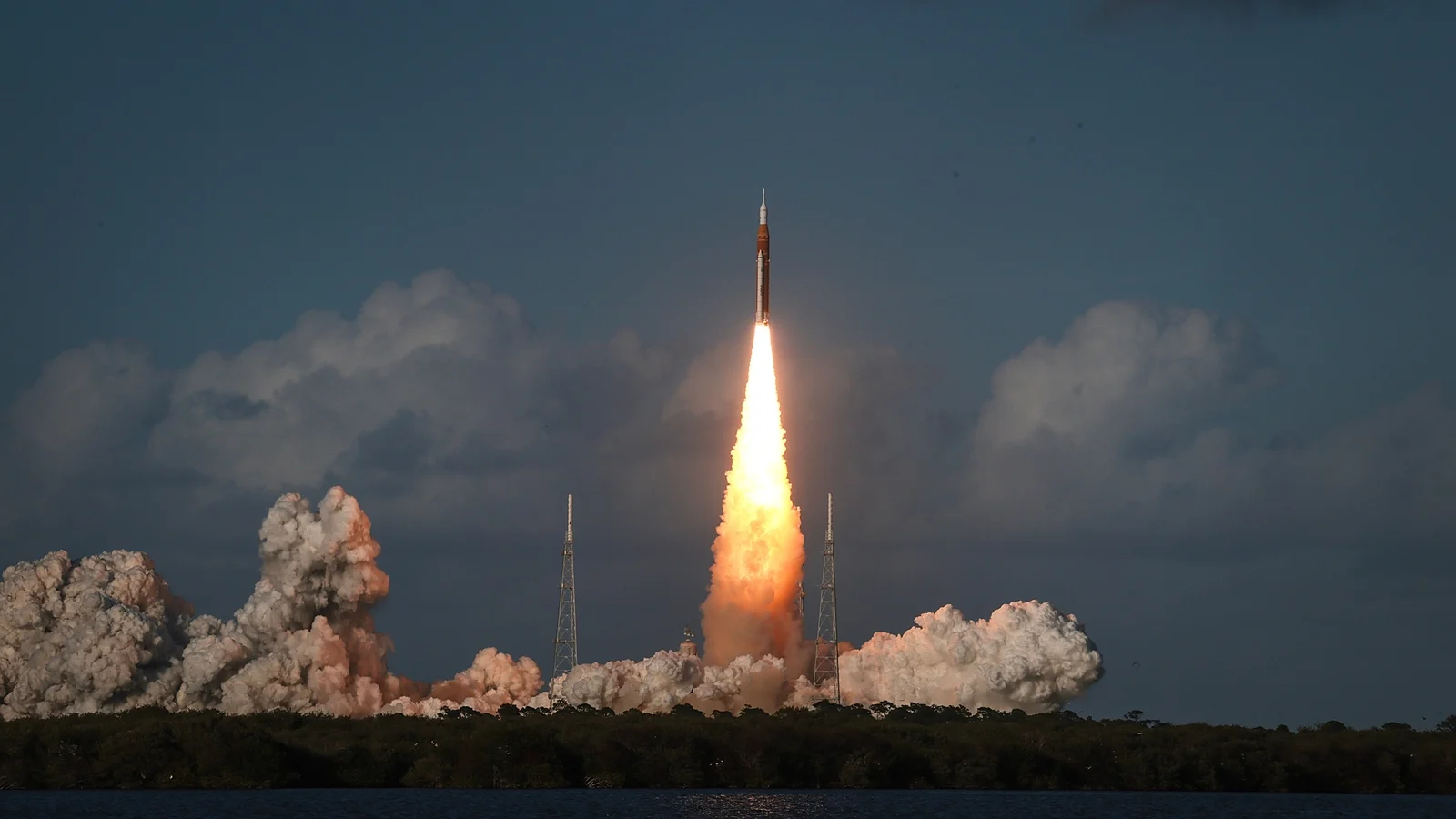
Under an Orange Sky: Humanity’s Return to Lunar Neighborhood
When the sun tipped toward the Gulf of Mexico and painted the Florida sky a molten orange, a sound like thunder rolled across Cape Canaveral. It was not a storm. It was four people leaving Earth.
At sunset, NASA’s towering Space Launch System awakened — flame and fury, steel and sound — and lifted the Orion crew capsule and its four-person crew away from the Kennedy Space Center. For those assembled on the sand and in temporary bleachers, the moment felt less like a mechanical event and more like a story beginning to unfold.
What’s happening: a ten-day voyage beyond the familiar
This mission is a carefully staged rehearsal: roughly ten days, a trajectory that will carry the crew around the far side of the Moon and then home again, a series of systems checks conducted farther from Earth than humans have ventured in more than half a century.
The crew — NASA astronauts Reid Wiseman, Victor Glover and Christina Koch, joined by Canadian Space Agency astronaut Jeremy Hansen — will push systems to their limits, doing things like manually steering the Orion capsule around its spent upper stage should automation fail. It’s a mission that tests both metal and mettle.
Distance matters. This voyage will carry them to nearly 406,000 kilometers from Earth — farther than any human has traveled in decades — eclipsing the roughly 400,000-kilometer mark that marked Apollo-era records. If all goes according to plan, they will return having proven hardware, procedures and international partnerships that must function flawlessly before humanity tries to settle the lunar surface again.
Who’s onboard
- Reid Wiseman — mission pilot and seasoned spacewalker
- Victor Glover — veteran of long-duration missions
- Christina Koch — engineer and record-holder for longest single spaceflight by a woman
- Jeremy Hansen — representing Canada, a symbolic and practical partner
Why this matters — a hinge in a longer story
This isn’t simply a test flight. It’s the new chapter of a program launched in 2017 with a far-reaching ambition: to reestablish an enduring human presence on the Moon as a stepping-stone to Mars. NASA’s Artemis programme is meant to move from demonstration to construction — habitats, logistics, and eventually a surface lander that will take boots back down to lunar regolith.
Plans on the drawing board aim for a crewed landing near the lunar South Pole within the decade. The mission now underway is designed to be the dress rehearsal for that bold step: validate Orion and the SLS, validate crew operations, validate the international choreography of spacecraft, contractors and ground support.
“We’re building the scaffold for an enduring presence,” said a senior mission official at mission control, voice steady over the chatter of telemetry. “This flight proves the pieces talk to one another at distances we haven’t tested with people aboard.”
On the ground at Cape Canaveral: community, ritual and salt air
Locals and tourists sat with folding chairs on the beachfront, the smell of grilled food mixing with diesel and sea spray. Vendors hawked shirts emblazoned with the mission patch. A volunteer fireman, who drove two hours from a town inland, summed up what many felt: “We come for the noise, sure,” he said, “but really we come because something in us still wants to see people do impossible things.”
A few miles back, in a small diner, a waitress wiped her hands and said, “My grandfather saw Apollo. I bring my baby so he can say he saw Artemis.” The layers of generational witness were visible in the faces there: awe, quiet pride, an almost sacred attention to the moment.
Technology, contractors and costs — the heavy lifting behind the spectacle
Behind the cheers are engineers and billions of dollars. The SLS has been years in the making, and its contractors — industry giants like Boeing and Northrop Grumman — have treated this launch as essential validation. Orion, manufactured under Lockheed Martin’s purview with an international service module contribution, separated cleanly from the rocket’s upper stage hours after liftoff as planned.
Artemis missions don’t come cheap. Independent estimates put the cost per SLS-Orion launch in the range of $2 billion to $4 billion, and NASA’s overall budget hovered near the mid–$20 billion range in recent fiscal years. Skeptics ask whether those funds might be spent more efficiently; proponents point to the program’s returns in jobs, technological advances and international partnerships.
“Space is expensive,” said a space policy analyst who has been tracking Artemis. “But investments pay forward — in science, spin-off technology and the inspiration economy. The question is governance: can we coordinate public resources, private innovation, and international partners to make those costs sustainable?”
Geopolitics and partners: a global enterprise with competitive undertones
There’s a geopolitical beat to this narrative too. The United States sees Artemis as reasserting leadership in deep space exploration. International partners — including Canada and Europe — bring expertise, hardware and a stake in the endeavor. At the same time, nations such as China have publicly articulated lunar ambitions of their own, and competition for the Moon is as much about prestige as it is about science.
“This is not just about who gets there first,” said an international relations scholar who studies space policy. “It’s about who sets norms, who builds infrastructure, and who writes the rules on the Moon. Cooperation matters — and competition will shape the next decade.”
Human resonance: more than a mission patch and press release
Flying crews beyond low-Earth orbit after fifty-plus years is a cultural moment. It invites simple, human wonder: What is it like to look back and see Earth hanging in total black? How does seeing our planet, fragile and finite, change a person?
One of the astronauts called down before liftoff — calm and crisp over the link — and said, “We go not for one nation but as part of the human story.” That sentiment echoes in the crowd: a shared belief that exploration, when done responsibly, can knit people together.
And yet the endeavor raises honest questions. Who decides what happens on the Moon? Who benefits from lunar resources? How do we make sure that the next frontier does not reproduce the inequalities we see on Earth?
What to watch next — and what it might mean for you
Over the coming days, the world will watch technical milestones: course corrections, health checks, the re-entry burn and splashdown. Each tick of the mission clock is a test of engineering and coordination. But beyond the telemetry, there are deeper currents at play: the shaping of international partnerships, the balance between public funding and private innovation, and the broader question of why we invest in exploration at all.
Will a renewed human presence on the Moon lead to breakthroughs in energy, materials science, or even climate observation? Will it inspire a generation of students to study math and engineering? Or will it become another arena where wealth and influence determine access?
As you read this from Nairobi, São Paulo, Seoul or Oslo, ask yourself: what do you want the next chapter of space exploration to look like? A race for prestige? A shared platform for science? Or a legacy project that lifts up terrestrial concerns at the same time?
For now, four people are on a voyage that threads technology, politics and a very old human desire to push farther. In a few short days, they will return to tell the tale — and the rest of us will have a little more of the unknown mapped into the known.
Watch the skies. Ask questions. And, if you can, stand with someone and watch the horizon glow. You might just feel what an entire planet has felt before: the simultaneous smallness and grandeur of being alive at a moment like this.