Night of a Thousand Shadows: When the Sky Became a Frontline
There are nights when a city hears only the ordinary sounds—distant traffic, a dog barking, the hiss of a late tram. Then there are nights that fracture time, when the ordinary is ripped away and the horizon itself feels like the front line. Last night, that boundary blurred across a wide swath of eastern Ukraine and spilled over into neighbouring Russia: the sky turned into a conveyor of danger, and people woke to a new kind of fear.
Ukraine’s air force reported what amounted to a rolling aerial offensive — more than 400 long-range drones launched over roughly 24 hours, accompanied by at least ten ballistic missiles aimed principally at areas near the frontline. “We are seeing an unprecedented tempo of strikes,” Yurii Ihnat, a spokesman for the Ukrainian Air Force, told state television, his voice tight with the kind of exhaustion that follows a long vigil.
The Anatomy of an Attack
These weren’t the thunder of massed artillery alone: this was precision, persistence, and a war of machines in the sky. Operators sent swarms of loitering munitions and strike drones across contested airspace, probing air defenses and hunting for soft targets—warehouses, energy infrastructure, apartment blocks near the front.
“It felt like a swarm,” said Anya, a volunteer firefighter who spent the night battling blazes in Kharkiv, Ukraine’s second city. “We’d put one fire out and another would begin. You could hear a different kind of silence after each impact, as if the buildings were holding their breath.”
Kharkiv: A City Punctured by Explosions
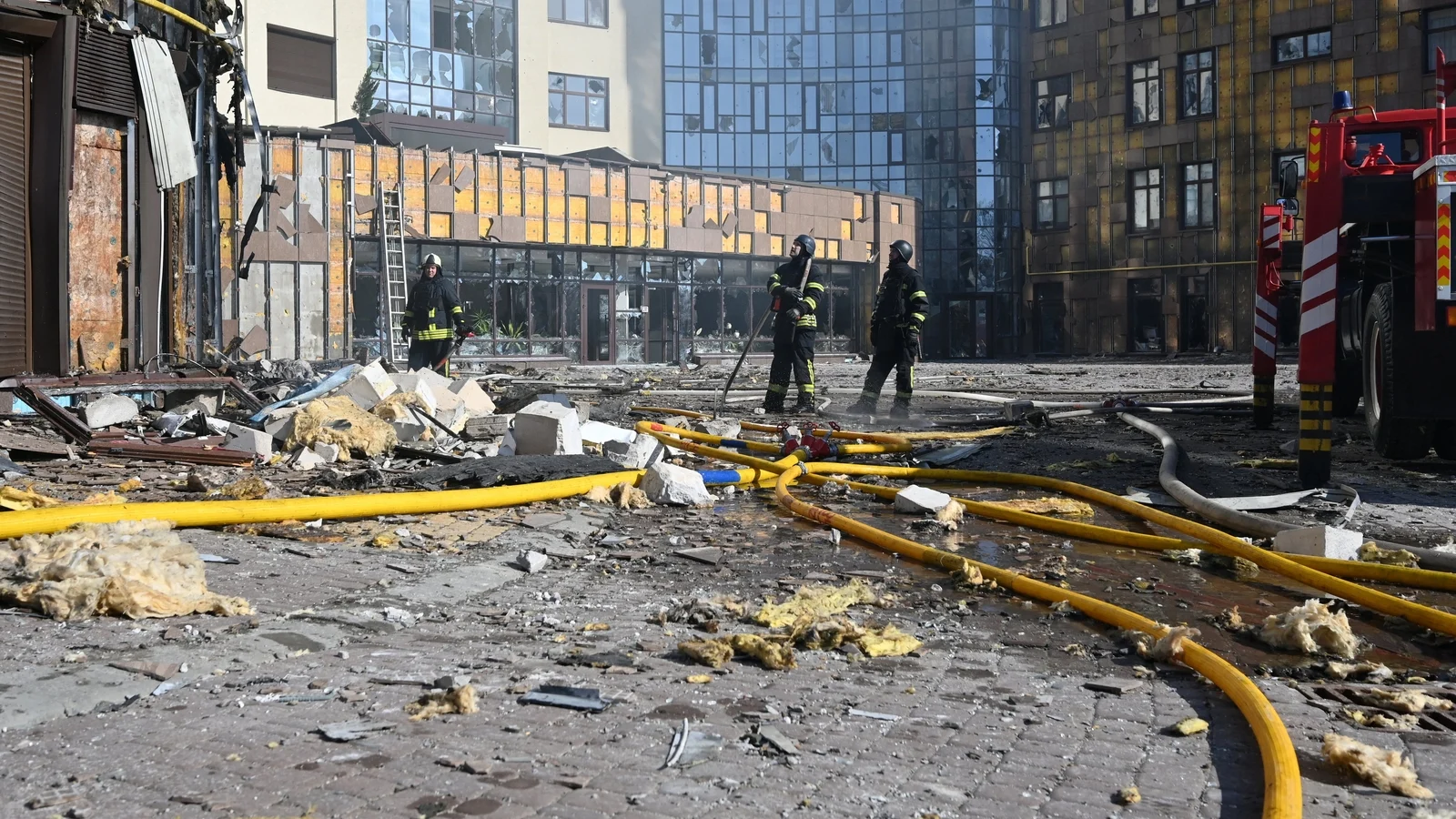
Kharkiv bore a heavy part of the blow. Mayor Ihor Terekhov posted updates throughout the night, describing strikes that hit at least four districts. Local officials said there were roughly twenty confirmed impact sites from drones, some of them in densely populated neighbourhoods. Fires broke out in high-rise apartments, and images circulating on social media showed charred facades, shattered windows and furniture strewn through ruined flats.
Two people were reported injured in the evening assault, including an eight-year-old girl. “We wrapped her in a blanket and tried to keep her warm while we waited for the ambulance,” recounted Olena, a neighbour who helped carry the child down seven flights of stairs. “She kept asking if the sky was angry.”
Scenes like these are familiar now to many Ukrainians: the smell of smoke lodging in stairwells, the ritual of checking cell phone battery percentages to ensure you can call for help, the small libraries of neighbours’ names and where they shelter in a building. Still, each strike reshapes a community’s sense of safety.
Further South: Zaporizhzhia and the Ripple Effect
Further down the map, in Zaporizhzhia, regional governor Ivan Fedorov reported damage to a residential high-rise and a local business; by luck or design, there were no injuries in that attack. But the psychological toll was immediate—residents who had slowly returned to routines hours earlier found themselves packing bags again, preparing to sleep in basements or under stairwells.
“You think you’ve adjusted to the noise, but it always surprises you,” said Maksym, a shopkeeper who keeps his business curtains drawn as a reflex. “You start counting the seconds between an impact and the echo—it’s how you remember where you were.”
Across the Border: Belgorod’s Civilian Toll
The violence did not stop at international lines. In Russia’s Belgorod region, officials said dozens were affected by a string of drone strikes, with 13 people reported injured—11 of them in the border village of Shebekino. The cross-border dimension — attacks landing on both sides — underscores a grim reality: modern conflicts with long-range drones can make geography porous in a way that traditional frontlines did not.
“My grandmother used to say the border was a line you could cross on foot,” said Andrei, a teacher from Shebekino, as he helped clear glass from a shattered storefront. “Now a border is something that can be reached by flying metal.”
Moscow’s Night Watch
Even Moscow’s skyline felt the tremor. Mayor Sergei Sobyanin wrote that air-defence units intercepted a drone heading toward the capital after midnight, along with two others earlier in the day. Whether intended as strategic strikes or provocative incursions, these interceptions are a reminder that major cities, not just front-line towns, now factor into aerial defence calculations.
Voices from the Ground
On a night like this, statistics matter—but human voices carve out meaning. A volunteer medic in Kharkiv, who asked to be called Dmytro, described the hospital corridors as a map of small miracles and exhausted hands.
“We treated burns, contusions, panic attacks. There’s a child on bed 12 drawing pictures with a black marker of a rocket. His drawings are all upside-down,” he said, attempting what sounded like levity in the face of trauma. “You try to make room for humanity in a place that smells of antiseptic and fear.”
An international security analyst in Kyiv, Dr. Marta Serhiyenko, noted what military analysts have been watching for months: “The saturation use of unmanned systems has become a tactical choice. Hundreds of drones in a single operation are not just about physical damage—it’s about draining air defenses, misdirecting forces, and eroding civilian morale.”
What This Moment Tells Us
There are broader themes stitched into last night’s bombardment. Drone technology—smaller, cheaper, and increasingly lethal—has democratized sky-borne strikes. Air defenses, designed for missiles and aircraft, are being forced to adapt to a flood of loitering munitions. For civilians, the front line has metastasized; infrastructure that once seemed beyond reach is now vulnerable.
- Over 400 long-range drones reported in a 24-hour period
- At least 10 ballistic missiles reportedly launched toward frontline areas
- Multiple urban districts in Kharkiv damaged; at least two injuries, including a child
- Damage reported in Zaporizhzhia and cross-border injuries in Russia’s Belgorod region
What does it mean to live under a sky that can be weaponised so readily? How do cities preserve normalcy when the ceiling above them is uncertain? These are not rhetorical questions; they are urgent policy puzzles for governments, planners and humanitarian organisations.
Global Ripples
The strategic shift we’re witnessing is not confined to Eastern Europe. Militaries around the world are watching and recalibrating. Drone proliferation raises legal and ethical questions, from accountability for civilian harm to the arms-control frameworks that have not yet caught up with remote, unmanned lethality.
“This accelerates a global debate about the rules of the air and the protection of non-combatants,” said Dr. Julian Morales, a policy researcher specialising in unmanned systems. “If one conflict normalises saturation drone tactics, others may follow. That’s a dangerous precedent.”
After the Smoke: Resilience and Reckoning
By morning, firefighters were hosing down smouldering apartments in Kharkiv. Volunteers carried blankets and tea to people who could not sleep. A makeshift table near a stairwell hosted a rota of residents serving warm dumplings and offering clothes. Small rituals of care reasserted themselves like stubborn perennials pushing through asphalt.
Still, the damage lingers: broken windows, a child’s trauma, a family’s furniture scattered, a town’s sense of safety frayed. For many who lived through the night, the question is not only how to rebuild what was broken, but how to live forward in a world where the sky can be weaponised with such speed and stealth.
When you look up tonight, what do you see? For some, stars. For others, the underside of conflict. For communities in Kharkiv, Zaporizhzhia and beyond, the sky tells a story of endurance—and an urgent call for solutions that protect people, not just borders.