As a fast-moving Ebola outbreak tightens its grip on eastern Democratic Republic of Congo, UN health chief Tedros Adhanom Ghebreyesus has arrived in the hardest-hit province with a blunt message: the country needs more international support—and stronger trust at community level—to stop the virus.
Speaking to reporters in Bunia, the capital of Ituri province, the World Health Organization director-general said the international community was already assisting the DRC government as it confronts the crisis.
But he stressed that “community ownership” would be decisive, calling for efforts to overcome “mistrust” and misinformation, alongside increased financial contributions from other countries.
“We are here to discuss with the community, to see how the response is running and if there are challenges to help,” he said.
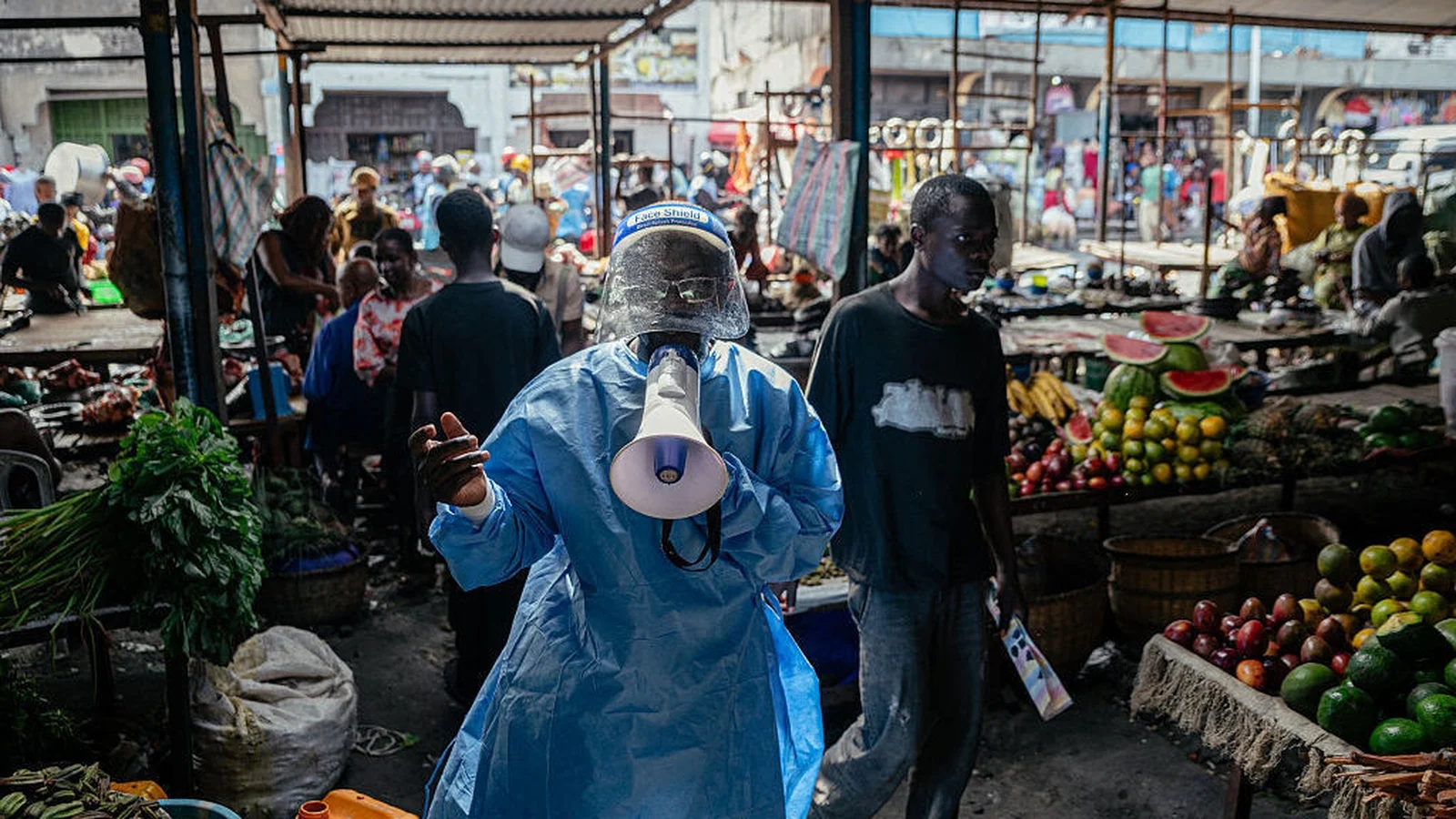
World Health Organization Director-General Tedros Adhanom Ghebreyesus in Bunia
At a later press conference in Ituri, Dr Tedros sought to reassure residents facing a disease that spreads through close contact and bodily fluids. “You’re not alone in this. We’re here, we’re with you, and we will see this through together,” he told people.
The highly contagious haemorrhagic fever has already been detected in three provinces in eastern DRC and has crossed into neighbouring Uganda.
Since the outbreak was declared on 15 May, the Africa Centres for Disease Control and Prevention said on Thursday that the DRC has recorded at least 1,077 suspected cases, including 246 deaths. Uganda has reported nine confirmed infections, including one death.
WHO officials have warned that the outbreak’s real scale in the DRC may be significantly larger, as the virus is believed to have been circulating before it was identified.
The vast, impoverished central African nation—whose mineral-rich east has endured three decades of conflict—has limited laboratory capacity to test and confirm suspected cases, complicating efforts to map and contain transmission.
In response to the growing threat, Uganda this week closed its border with the DRC and imposed a 21-day quarantine on anyone arriving from across the frontier.
Health workers wearing protective equipment are disinfected after leaving an isolation area at a hospital in Mongbwalu
On Friday, the WHO announced a milestone: one patient recovered on Wednesday, left hospital and was discharged into the community after returning two negative tests. WHO’s Anais Legand said the case marked a “first” among patients confirmed as Ebola carriers in the current outbreak.
Ebola has killed more than 15,000 people in Africa over the past 50 years.
The deadliest outbreak in the DRC claimed nearly 2,300 lives from 3,500 cases between 2018 and 2020.
Medical charity Médecins Sans Frontières (MSF) described the latest flare-up as unprecedented in its early trajectory, saying that “never has an Ebola epidemic recorded so many cases in the first days after it being declared”.
MSF also warned that too few medical experts had been deployed to the affected area.
“Two weeks after the declaration of the Ebola disease outbreak in Ituri Province, the situation is deeply alarming and a legitimate source of anxiety for communities and frontline health workers alike,” it said.
Ituri is an especially difficult environment for a public-health response. State services are largely absent, and insecurity—driven by armed groups and militias—restricts access for medical teams and supplies.
Still, Dr Tedros pointed to the country’s experience fighting Ebola and urged a joined-up approach. “There is experience in this country and under the government’s leadership, and especially with community ownership, we can stop it,” he said.
“These are the ingredients which are important, of course, with the support from the international community as well. So the issue is in our hands.
“If we do our best, it can be stopped,” he added.
No vaccine or specific treatment exists for the Bundibugyo strain of Ebola, which is behind the current outbreak.
However, the head of the CDC Africa said on Thursday that a vaccine should be ready by the end of the year.
Read more: WHO announces first confirmed Ebola recovery in DRC outbreak
The WHO said its specialists had reviewed several possible vaccines judged “promising enough” to move toward evaluation in clinical trials.
“In the meantime, our priority is to stop transmission with tools that we have used for decades of Ebola responses, which include disease surveillance, rapid testing and diagnosis, contact tracing, isolation and care for patients, infection prevention and control, community engagement, and safe and dignified burials,” it said in a statement.
North and South Kivu—two other provinces reporting Ebola cases in the outbreak—have also been battered by near-continuous violence for three decades.
Large parts of the affected region are controlled by the Rwanda-backed armed group M23, which has been fighting government forces.
The conflict has driven millions from their homes, forcing families into displacement camps where poor hygiene conditions heighten the risk of disease spread.
Nearly a million displaced people are in Ituri province, and fears are rising that the epidemic could sweep through crowded camps.