Nikopol at Dawn: A Market Silenced by a Drone
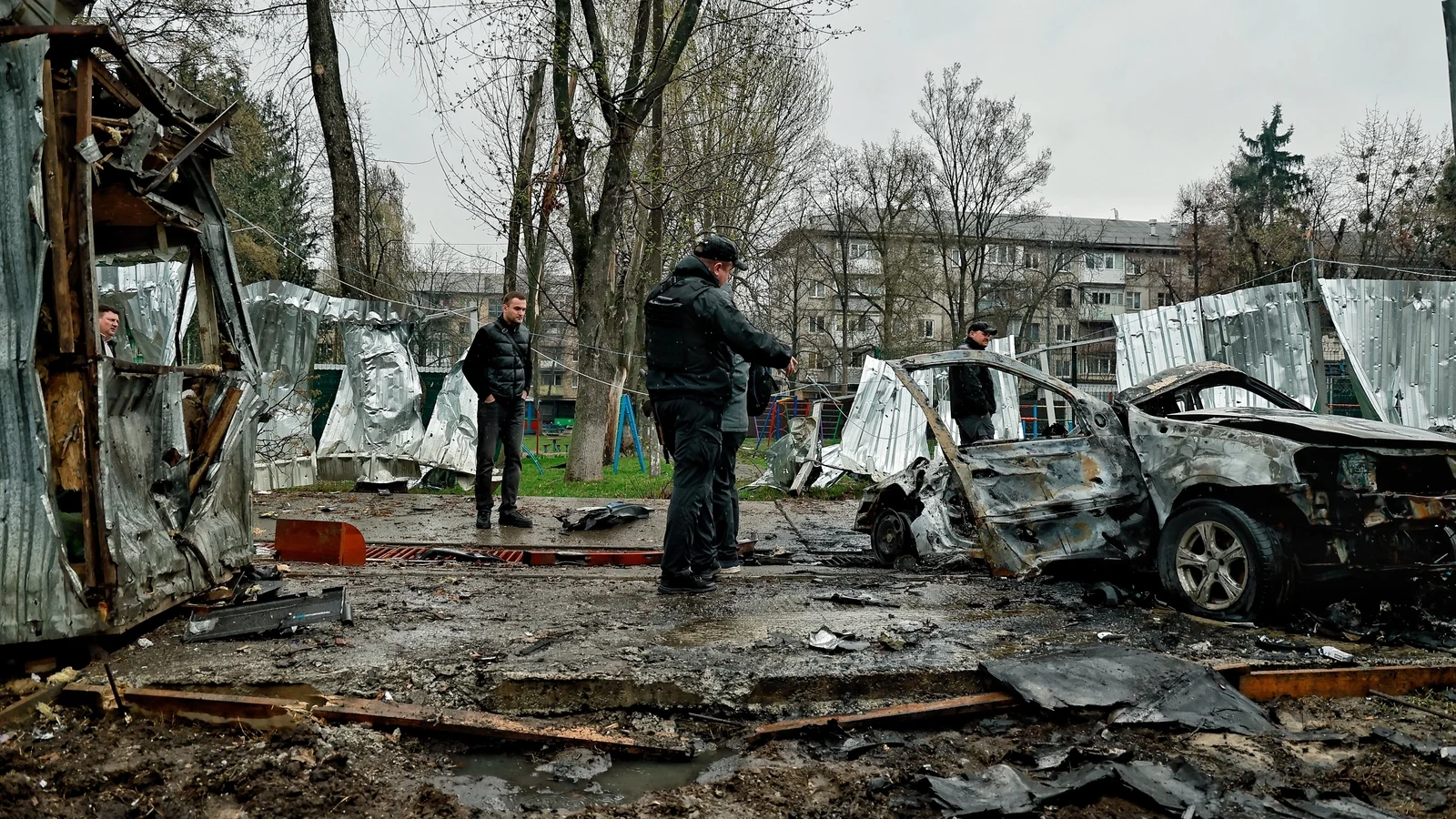
The sun was just finding its way across the Dnipro, turning the river into a strip of molten silver, when the market in Nikopol—normally a noisy quilt of voices, clattering stalls and frying oil—was ripped apart by a drone strike.
Five people died. Nineteen others were wounded. Among the injured was a 14-year-old girl in critical condition, hospital staff told local authorities. The prosecutor general’s office called the attack “yet another war crime,” and the regional governor, Oleksandr Ganja, named the victims as three women and two men.
Walk through Nikopol any morning and you will smell coffee, sunflower oil, and fresh bread. You will see women in headscarves bargaining over cabbages, fishermen hauling crates by the river, and teenagers on the edge of school, clutching backpacks. This is a frontline town—its skyline punctured by the knowledge that across the river, a few kilometres away, lies territory held by occupying forces. The omnipresent question—will today be the day?—is spoken in small, resigned gestures more often than in words.
Scenes from the Rubble
“She sold dumplings here for twenty years,” said Maria, 42, crouched beside a ruined stall, her apron still clotted with grease. “People came for her vareniki every Saturday. Now there’s just a blanket and two shoes. How do you explain that to a child?”
Bodies were pulled from the rubble by volunteers and rescue teams within hours. An ambulance siren became the town’s new morning chime. Eyewitnesses described a shower of broken glass, smoke curling up over the stalls, and the low, stunned murmur of people who had been hit in the only place they trusted to buy food.
“Markets are where life is lived,” said Ihor, a teacher who helped carry the wounded. “They are not military targets. Yet here we are, keeping count of names instead of making plans for the spring harvest.”
Across the Border: Violence Returns the Favor
Meanwhile on the Russian side of the frontier, the port city of Taganrog in the Rostov region reported its own tragedies. A drone and missile attack killed one person and seriously wounded four, regional governor Yuri Slyusar said. Falling debris also struck a foreign-flagged cargo vessel in the Sea of Azov, igniting a fire; air defences were reported to have intercepted other incoming drones over Taganrog Bay.
“A missile hit a commercial facility,” Slyusar wrote. “We are treating the wounded as critical.” He did not specify who launched the attack.
For residents of both countries, this tit-for-tat violence has become a brutal rhythm. Kyiv has carried out strikes into Russian territory in response to cross-border attacks and strikes that, since the full-scale invasion in February 2022, have been almost daily for many communities. Each strike begets another; each civilian casualty piles on the collective trauma.
The Wider Toll
How many people have been hurt by this war? The numbers stagger. International monitors and humanitarian agencies estimate that since February 2022, millions have fled their homes and tens of thousands of civilians have been killed or injured. Whole towns have been transformed into zones of caution, their marketplaces, schools and hospitals turned into potential targets.
“When conflicts move into the cities, infrastructure becomes a battlefield,” said Olena Kovalenko, a security analyst who tracks aerial warfare. “Drones are cheap, quiet, and increasingly capable. They turn everyday public spaces—market stalls, bus stops, apartment courtyards—into vulnerable points in seconds.”
That calculus is visible in Nikopol. The town’s proximity to the occupied bank of the Dnipro makes it a regular target. The river, which should be a lifeline, has instead become a front line—its banks surveilled, its crossings perilous.
Local Lives, Global Patterns
What is happening in Nikopol is not just a tragic local event; it is a manifestation of larger shifts in modern warfare.
- Urbanization of conflict: Fighting now happens in dense civilian spaces, where the lines between combatants and civilians blur.
- Proliferation of drones: The use of unmanned aerial systems by state and non-state actors has democratized aerial bombardment.
- Maritime risk: Attacks in and around the Sea of Azov add another layer of danger for commercial shipping and the global supply chains that rely on these routes.
“This is an era where you don’t need a fleet to hit a port,” Kovalenko said. “You need a drone, patience, and a GPS signal.”
Human Stories Beneath the Headlines
At the town’s community center, volunteers gathered donated clothes and blankets. A math teacher organized lists of names. An elderly man, who asked only to be identified as Petro, put his hand to his chest and said, “We grew up with this river. We got married here. Our children learned to swim here. Now the sound of a drone makes me think the worst.” His voice broke on the last word.
These intimate scenes are easy to overlook when the world is scrolling through breaking-news alerts and satellite images. Yet they matter. They are the small centers of life that war touches—and often shatters.
Legal and Moral Ripples
The prosecutor general’s office in Kyiv labeled the market attack a war crime. International law is supposed to offer some protection: targeting civilians is prohibited, and parties are required to distinguish between military objectives and civilian objects.
Legal experts warn, however, that gathering evidence in the field is an uphill task. “Documenting intent, proving command responsibility—these are complex, resource-intensive processes,” noted Dr. Marta Sokol, a human-rights lawyer. “But they are essential if accountability is to follow conflict.”
Whether any case stemming from Nikopol will yield prosecution remains to be seen. Meanwhile, the bodies are buried, the injured are treated, and the small mercies of neighbors continue: a shared loaf of bread, a hand on a shoulder, an offer to watch a child when parents are hospital-bound.
What Do We Do Next?
Ask yourself: how do you measure compassion in wartime? Is it the international sanctions and statements of condemnation, or the neighbor who arrives with a thermos of soup? Both matter. Institutions set the rules; people sustain life.
For residents of Nikopol and Taganrog, the questions are immediate and practical—Where will we buy food tomorrow? How will children get to school? For those farther away, the questions are larger and moral—How do we respond to suffering we see on a screen? How do we keep the focus on civilians, not just front-line positions?
There are no easy answers. There are, however, choices: to listen, to give, to press leaders for diplomacy, and to keep bearing witness. In the end, stories like Nikopol’s ask us to remember that war is not only a contest of missiles; it is a contest over memory, decency, and the right of ordinary people to live ordinary lives.
After the Smoke Clears
By nightfall, the market square in Nikopol was eerily quiet. A single lamp flickered above the rubble. Volunteers still moved quietly, clearing glass and salvaging what they could. Somewhere, a radio played an old folk song, and for a moment the melody softened the edges of grief.
“We will rebuild the stalls,” Maria said, eyes fierce with a resilience that is both weary and stubborn. “We have to. Markets are who we are.”
Her words linger—both a promise and a challenge. As readers, what will we do with that promise? Will we carry it beyond the headline, into the next conversation, the next donation, the next vote? Or will the momentum of outrage fade like so many morning headlines?
For the people of Nikopol, the answer is not theoretical. It is the slow, stubborn work of putting life back into the places where it was taken away.