When Humans Turned Their Heads and Saw the Moon Anew
There are moments when the universe does something modest and magnificent at the same time: it offers a fresh angle. For the four astronauts aboard Orion, the third night of their journey felt like that—quiet, intimate, and quietly epochal. Far from the chatter of mission control and the static hum of life-support systems, they closed their eyes under a canopy of electronic stars and woke up to a view no human had ever truly held.
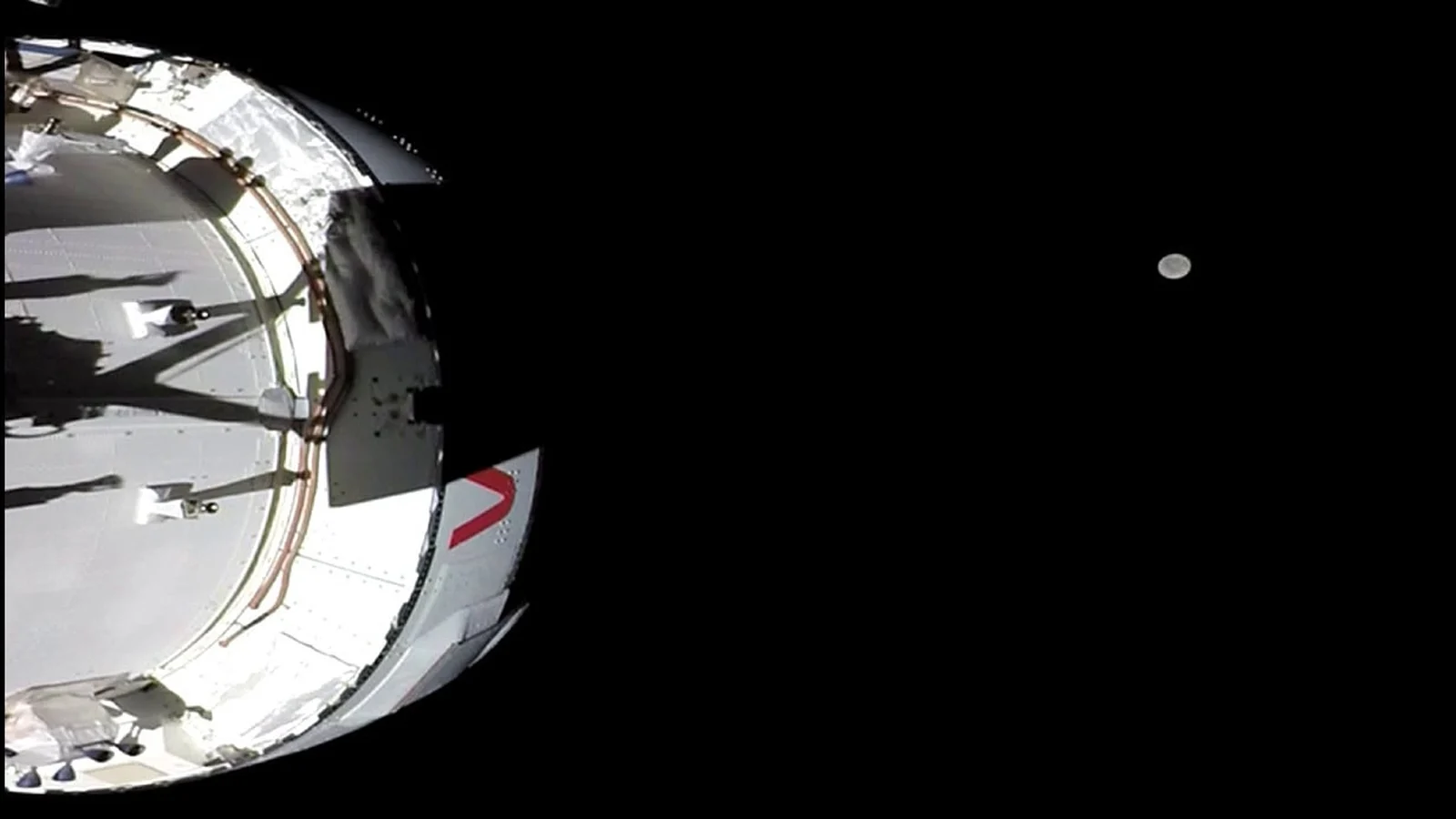
At roughly two-thirds of the way between Earth and the Moon—about 322,000 kilometres from home and 132,000 kilometres from lunar soil—Artemis II’s crew peered into the dark and unrolled a geological story frozen in rock. NASA released an image from the spacecraft that shows the Orientale basin, the Moon’s great concentric wound, meeting the edge of the lunar disk like a bulls-eye painted in stark relief. For the astronauts, and for the rest of us watching on screens, the sight landed with the weight of history and the lightness of wonder.
The Orientale: Moon’s “Grand Canyon”—Seen by People for the First Time
Orientale is not quaint. It is a multi-ringed, impact-scarred basin nearly 930 kilometres across—more a continent than a crater. Robotic orbiters have photographed its rings before, but the recent image marked the first time an unmediated human gaze could claim it. “It’s very distinctive,” one mission specialist told a live audience of schoolchildren by video call, “and no human eyes previously had seen this crater until today.”
Picture the eclipse of texture: concentric ridges like ripples frozen in stone, shadowed floors and jagged rims bathed in the cold clarity of space. The impression is not just scientific; it’s almost literary, a reminder that the Moon keeps a slow memory of violent events that rewrote its skin billions of years ago.
Why This View Matters
There is technical importance here as well. Apollo astronauts orbited low—roughly 70 miles (about 113 kilometres) above the surface—allowing them to study small swaths and touch down in specific places. Artemis II will swing much wider, approaching to about 4,000 miles (≈6,400 kilometres) at closest approach, giving crewmembers an all-encompassing view: full lunar disk, both poles, and vast far-side territory previously seen only through robotic lenses.
“Last night, we did have our first view of the Moon far side, and it was just absolutely spectacular,” one of the flight engineers said during a broadcast from the spacecraft. John Honeycutt, who manages NASA’s Space Launch System program, pointed out that some features on the left edge of the latest image had never before met human sight—a milestone that reads like a small correction in the human narrative of exploration.
Inside Orion: Eggs, Shrimp Cocktail, and a Little Homesickness
Up close, the mission has the humanness of any long trip. Mornings start not in a hotel bathroom but with floating scrambled eggs and a coffee pouch. The crew woke one day to a cheerful wake-up call: Chappell Roan’s “Pink Pony Club.” Onboard menus have a touch of celebration—small bags of shrimp cocktail appeared during a Q&A with children in Canada, eliciting laughter and a chorus of “oohs” from viewers around the globe.
“We’re up here, we’re so far away, and for a moment, I was reunited with my little family,” the mission commander said during a press conference, his voice thick with the kind of happiness that makes you feel the distance between him and two little girls back home. “It was just the greatest moment of my entire life.”
There is also serious preparation woven into the everyday. The astronauts have been trained as field geologists—tasked with photographing and describing lava flows, impact craters, ancient mare, and the kinds of surface textures that can tell a planetary story. They ran a manual piloting demonstration, reviewed their flyby photography plan, and practiced emergency medical techniques in cramped quarters—CPR between cushions and console panels, a reminder that there’s a practical choreography to staying alive in orbit.
A Networked Audience: Schoolchildren, Engineers, and a Global Living Room
Across national borders the mission has become a communal watch. In an Ottawa classroom, a teacher described the moment children saw the live feed: “They fell silent, the kind of silence that grows when a story is being told.” A small fishing village in Newfoundland reported that locals gathered outside the community centre to craned necks at the sky and then huddled around a laptop. In Houston, mission control relayed both telemetry and human tenderness; an engineer admitted he teared up seeing the Orientale rings, then laughed at himself for being cliché.
“It’s a weird mix of the technical and the tender,” said a flight systems engineer speaking from mission control. “One minute you’re troubleshooting a guidance algorithm; the next you’re trying to explain what a 3.8-billion-year-old crater looks like to a ten-year-old who just asked if it has dinosaurs.”
Beyond the Flyby: Why Artemis Still Matters
Artemis II is a waypoint, not a destination. It sits squarely inside a larger plan: to build a sustainable human presence on and around the Moon—small habitats, solar arrays, perhaps a gateway in lunar orbit that becomes a staging post for Mars. The program is both a technical rehearsal and an act of cultural renewal. It asks what it means in the 21st century for multiple nations and communities to share a vision of space as a commons, not a conquest.
There are also records waiting on the trajectory charts. If trajectory corrections unfold as planned, these astronauts could become the farthest-flung humans in history, nudging past records set in the Apollo era. If that happens, it will be more than a number; it will be a measure of confidence that our species can again stretch beyond a single planet.
Looking Up, Looking Forward
As I write this, you might find yourself glancing at the night sky more often, waiting for a sliver of brightness or a remembered face from a life you live on terra firma. What do we owe the moment when the ordinary becomes extraordinary? Maybe it is patience: to let an image of an ancient impact basin sit with us for a while. Maybe it is curiosity: to ask what else the Moon’s quiet surfaces can teach us about our own planet and our place in the cosmos.
If nothing else, Artemis II is an invitation—to children asking questions from classrooms, to engineers debugging code at 3 a.m., to families who spent a few minutes on a live stream whispering “there they are”—to imagine a future where the Moon is not simply an object in the sky but a shared chapter in a human story still being written. Who will be the next to look up, and what will they see that changes the way we see ourselves?