A Pacific Evening, a Tiny Capsule, and the Whole World Holding Its Breath
Just after golden hour on a cool San Diego evening, the horizon over the Pacific looks like any other — gulls wheel, fishing boats bob, families stroll along the Embarcadero with coffee and the soft clack of camera shutters. But tonight the rhythm of the sea is a metronome for something much older and wilder: the safe return of four people who spent ten days whittled down to the shape of a single, blazing point of light against the black.
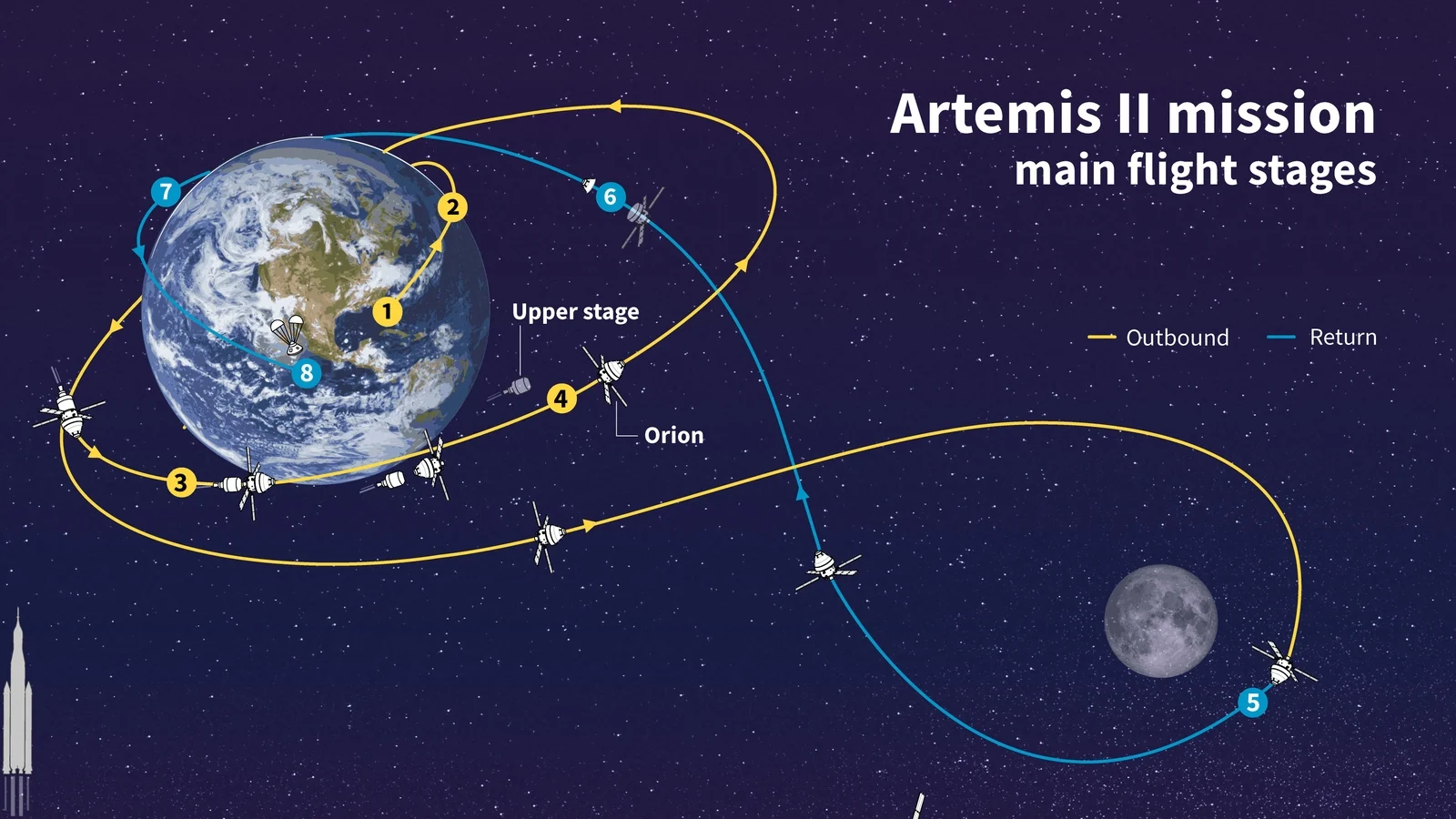
At 5:07 p.m. local time, Orion is scheduled to meet the ocean. For astronauts Reid Wiseman, Victor Glover, Christina Koch and Canada’s Jeremy Hansen, the splashdown is not merely a landing; it is the crucible of the mission — the moment that tests everything engineers, technicians and families have prayed would hold. For the rest of us it is a spectacle, a relief, an invitation to remember how small and astonishing we are.
The Long Arc of a Short Voyage
Their ten-day circuit around the Moon produced images that will live long in the public imagination — the Earth as a blue coin in a coal-black sky, rilles and highlands etched with impossible clarity, a solar eclipse witnessed from a vantage point most humans will never travel to. But this was also, in NASA’s terms, a test mission: a trial run for hardware and procedures meant to take people beyond lunar flybys and toward actual landings in years to come.
“Every mile we put between the capsule and home is a proof point,” said Amit Kshatriya, NASA’s associate administrator, speaking at a late briefing. “We design for extremes; we hope to never see them. Tonight we’ll find out how well our design holds up when everything is pushed to the edge.”
That edge is literal. During re-entry, Orion will be shearing through the atmosphere at nearly 11 kilometers per second — roughly 34,965 feet per second, and about 30 times the speed of sound — creating a wall of heat that briefly reaches around 5,000 degrees Fahrenheit, or roughly 2,760 degrees Celsius. The heat shield that keeps the crew alive does so by ablating — by intentionally eroding away, carrying heat with it. That same shield surprised engineers on an earlier uncrewed flight when it eroded in ways the models hadn’t predicted. For Artemis II, NASA altered the re-entry corridor and leaned on months of additional testing.
Why the Heat Shield Matters
The physics is breathtaking in its simplicity and horror: a small capsule hurtling into a sea of air that wants to strip its kinetic energy in the most violent manner possible. “If the shield does its job, it’s quiet heroism,” said an aerospace engineer I spoke with in Houston, pinching the bridge of his nose as if to steady the word. “If the shield fails, the rest of the mission is academic.”
NASA officials stress their confidence. “Our ground testing, flight data and updated models point to a robust system,” Kshatriya told reporters. “But the human element — the crew trusting those calculations — is its own kind of bravery.”
Families, Friends and a City Waiting
Back on land, the waiting is as human as any movie scene. Mission control in Houston reserved a corner of the control room for family and close friends; they will be among the first to clap eyes on their loved ones once Orion is hoisted aboard the recovery ship. “It has been a very emotional week,” Catherine Hansen told me over the phone, her voice soft and steady. “We have lived between joy and a kind of gnawing anxiety. You do the math in your head — all the systems and checklists — but some nights you just hold the photograph and hope.”
Down in San Diego, a cluster of local fishermen and marina workers have staked out the shoreline, more out of curiosity than a technical interest. “I’ve watched Navy recoveries before,” said Luis Marquez, who runs a bait shop at Point Loma. “But when you think about someone coming back from the Moon — that’s different. My grandson’s been asking a thousand questions. He wants to be an astronaut now.” The city, modest and unshowy, wraps the spectacle in everyday texture: tacos steaming from a truck, a dog chasing a frisbee, and the distant horns of ships that will one day help pull the capsule safely from the water.
Milestones, Representation, Meaning
This mission arrived with lines of firsts stitched into its narrative. Victor Glover became the first person of color to complete a lunar flyby in the modern era. Christina Koch held the mantle of a woman navigating beyond low Earth orbit. Jeremy Hansen represented Canada in a way that reminds us: space programs are increasingly international in both makeup and ambition.
“Representation matters in rooms we cannot yet occupy,” said Dr. Amina Okoye, a sociologist who studies STEM pipelines. “When kids see faces and names that reflect them in the context of valor and exploration, it expands the possible. It’s the social architecture of future missions.”
Those human stories are threaded through the technical details. The mission gathered high-resolution data on lunar geology, tested life-support systems in sustained deep-space conditions, and observed micro-meteorite impacts and solar activity — all building blocks for future endeavors that may include sustained lunar habitats and even missions to Mars.
What Success Looks Like — And When We Can Truly Say It
NASA has been careful with its language. “We’ll start celebrating when the astronauts are in the medbay aboard the recovery ship,” Lakiesha Hawkins, a senior NASA official, reminded reporters. It’s a candid admission: spaceflight is spectacular but unforgiving. Success is not a photograph of a capsule drifting peacefully; success is measured in a litany of small, crucial checks — parachutes deployed within margins, heat shield performance within model tolerances, no anomalies during the complex choreography that is splashdown and naval retrieval.
And then, for the moment the public craves, there will be hugs and the first intake of salty air and jokes about the food aboard Orion. Commander Reid Wiseman said in a quiet moment during a press availability that he hoped, if only for an instant, people would stop and look up. “We flew out there and spent some time looking back,” he said. “If that invites even a million people to feel a little more stewardship for this pale blue dot, then that’s worth everything.”
Broader Questions
What does it mean for us to push back into deep space now — in an era of climate urgency, growing geopolitical tensions, and technological abundance? Is lunar exploration a distraction, or a unifying human project that equips us to manage Earth better? The answers are not binary.
Exploration has always been an amplifier of capacities: new materials, communications, medical practices and a cultural vocabulary that can inspire policy. It can also be a mirror — reflecting priorities. “If we can see Earth as fragile from the Moon, perhaps we can govern it with more care,” Dr. Okoye suggested. “But that requires policy, funding and, crucially, political will.”
Waiting, Watching, Wondering
Those of us onshore — in San Diego, Houston, Ottawa, or anywhere else — are participating in a ritual older than written history: we wait for travelers to return from the unknown. Maybe you will watch the splashdown live, or maybe you will scroll past the clip tomorrow and keep living. Either way, the image of a small capsule bobbing in the Pacific will be a reminder that humanity keeps pushing outward even as we struggle inward.
Will the heat shield do its quiet work? Will parachutes blossom like great white flowers? Will there be hugs and relief and the sudden, wonderful banality of chips and soda aboard a recovery ship? These are the things I’m watching for — not because the gizmos are glamorous, but because the people inside them are ours.
Tonight we test our machines and our nerve. Tomorrow we will measure the lessons and decide how to take them forward. And somewhere between the technical readouts and the family embraces, we might find reasons to cherish this planet anew. Wouldn’t that be a success worth celebrating?