Smoke on the Pan-American: A Highway, a Crater, and a Country on Edge
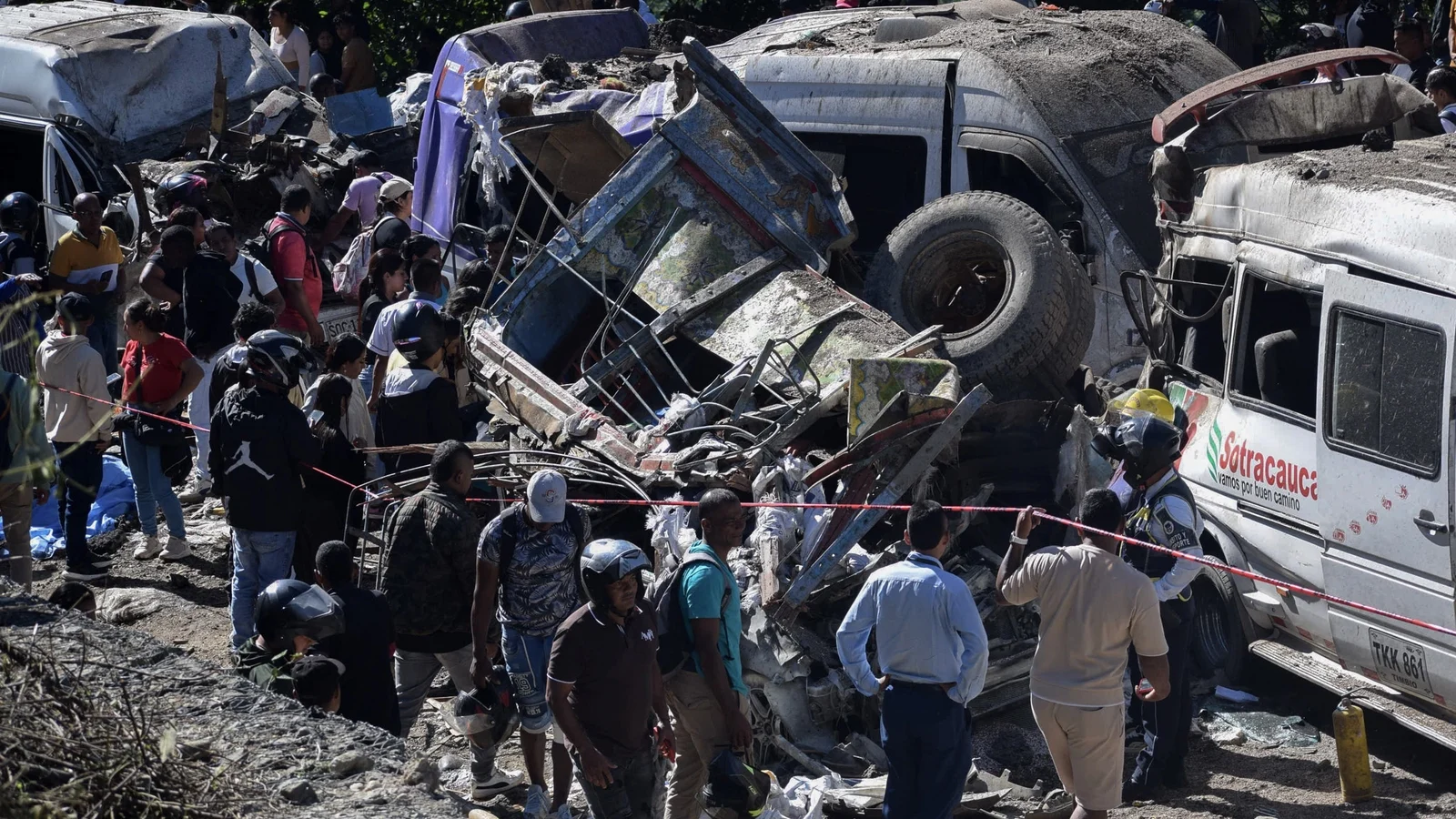
They describe it as if the road itself had been torn open. Soot-blackened buses leaned like broken toys in the dust, a yawning crater scarred the asphalt, and the air tasted of diesel and fear. On a stretch of the Pan‑American Highway that stitches together the restless southwestern department of Cauca, a bomb detonated with a force that sent ripples through communities already accustomed to living on the fault line of Colombia’s long conflict.
By the next morning Colombia’s National Institute of Legal Medicine and Forensic Sciences reported it was examining 19 bodies. The Cauca governor’s office put the immediate death toll at 14 and confirmed more than 38 wounded. Witnesses and rescuers arrived to overturned cars, twisted metal, and the kind of silence that follows a sudden, public violence.
The scene—and the signal
“I heard a sound like the mountain falling,” said Diego, a farmer from a nearby village who walked the stretch of highway at dawn. “When I got there, people were screaming, and smoke was everywhere. The road looked like it had been swallowed.”
Military officials described a calculated ambush: assailants reportedly blocked the highway by parking a bus and another vehicle across the lanes, forcing traffic to stop before the explosion. Colombia’s military chief, General Hugo López, called it “a terrorist attack against the civilian population” at a press briefing, framing the blast as more than a single act of violence—it was an attempt to terrorize everyday life.
For the people of Cauca, however, the blast was also a brutally familiar note in a longer, sadder song. This is a region scarred by decades of armed actors—leftist guerrillas, right‑wing paramilitaries, and criminal bands—each with roots in narcotrafficking, illegal mining, and extortion. A single headline can’t convey the slow grinding pressures of roadside checkpoints, forced displacements, and threats to local leaders. But a crater in the highway does something else: it refuses to be ignored.
A countdown to the ballot box
The timing is painfully explicit. Colombia is a month away from national elections scheduled for 31 May, when voters will select a successor to President Gustavo Petro. Security has become a top electoral issue, and an attack that kills civilians on a national artery can have a chilling effect on turnout and public confidence.
“They want to shape the political map by blood,” said Ana María Rojas, a schoolteacher in a town near the highway. “If people are afraid to go to the polls, the ones who profit are the armed groups.”
President Petro himself used social media to condemn the bombing, labeling those behind it “terrorists, fascists and drug traffickers,” and urged the military to increase pressure on criminal networks. He pointed fingers at Iván Mordisco, whom the president has described in the past as one of the most wanted criminal leaders in the country. Whether the attribution will stand up under investigation, and whether it will alter the political climate before voters gather, remains unclear.
Violence on the rise—what the numbers say
The recent blast is not an isolated incident. Authorities documented a string of attacks in Valle del Cauca and Cauca in the days surrounding the bombing—26 recorded incidents over two days, according to Defense Ministry briefings—following a separate bomb attack at a military base in Cali that injured two people the prior Friday.
These incidents map onto broader, stubborn realities. The 2016 peace accord with the Revolutionary Armed Forces of Colombia (FARC) dramatically reduced the footprint of one of the country’s largest guerrilla armies, but not all fighters accepted the deal. Dissident factions have since evolved into criminal enterprises, moving into drug production, trafficking, and local extortion. Experts estimate thousands of dissidents remain active, embedded in territories where the state’s presence is weak.
People on the ground: fear, anger, resilience
At a temporary shelter set up beside the highway, volunteers handed out thermoses of coffee and wrapped injured travelers in blankets. “We took two buses full of people to the town square,” said Javier, an emergency worker with the municipal civil defense. “You never get used to the sight of blood. But you learn how to act fast.”
Local leaders spoke with a tone that mixed fatigue and defiance. “The bomb was meant to break us,” said Rosa Santos, an Afro‑Colombian community organizer. “But people here wake up every day and rebuild. We will not let violence decide our future.”
Others were less sanguine. A shopkeeper in a small market called El Rosal, who asked that only his first name, Mario, be used, said: “People are talking about leaving. My nephew got a message last week from someone telling him to stop working with a candidate or else. Now this—how can we have a real election when fear is part of the campaign?”
Voices from the capital
Analysts in Bogotá have been watching these escalations closely. “What we are seeing is a multipronged strategy,” said Dr. Alejandra Ríos, a security analyst specializing in insurgent behaviors. “Armed groups aim to destabilize the pre-election period, to undermine trust in state institutions, and to force concessions through intimidation. This is not only about territory; it’s about narrative.”
Ríos emphasized that the reach of dissident groups has been facilitated by lucrative illicit economies and long-standing social grievances in rural zones. “Without comprehensive state presence—schools, roads, legal economic opportunities—these groups can fill a vacuum. The bomb on the highway is a dramatic manifestation of those dynamics.”
Politics under pressure
Security is shaping campaign rhetoric. Leftist Senator Iván Cepeda, who has defended negotiation strategies with armed actors, currently leads in some polls, while conservative figures such as Abelardo de la Espriella and Paloma Valencia have promised tougher action against rebels. All three major contenders have reported death threats and have been campaigning under heavy protection.
Last year’s shooting of conservative frontrunner Miguel Uribe Turbay—wounded in broad daylight while campaigning in Bogotá—reminds Colombians how quickly political speech can turn to bloodshed. The question now is whether the state can ensure a peaceful process that allows citizens to vote without fear.
What comes next?
In the immediate term, authorities have bolstered military and police presence in vulnerable zones, and investigations are underway to establish responsibility. But boots on the ground are only part of the solution, experts warn. Long-term stability demands jobs, justice, and institutions that reach the countryside. It requires reducing the economic incentives of illicit markets and protecting local leaders who often pay the highest price for speaking out.
So, where does a nation go from the edge? Can a bomb on a highway be a turning point that spurs a deeper commitment to the rule of law, or will it harden divisions and hand more power to violent actors? Those are not just political questions; they are human ones, asked by families who have lost loved ones and by towns that now have a crater in their main road.
“We will mend the asphalt,” said Mayor Luisa Calderón of a nearby municipality, staring at the rocks and ash. “But mending the trust will take longer. Our hope is that voters will choose a future where fear does not decide who governs.”
As Colombia approaches its next vote, the country watches a single, fractured highway as if it were a mirror—reflecting both the scars of the past and the choices that will shape the road ahead. What would you do if your ballot might make a difference to whether that road stays intact or splits open again?