When a Quiet Morning in Leipzig Was Fractured: A Street, a Car, and Questions That Won’t Let Go
There are streets that wear history like a coat — cobbles smoothed by centuries of footsteps, façades that remember markets and marches, cafés that know the local rhythm. Grimmaische Straße in Leipzig is one of them: a broad, sunlit pedestrian avenue in the old town, lined with shops and the kind of cafés where morning regulars exchange news with their cappuccinos. It was here, in that ordinary urban chorus, that a car suddenly became an instrument of violence, careering down the promenade and into people who had not expected to become targets of fate.
By evening, two people were dead, dozens shaken and injured, and the question “Why?” hung over the city like smoke. Police arrested a 33-year-old German man at the scene; authorities later named two victims by age — a 63-year-old woman and a 77-year-old man — and said about 20 others suffered lighter injuries. The driver reportedly stopped of his own accord and is being investigated on suspicion of murder and attempted murder.
The scene: sirens, shards of glass and coffee cups
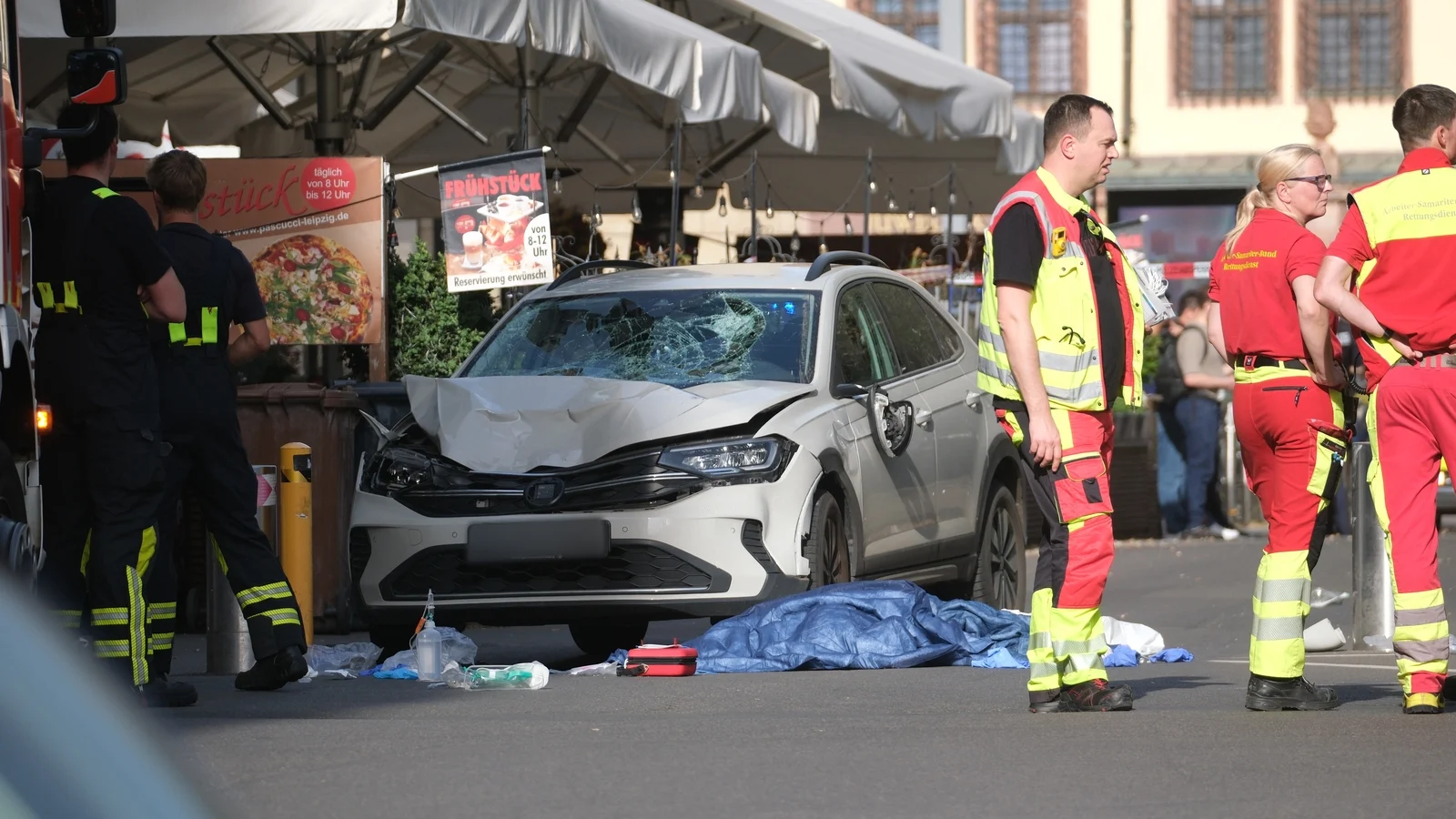
Row upon row of emergency vehicles converged on the cobbled lane. Television shots picked out a white car with a shattered windshield and a crumpled hood; firefighters, paramedics and two helicopters were on site. A police cordon fence separated the chaos from the city’s pedestrian life. Yet within hours, people were sitting again at terrace tables a short distance away, nursing hot drinks, blinking at a newsfeed that had outrun the smell of petrol and the sharp metallic tang of trauma.
“I was coming back from the bakery,” said Jana, who works at a nearby bookshop. “There was this sound like someone pushed a garbage truck into a concert — a sickening, grinding sound — then screams. You never imagine any of this here.”
Another bystander, an elderly man who asked not to be named, touched his chest and said: “You walk these streets for fifty years and you never think the path home will suddenly not be safe. It rattles your bones.”
Officials speak, but motive remains elusive
Saxony’s state leader, Michael Kretschmer, described the episode as something that “shakes me to the core” and vowed a thorough investigation: “We will do everything in our power to investigate it quickly and fully. The rule of law will act with all due rigour.”
State interior minister Armin Schuster used the German term “Amokfahrt” — a phrase that captures the particular horror of a vehicular rampage. “These acts are often associated with psychological instability,” he said, while cautioning that motive must be established by police and prosecutors, not assumed in headlines.
Police themselves said there was “no basis on current knowledge” to assume a political or religious motive. For now, investigators are piecing together the hours before the crash, forensic teams combing the scene, and prosecutors preparing to assess whether the suspect acted alone — as officers have currently concluded — and what charges will be brought.
Voices from the street: grief, anger, bewilderment
In the days after the crash, the city felt both raw and resolute. A café-owner named Anika stood outside her shop sweeping up broken ceramic from a fallen display. “Customers are asking if it’s time to lock our doors,” she said. “I tell them: if we let fear rearrange our lives, then those moments win. But I also tell them we must understand — really understand — what happened.”
A volunteer paramedic who helped at the scene, calling himself Lukas, described a different strain. “We try to steady people, to stop the bleeding, to plug the holes in the day. There’s a part of this job that learns to be practical fast. But this? This gets into you. You see faces that don’t expect to die today, and then they do.”
Leipzig’s resilience — and its questions
Within Germany, vehicle-ramming attacks are a grim pattern over the past decade. The December 2016 truck attack at a Berlin Christmas market changed policing and public anxiety across the country; more recently, attacks hit a Christmas market in Magdeburg in December 2024 — six people were killed and more than 300 injured — and another vehicle incident in Munich in February 2025 resulted in deaths and dozens wounded. Those events have left officials balancing tougher security measures with a desire to keep public squares accessible.
“Public life is the hallmark of a democratic society,” said Dr. Elena Weiss, a sociologist at a German university who works on urban safety. “Every time we wall a city in the name of security we lose something important. That said, we must be pragmatic: design, enforcement and mental health services need to be part of the response. The problem is not only policing — it’s how a society manages isolation, grievance and untreated psychological conditions.”
Beyond immediate horror: what this reveals about public spaces
There’s a practical conversation that follows every time a vehicle becomes a weapon. Planners talk about bollards and barriers. Councillors ask if more cameras or tougher checks are necessary. But residents and city-workers see a deeper issue: why do some people become so disconnected that a public avenue can turn into a scene of violence?
“Our squares are not just transit corridors,” said Marten, a local urban designer. “They are where people meet, they are where cultures mix. Hardening every street into a fortress would preserve life at a cost: the life of the city.”
Germany recorded an uptick in attention to such attacks after 2016. Internationally, the use of vehicles in public attacks has risen as attackers seek accessible weapons. According to public security reports collected across Europe, vehicle attacks surged in the mid-2010s and remain a tactic that is hard to predict and devastatingly effective in dense public spaces.
What happens now: investigation, healing, policy debates
Investigators will sift through phone records, CCTV footage, medical histories and witness accounts. Prosecutors will decide whether to pursue charges that range from murder to attempted murder. The driver is currently detained and under criminal inquiry.
Beyond legal steps, the city faces questions about support for victims, public memorials and the quiet work of community healing. Some residents have called for a memorial at the site, others prefer practical investments in mental health resources for the most vulnerable.
“What we need now is clarity but also compassion,” said a head nurse at a local hospital. “We treat bodies and we treat fears. The health system must be part of the long-term response.”
Where do we go from here?
Leipzig’s old town will reopen its cafés and its storefronts will put out new displays. The city has rebuilt from fires and wars before; it will, in time, stitch this day into its history. But every rebuilding asks the same questions anew: how do we keep our public life vibrant without becoming vulnerable? How do we spot the warning signs of someone on the brink? And how do we balance vigilance with our right to walk streets without suspicion?
Ask yourself: in a world where everyday objects can become weapons, what do we owe each other to prevent that turning point? Is the answer more barriers, more surveillance, more services — or some combination of all three, grounded in human connection rather than fear?
For now, Leipzig watches, listens and mourns. The immediate horrors recede into a list of names and questions: two dead, twenty or so injured, a suspect in custody. The longer work — understanding motive, shoring up care structures, and deciding how public life will be protected without being neutered — is just beginning.
“We must be careful not to lose the city to worry,” Jana, the bookseller, told me, folding a blanket around her shoulders as night came down. “But we must also be careful with each other. That is how we survive days like this.”