Two marches, one city: London once again at the crossroads
On a bright, unsettled Saturday in central London, two very different processions carved their paths through the same streets — each carrying its own grievances, symbols and predictions for the future.
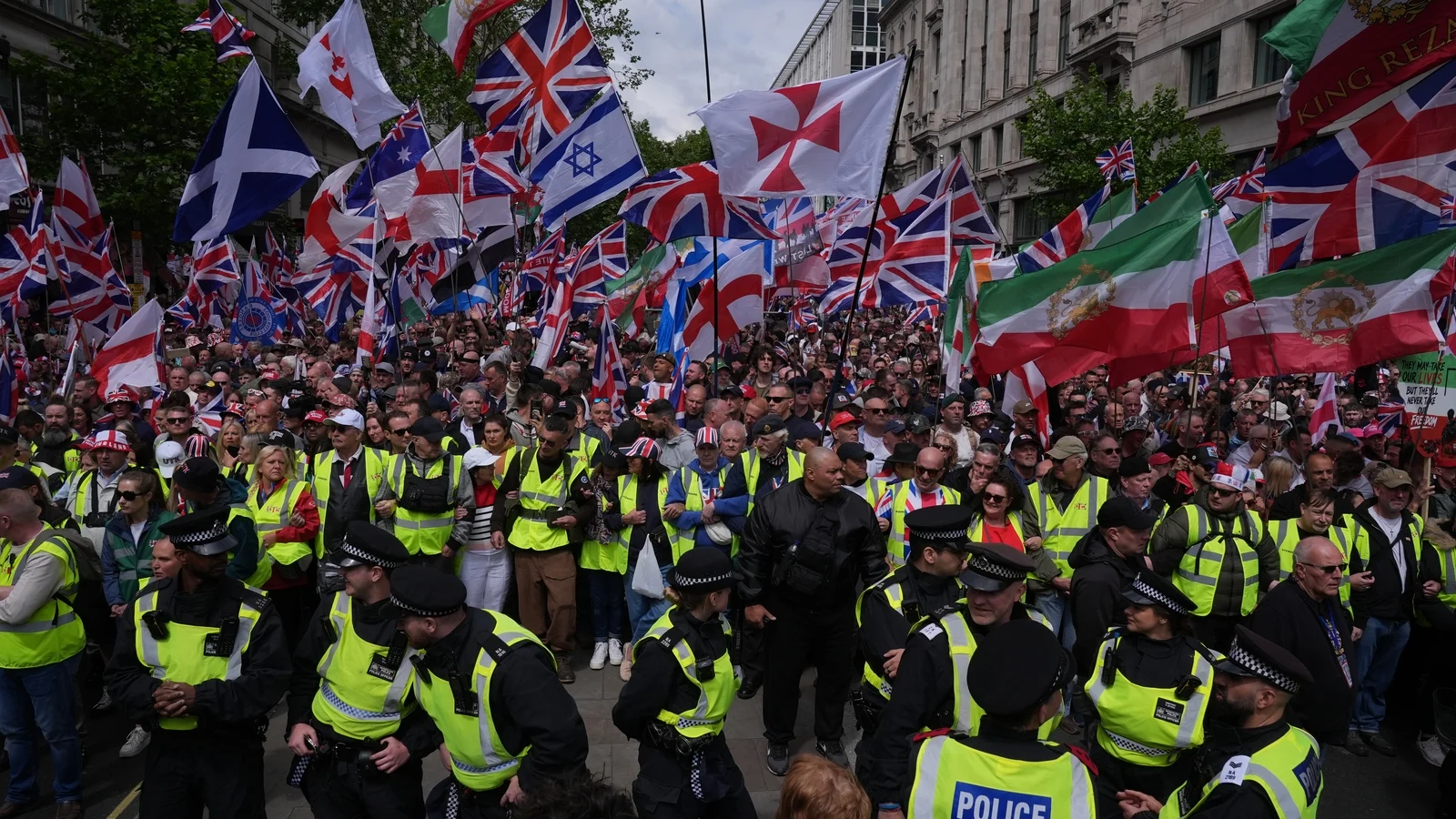
On one side, the Unite the Kingdom rally led by Tommy Robinson — the nom de plume of Stephen Yaxley-Lennon — drew supporters in red “Make England Great Again” caps, flags and chants demanding “We want Starmer out.” On the other, a pro-Palestine Nakba Day march filled Pall Mall and surrounding thoroughfares with keffiyehs, placards reading “Free Palestinian Hostages” and banners declaring “Bristol stands with Palestine.” Police put around 4,000 officers on duty for both events and recorded 43 arrests by roughly 7:30pm; 22 others were arrested at the FA Cup final at Wembley, according to Metropolitan Police figures.
It was a day where noise could be read as data — the number of people, the variety of faces, the cadence of slogans — and where those numbers meant something more than crowd control. They mattered to politicians, prosecutors and civil liberty campaigners trying to read the mood of a country grappling with polarisation, migration and foreign conflicts that roil domestic politics.
The crowds: claims, counterclaims and the smell of the city
Estimating crowds at mass events is always fraught. Organisers of the pro-Palestine rally said at least a quarter of a million people had gathered; the Metropolitan Police had earlier estimated around 30,000. Tommy Robinson, speaking on stage, boasted of “millions” in attendance; officers put the likely turnout in the tens of thousands. Numbers became another battleground.
As the marches snaked past historic facades, the city provided texture: commuters dodging placards near Euston, tourists bewildered by chanting on the Mall, and market stallholders in Camden watching through the afternoon haze. A stall owner near the route, who gave his name as Ahmed, summed up the mood: “You could feel the tension in the air — like it was waiting to be lit. But mostly people came to be seen and heard, not to fight.”
Voices at each protest carried distinct grievances. Siobhan Whyte addressed Robinson’s crowd with a rawness that stopped conversations: she described her daughter, Rhiannon, murdered in a tragedy that she says could have been prevented. “Keir Starmer failed my daughter,” she declared, tears in her voice. “If I don’t speak now, who will?”
At the pro-Palestine gathering, Labour MP Apsana Begum and former leader Jeremy Corbyn urged unity against what they called the far right. Diane Abbott warned of “viciously right-wing” forces and urged people to “fight the fascists, fight the antisemites.” Zarah Sultana, whose rhetoric has often inflamed debates, told the crowd that familiar political alternatives were insufficient, painting the moment as a wider call to change policy, not merely personalities.
Policing, surveillance and a new legal landscape
Authorities did not police the day casually. In addition to uniformed officers on the ground, the Metropolitan Police deployed drones, monitored CCTV feeds around Wembley and — for the first time in a protest policing operation — planned to use live facial recognition systems in areas expected to be used by attendees. Commander Clair Haynes said officers would also monitor FA Cup crowds at Wembley for people likely to head toward demonstrations.
Those measures were part of a wider operating picture that included new guidance from the Crown Prosecution Service urging prosecutors to consider the online impact of chants, banners and placards. The advice asks whether slogans or symbols, once filmed and shared, might amount to stirring up hatred or otherwise influencing an audience beyond the immediate crowd.
Human rights lawyers and civil liberties groups were quick to raise concerns. “We are entering a zone where protest becomes subject to not just physical policing but digital policing,” said Clara Mendes, a solicitor who specialises in public order law. “Prosecutors now have to balance freedom of expression with online harms, and that is not an easy calculus.”
A Met spokesperson defended the tactics: “We have a duty to keep people safe and to protect the right to peaceful protest. The measures used today were proportionate and targeted.” But the use of live facial recognition and the threat of prosecuting organisers for content seen online has alarmed campaigners who argue it could chill dissent.
- Drones and CCTV were used to monitor movement and gather intelligence.
- Live facial recognition was deployed in specific, non-route areas expected to be used by attendees.
- Organisers and speakers face potential prosecution under new restrictions intended to curb extremism and hate speech.
Arrests, assaults and the limits of speech
By evening, the Met recorded 43 arrests related to the day’s activities, plus 22 at Wembley. Four officers were assaulted, and six reported hate crime offences, the force said. Two men arriving at Euston were detained in connection with separate incidents in Birmingham; one was wanted on suspicion of grievous bodily harm, the other for allegedly encouraging people to attack an officer.
Recent criminal cases were on everyone’s lips: prosecutions after individuals were filmed shouting “death to the IDF” or “globalise the intifada” had already raised debate about whether certain slogans cross the line into criminal behaviour. The CPS guidance now explicitly tells prosecutors to factor in context, the potential for online amplification and heightened tensions tied to international events.
“It’s not just words shouted into a void anymore,” said Dr Fiona Greene, a sociologist who studies protest movements. “The internet magnifies speech; a chant in Trafalgar Square can be replayed millions of times over. That changes everything for both organisers and the law.”
Voices from the street — who is being heard?
A young marcher in a keffiyeh, who introduced herself as Mariam and works in a local clinic, told me: “This is personal. My family watch the news and we feel helpless. Today, we came to demand that our leaders listen.” Nearby, a man in a red Mega hat — call him Paul — said, “We want borders, and we want our communities safe. This is about our future.” Both were firm in their convictions; both believed their cause was urgent.
Between them stood the figure of the city, old and new, an amphitheatre for global anxieties. London’s pavements have long carried competing histories; on this day they were packed with the present.
Why it matters — and what comes next
These demonstrations were not isolated. They sit at the confluence of several currents: rising populism, international conflict reshaping domestic politics, and a legal system scrambling to adapt to a digital age where a single slogan can travel the globe in seconds. The UK government’s decision to block 11 foreign nationals described as far-right agitators before one rally — and the announcement that organisers could be prosecuted — reflect that anxiety.
So where does London go from here? Will the increased surveillance and new prosecutorial guidance deter violent rhetoric, or will it chill legitimate dissent and political expression? Can a democracy keep the streets safe without locking down debate?
As the sun set and crowds dispersed, what lingered was less a verdict than a question — about how a plural society listens to itself when the noise gets loud. “We are all learning how to protest in the age of social media,” Dr Greene said. “The law will catch up, or it will fracture trust. The choice is ours.”
What did you see or feel when you last walked through a city where people were protesting? Did the energy feel like civic renewal — or something else? London offered both answers on a single afternoon. The task now is to turn that moment into policy that protects both safety and the right to be heard.