They Came for Prayer: A Morning of Violence at San Diego’s Largest Mosque
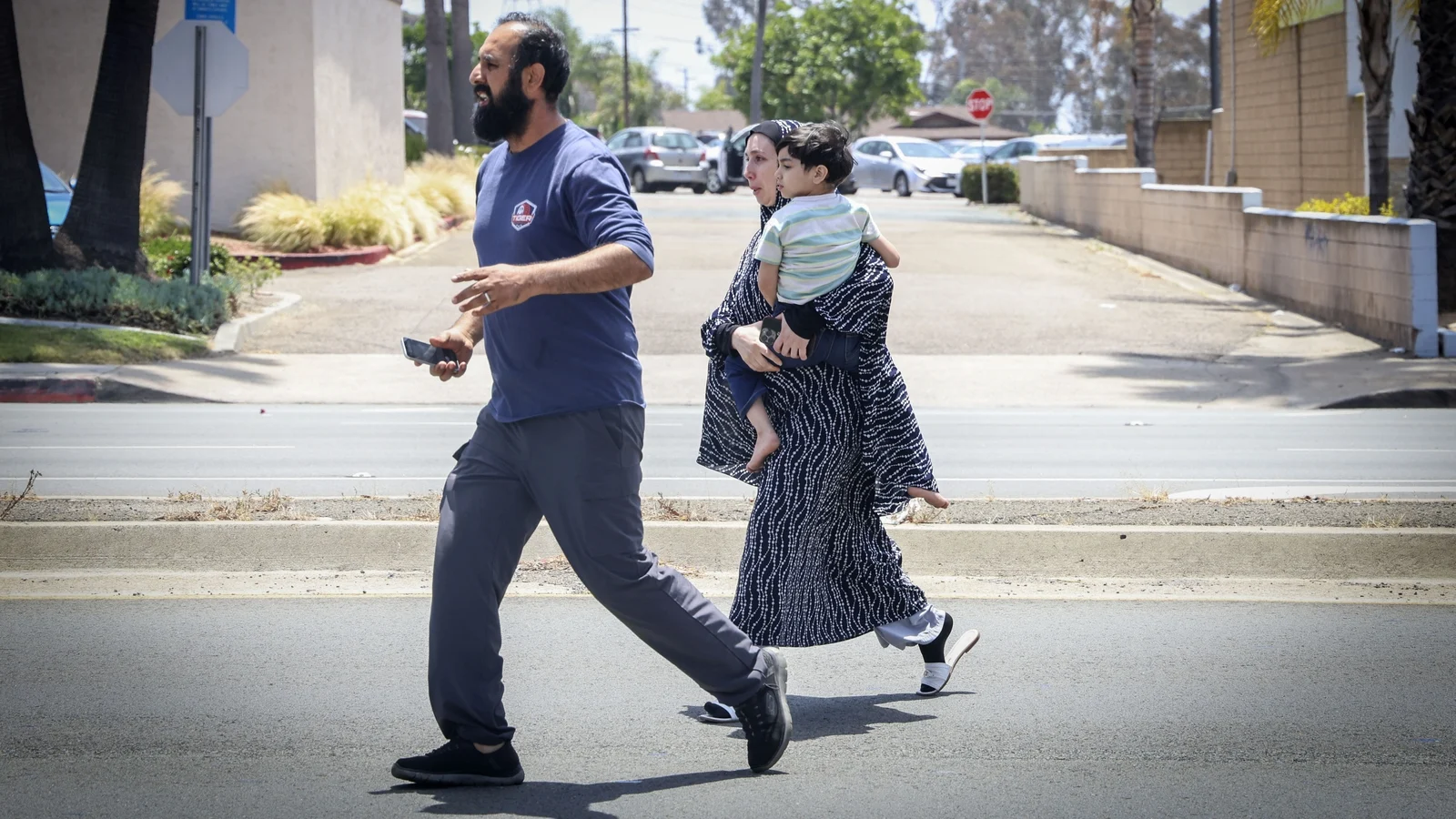
It was supposed to be a quiet, ordinary morning at the Islamic Center of San Diego — a sprawling complex of prayer halls, classrooms and a day school where children in uniform line up for lessons. Instead, the campus became the scene of a nightmare: three men killed outside the mosque, frantic calls to 911, a lockdown that rippled through surrounding neighborhoods, and the discovery of two teenage shooters who had taken their own lives a few blocks away.
“We are actively investigating this as a hate crime,” San Diego Police Chief Scott Wahl told reporters at the scene, his voice tight with a mix of sorrow and determination. “There was definitely hate rhetoric that was involved.”
Four Minutes
Four minutes. That is how long it took officers to arrive after the first emergency call — a stark number police repeatedly returned to as if timing could explain some of the horror. Officers found three victims outside the mosque. Within hours, a vehicle was located a few blocks away with two young men, aged 18 and 17, dead inside. Authorities said both shooters died by suicide.
“There were no officers involved in firing their weapons,” Chief Wahl said, clarifying what many onlookers feared would be an exchange of gunfire. “We immediately began to deploy with an active shooter response into the mosque and adjacent school.”
The identity of one of the victims has been revealed in news reports as a security guard whose quick actions — according to police — prevented an even greater loss of life. “His actions were heroic and he undoubtedly saved lives today,” Chief Wahl added, the word “heroic” landing heavy in the chilly air outside the mosque.
Community in Shock
Inside the mosque complex, families gathered, some chanting softly in prayer, others staring into their phones for news. Bright Horizon Academy, the Islamic school housed on the property, shut down its classrooms in the wake of the shooting. Teachers comforted children who could not yet fathom the quiet turned violent.
“We have never experienced tragedy like this before,” Imam Taha Hassane told me later, rubbing his temples, the fatigue of grief showing on his face. “All I can say right now is that we are sending our prayers and standing in solidarity with the families. It is extremely outrageous to target a place of worship.”
A neighbor who asked to be identified only as Maria described the scene she stumbled into after hearing sirens. “I came out in my slippers and saw police everywhere. There was this sense you could taste — all of us silent, like we were waiting for the next blow.”
Warning Signs That Were Missed
In a chilling detail, Chief Wahl said the mother of one of the suspects had contacted police two hours before the massacre to report weapons and a vehicle missing. She said her son and a companion were dressed in camouflage, and officers began canvassing local sites — including a nearby mall and the high school the youth attended. Then the calls about the shooting came in.
Police also reported the discovery of a note at the home of one of the boys; Wahl declined to disclose its contents. The presence of such a note raises questions about what family members, friends, schools, or mental-health professionals might have seen, and whether communities are equipped to act when warning signs appear.
What This Means in a Wider Context
How should we understand a violent act that targets a house of worship? Is this an isolated tragedy, or the symptom of a trend? Places of worship in the United States have increasingly become targets over the past decade — Jewish, Muslim, Sikh, and Black churches have each experienced attacks that long ago shattered the idea that sacred spaces are safe from the worst of humanity.
“This attack sits at the intersection of two persistent and interlocking crises: the pervasive availability of high-lethality weapons and the emboldening of extremist hate online,” said Dr. Leila Rahman, a researcher who studies violent radicalization among youth. “Young people who consume violent rhetoric can be radicalized fast, and if they have access to guns, the consequences can be swift and fatal.”
Statistics underscore that reality. The United States has one of the highest rates of firearm deaths among wealthy nations, with tens of thousands of gun deaths reported annually — a grim tally that includes homicides, suicides and unintentional shootings. Communities of faith are not immune; anti-Muslim bias incidents and hate crimes have been documented by both civil-rights groups and federal reporting as a persistent and sometimes growing problem in years of heightened global tensions.
At the Crossroads of Global Tensions and Local Fear
The attack came the week before Eid al-Adha, an important Muslim holiday, and as pilgrims prepare for the annual Hajj in Mecca. That timing has pierced the community’s sense of security. “To have this happen just before a sacred time of reflection and sacrifice — it feels like a wound made to our hearts,” said Amina Farooq, a volunteer at the mosque who helps coordinate holiday events.
In recent months, political and military tensions overseas have often translated into spikes in hate and fear at home. The mosque’s leaders and supporters in San Diego say they have felt that undercurrent. “You can’t separate global geopolitics from what happens on our streets,” Imam Hassane said. “When leaders trade threats and images of war, it filters down to people who want someone to blame.”
Voices from the Statehouse and Beyond
California Governor Gavin Newsom expressed horror over the killings, saying worshippers “should not have to fear for their lives.” He pledged state support and urged communities to stand together. “Hate has no place in California, and we will not tolerate acts of terror or intimidation against communities of faith,” he said on social media.
A White House spokesperson described the shooting as a “terrible situation” and indicated federal resources would be made available, while civil-rights organizations called for swift investigation and accountability.
What Comes Next?
For now, the mosque is at once a crime scene, a grieving congregation, and a community hub trying to stitch itself back together. There will be vigils and services, outreach to counselors for the children, and a push for increased security. There will also be questions — about how two teenagers came to commit such violence, about gun access, about the hardened rhetoric seeping into young minds online.
“We want our children to feel safe to come to school and to pray,” said Farooq. “We will mourn. We will remember. And we will ask how this could have been prevented.”
Questions for the Reader
What responsibility do families, schools and tech platforms share when a young person drifts toward violent rhetoric? How do we protect houses of worship without turning sanctuaries into fortresses? And when the global becomes local, how do diverse communities stand together without ceding the particular dignity of each?
As San Diego’s Muslim community counts its dead and tends its wounded, the questions multiply. In the quiet between prayer and policy, between grief and justice, the answers will have to come from all of us.