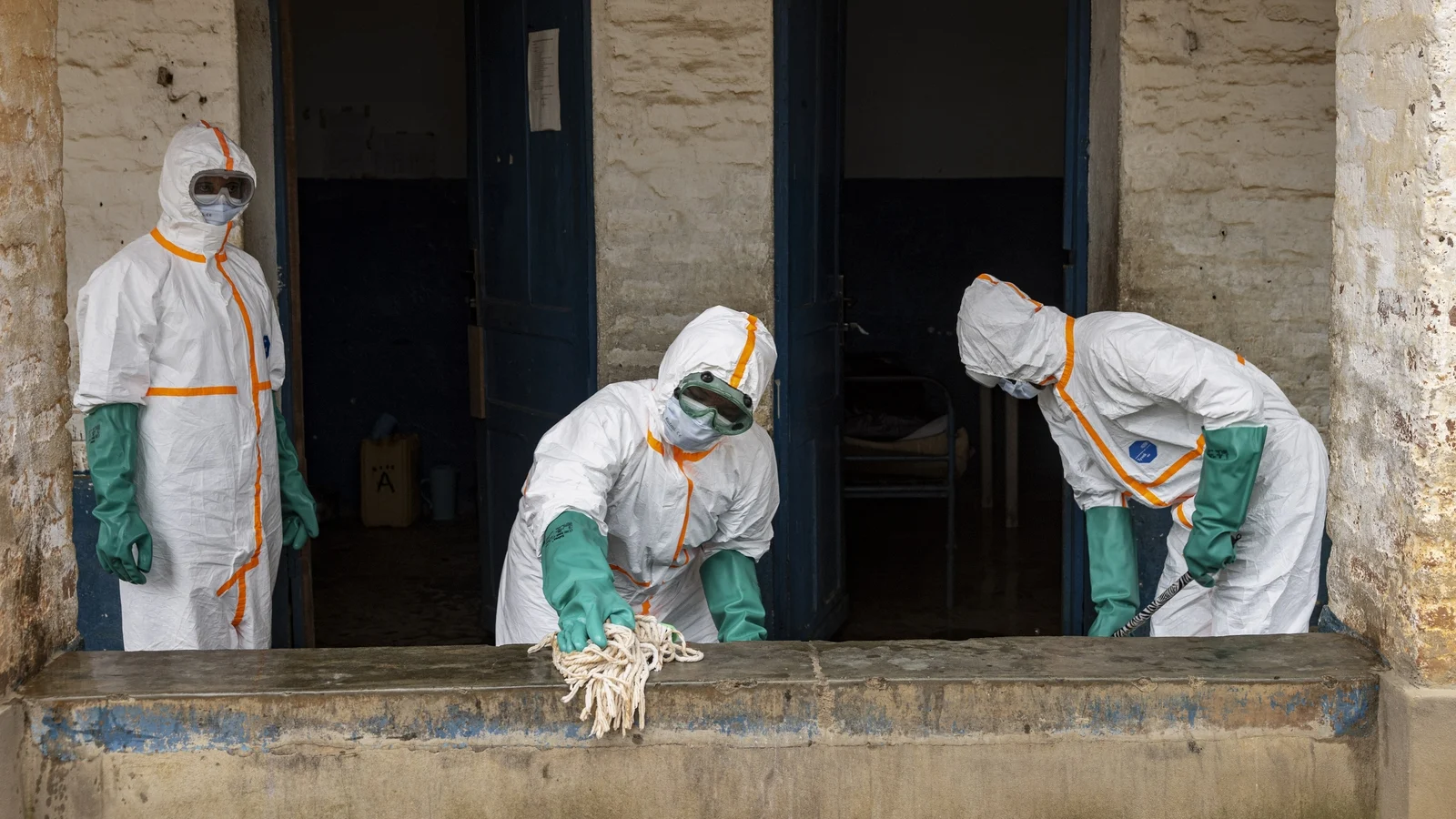
Ebola is racing across the Democratic Republic of Congo, and the World Health Organization is warning that the danger does not stop at the border.
Countries neighbouring the DRC face an especially acute threat from the virus and must move fast to protect their populations, WHO director-general Tedros Adhanom Ghebreyesus said, announcing he would travel to the vast central African nation on Tuesday as it grapples with the latest outbreak.
“Countries bordering DRC are at especially high risk and should take immediate action,” Dr Tedros told a virtual ministerial meeting focused on the viral haemorrhagic fever, which spreads through direct contact with bodily fluids.
It can cause severe bleeding and organ failure.
Describing the situation as “especially challenging,” Dr Tedros said the response is struggling to keep pace with a fast-moving epidemic.
“First, the delay in detecting the outbreak means that we are now playing catch-up with a very fast-moving epidemic. We are urgently scaling up operations but at the moment, the epidemic is outpacing us,” he said via video link from Geneva.
He cited security concerns in the eastern provinces, where the outbreak was first detected in mid-May, noting the area is “highly insecure, with intensified fighting in recent months (and) there is also significant distrust of outside authorities among the local population”.
Another complication, he said, is the lack of tools tailored to the specific variant driving the outbreak. There are “no approved vaccines or therapeutics” for the Bundibugyo strain of Ebola behind the current outbreak.
Since mid-May, the WHO has recorded 10 confirmed Ebola deaths and 220 suspected deaths in the DRC, alongside 900 suspected cases since Kinshasa declared the outbreak on 15 May.
The UN agency said the true extent of transmission is likely larger, with experts suspecting the virus may have circulated undetected for some time.
Health workers conduct temperature screenings and health checks on travellers at the Kanyaruchinya checkpoint in Goma
In Uganda, one person has been confirmed dead and six others are confirmed infected.
Africa’s regional risk picture is also sharpening. Ten other countries are “at risk” of infection, the African Union’s health agency, Africa CDC, warned on Saturday.
These are Angola, Burundi, the Central African Republic, the Republic of Congo, Ethiopia, Kenya, Rwanda, South Sudan, Tanzania and Zambia.
Building trust
Africa CDC head Jean Kaseya said “high mobility and insecurity” are helping push the outbreak beyond local front lines, after the WHO declared it an international emergency.
Insecurity remains a defining challenge in eastern DRC, an area scarred by three decades of conflict involving a long list of armed groups.
In rural parts of Ituri province, state services have been largely absent for decades.
South Kivu province is controlled by the M23 armed group, which has never managed an epidemic like Ebola.
Dr Tedros said rebuilding confidence in Ebola-hit communities is essential to slowing transmission.
That trust gap has been underscored by recent attacks: two hospitals in Ituri have been targeted by suspicious locals over the past five days—one in Mongbwala, where the outbreak was first detected, and another in Rwampara, where tents used to isolate Ebola patients were set on fire.
In Rwampara, violence broke out after a family was stopped from taking away a deceased man’s body for burial, due to contamination risks.
“Loved ones are throwing themselves at the bodies, touching the corpses… while organising mourning rituals bringing together loads of people,” said Jean Marie Ezadri, a civil society leader in Ituri.
Dr Tedros said the WHO is channelling funding, medical supplies and staff into the DRC to bolster national efforts, while accelerating clinical trials for potential treatments.
“It will get worse before it gets better,” he said.
“But we know this virus and we know how to stop it.”
The WHO has declared the outbreak of the rare Bundibugyo strain of Ebola a public health emergency of international concern.
Ebola has killed more than 15,000 people across Africa in the past half-century.