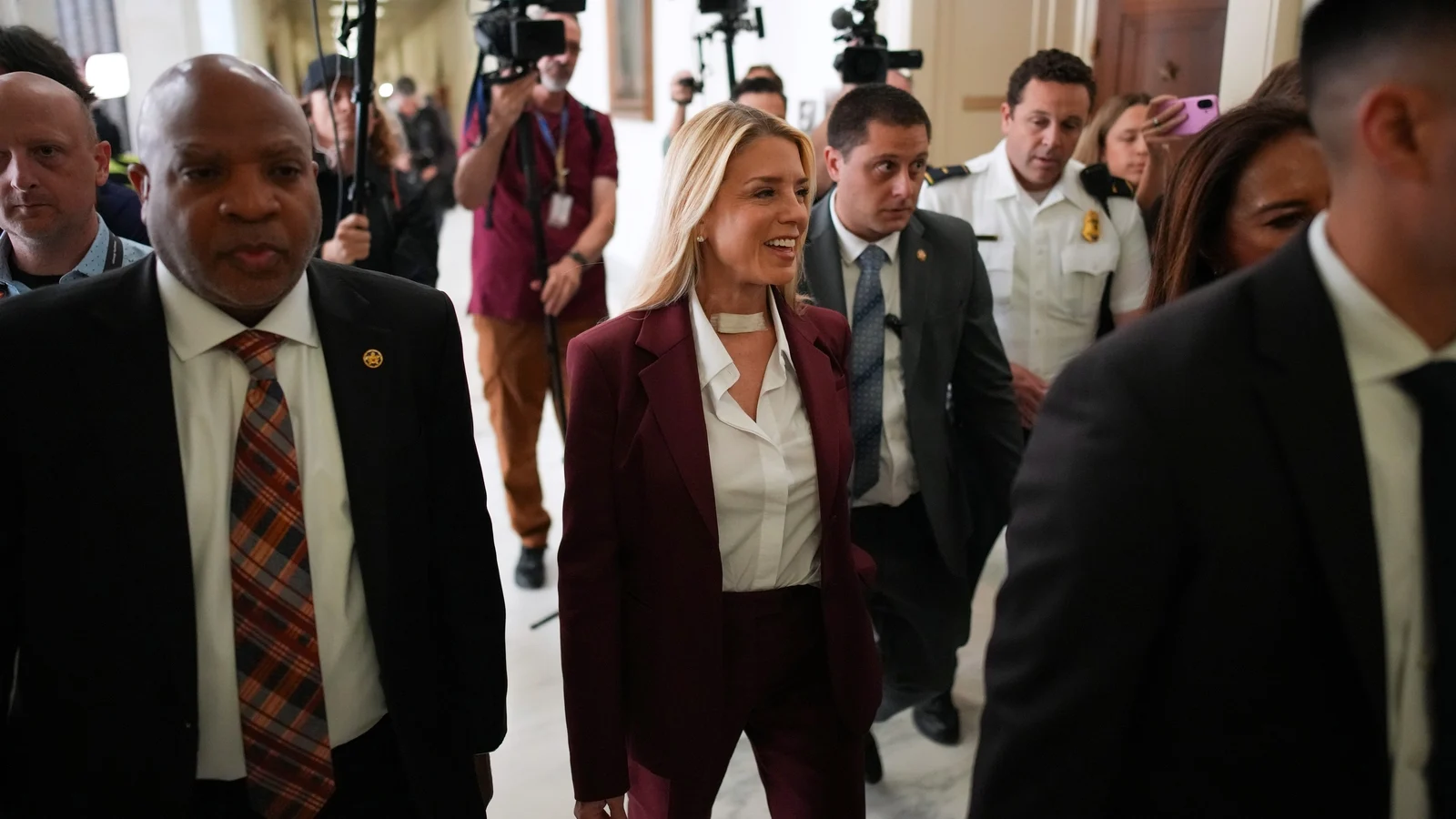
Pressed by lawmakers over the Justice Department’s handling of the Jeffrey Epstein files, former US Attorney General Pam Bondi declined behind closed doors to address whether President Donald Trump knew about Epstein’s conduct that led to criminal indictments or whether Trump ordered her to censor material before it was released, Democrats said.
During a private interview with the House of Representatives Oversight Committe, Bondi also pointed to Todd Blanche — now serving as acting attorney general — as the official who oversaw the release of the records.
“I did not lead every aspect of this effort or conduct that document review myself. I delegated oversight over this process to Deputy Attorney General Todd Blanche,” Ms Bondi said in a prepared statement obtained by Reuters.
Bondi later said she stood by Blanche during her testimony. “I praised Acting AG Blanche’s management of this Herculean task. I said his ethics are beyond reproach and that he is an incredible Attorney General,” she wrote on X.
Robert Garcia, a Democrat from California, speaking to the media on Capitol Hill
Representative Robert Garcia of California, the committee’s top Democrat, told reporters that Bondi would not respond to questions involving Trump. Garcia said a Justice Department lawyer seated beside her “stepped in and told the former attorney general that she was not going to answer those questions”.
While Bondi led the department, the Justice Department said it would withhold details that could expose victims or jeopardize active investigations.
Still, Democrats — and some Republicans — have sharply criticized Bondi over the rollout of millions of Epstein-related documents.
Democrats and some Republicans accused her of trying to shield Mr Trump from scrutiny. Mr Trump opposed the release of the information until shortly before Congress overwhelmingly passed a law ordering its release.
Read more
Democrats accuse US attorney general of Epstein file ‘cover-up’
Trump sacks Bondi and appoints former personal lawyer as acting US Attorney General
Democratic Representative Melanie Stansbury of New Mexico said Bondi told lawmakers that 3 million of roughly 6 million Epstein-related documents have been released so far. “This is a cover-up,” Stansbury said.
In her opening statement, Bondi acknowledged there had been “redaction errors” but did not spell out what those mistakes were. She also defended the Trump administration’s approach to the Epstein matter and the process used to publish the records.
“To the best of my knowledge, the department produced everything required,” she said in her statement, which was obtained by Reuters.
The interview ended without Bondi addressing reporters waiting outside the committee room.
Before the session began, committee chairman James Comer of Kentucky said lawmakers planned to seek answers on what remains withheld. “We will be asking today about why documents still are not released … what documents remain and why they haven’t been turned over,” he told reporters.
President Trump fired Bondi on 2 April, in part due to her handling of the Epstein files.
The committee’s Republican chairman James Comer speaks to the media on Capitol Hill
Mr Trump and Epstein socialised in the 1990s and early 2000s, but Mr Trump has repeatedly said he ended the relationship before Epstein pleaded guilty in 2008 to soliciting prostitution from a minor.
Epstein was arrested again in 2019 and charged with sex trafficking of minors, accused of recruiting and abusing underage girls in New York and Florida. His death that year in a New York jail cell was ruled a suicide.
The Epstein files revealed the financier’s ties to powerful people including Mr Trump, former President Bill Clinton and Andrew Mountbatten-Windsor, the former Duke of York. All have said they had no knowledge of Epstein’s alleged sex trafficking.
Epstein abuse survivors Sharlene Rochard holds a copy of redacted emails as she speaks to the media on Capitol Hill
Garcia also took aim at Comer’s decision not to videotape Bondi’s interview, saying a recording would have let the public assess her demeanor for themselves.
An Epstein abuse survivor also appeared outside the hearing room to condemn how the files were handled.
“It boggles my mind that the Department of Justice released nude photos…the Department of Justice released pornography. That is unacceptable,” survivor Sharlene Rochard told reporters outside the committee hearing room.