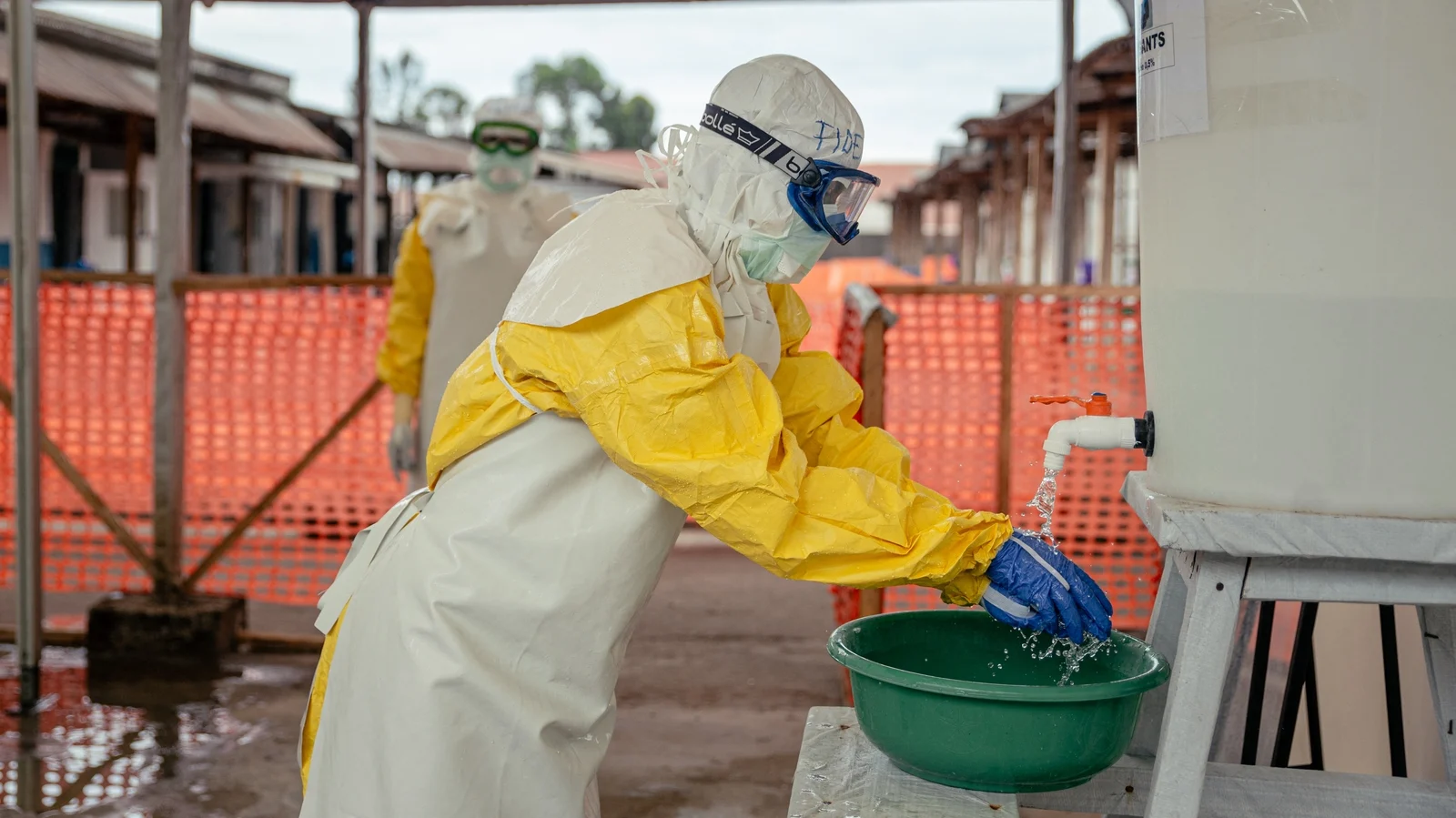
Ebola is outrunning the response in central Africa, World Health Organization chief Tedros Adhanom Ghebreyesus warned in Geneva, saying the outbreak in the Democratic Republic of Congo began with a dangerous advantage — even as he argued the global health agency is starting to close the gap.
The outbreak, declared on 15 May in the northeastern Democratic Republic of Congo, has been confirmed to have infected 359 people, including 61 who have died.
Health officials believe the toll could be considerably higher, however, because the virus may have been spreading unnoticed for a period before it was detected.
“The outbreak had a big head-start and we’re still behind,” Tedros told reporters at the UN health agency’s headquarters, adding that “we’re catching up”.
Tedros had just returned from the DRC, including a visit to Ituri province — the epicentre of the outbreak — where he said he was “very encouraged by the level of commitment I saw everywhere I went”.
Even so, he stressed that the fight remains urgent. “The virus is ahead of us… we need to move faster,” he said.
From the outset, the response was expected to be difficult, with many cases concentrated in Ituri, a region scarred by decades of armed conflict that has displaced millions and pushed families into crowded camps.
Tedros pointed to persistent obstacles: insecurity, limited testing capacity, lagging contact tracing, and mistrust among parts of the population.
Complicating the effort further, he said, is that there is no vaccine or approved treatment for Bundibugyo, the rare strain of Ebola driving the current outbreak.
Ebola spreads through close contact and bodily fluids, and over the past 50 years it has killed more than 15,000 people in Africa.
The current outbreak — the 17th recorded in the DRC — has so far produced 344 confirmed cases across three provinces, including 60 deaths, according to the WHO.
The agency has also counted 116 suspected cases.
Beyond the DRC, the WHO said 15 cases, including one death, have been reported in neighbouring Uganda. Those cases include a Congolese resident who arrived in Uganda after first travelling to the United Arab Emirates.
“WHO is working with public health authorities in Uganda and the UAE to gather additional information, assess the risk of exposure during travel, and to facilitate contact tracing,” Tedros said.
WHO Director-General Tedros Adhanom Ghebreyesus in the eastern DRC last week
Speed up contact tracing
The WHO has assessed the risk from the outbreak as “very high” nationally, “high” regionally, and “low” globally.
While the agency recommends exit screening at airports, ports and border crossings in affected countries to help curb the spread, Tedros said broader measures were counterproductive.
“Blanket travel restrictions imposed by some countries are disrupting supply chains and hindering the response,” he warned.
“We ask countries that have imposed blanket travel restrictions to lift them.”
Containing the outbreak, he said, depends on a sharper and faster operation in the hotspots, including decentralising laboratory testing so results can be delivered closer to where infections are occurring.
For now, only about 45% of known contacts of Ebola cases are being followed up, Tedros said.
“To get ahead of the outbreak, we need to get that number up to above 90%.”
Abdi Rahman Mahamud, the WHO’s emergency alert and response director, told reporters that more than 1,400 tests have been carried out so far.
But he said the planned decentralisation across five priority locations — Mongbwalu, Beni, Aru, Nyakunde and Tchomia — should soon allow teams “to do 1,000 tests a day.”