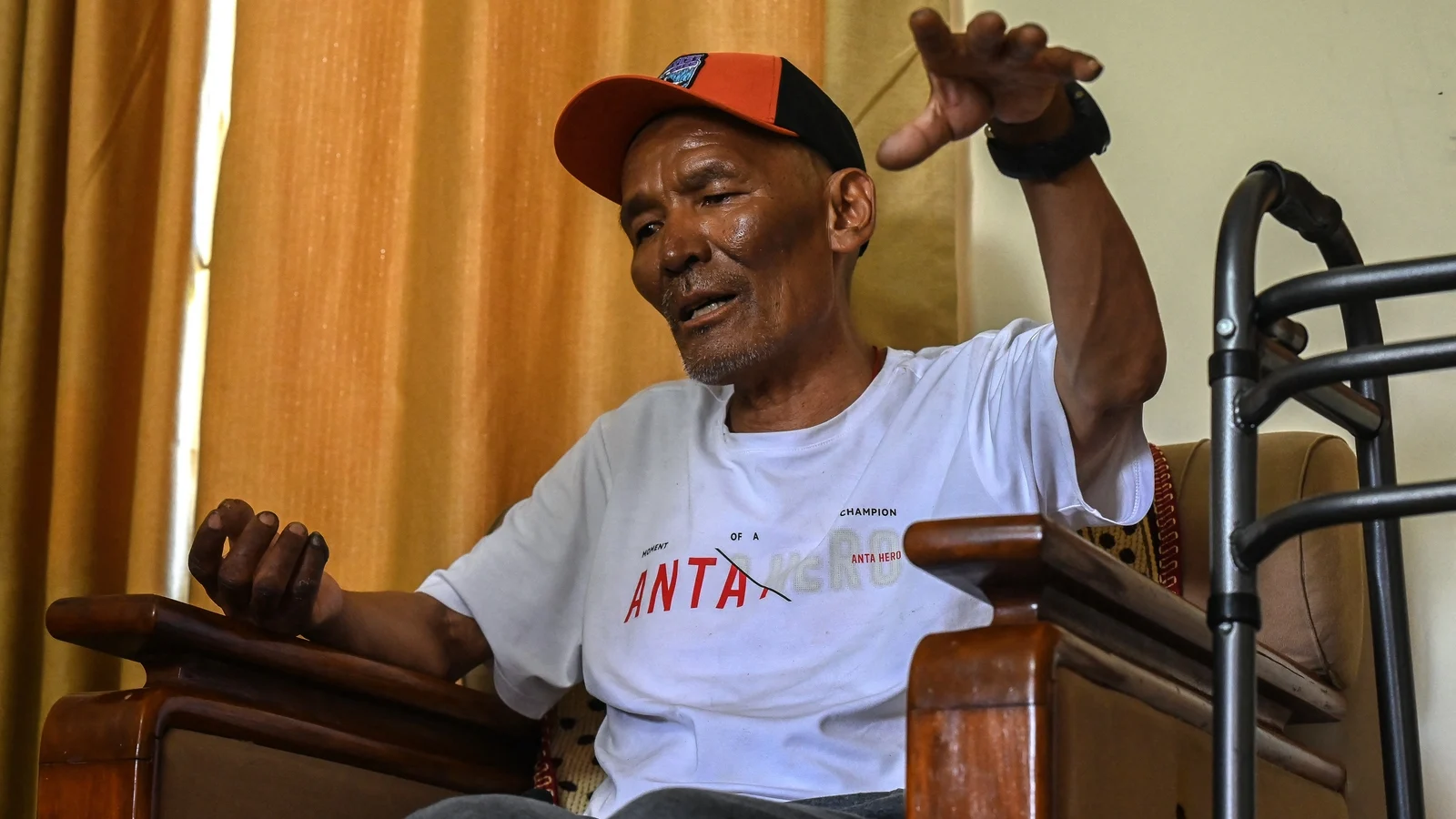
For three harrowing days on Mount Everest, Nepali mountaineer Dawa Sherpa lay trapped at the bottom of a crevasse, surviving on biscuits, chocolates and chunks of ice as his family back home began mourning him as dead.
Sherpa, who later emerged with frostbitten fingers and a fractured leg, says an avalanche ultimately helped save his life by filling the eight-metre-deep crack with snow and giving him a way to claw himself out.
After the snow slid in, he fought his way up and then crawled down the world’s highest mountain, alone and injured, following fixed ropes until he was close to Base Camp.
Everest survivor Dawa Sherpa shows his frostbitten hands
In Nepal, his absence had already triggered last-rite rituals. Monks had begun performing ceremonies as his family grieved, convinced he had died on the mountain.
“I am very happy to be back, I thought I would die there,” Sherpa said after spending a week on Everest by himself.
The 57-year-old had been employed as a cook at Camp Two and had also climbed as a guide as far as the Everest Balcony.
The Balcony, roughly 8,400 metres above sea level, is a staging point where climbers typically pause to rest and acclimatise before the final ascent to the summit.
Sherpa said he started back down with two international climbers and a guide, but he fell behind after his oxygen ran out.
“When my oxygen ran out, I couldn’t move my hands or feet. So, I stayed at the rope for about half an hour.”
The rest of the team made it to Camp Two and alerted others that Sherpa had been left behind higher on the mountain.
He had a satellite phone, he said, but could not get it to work. He also carried a walkie-talkie radio, though its batteries were flat.
Sherpa spent the night in a nearby tent and then descended to Camp Two, only to find that by then other climbers had already moved further down.
He decided to try to reach Base Camp in a single push. But while crossing the Khumbu icefall — the fractured, shifting head of a glacier — he plunged into a crevasse.
Climbers ascend Mount Everest (file image)
“I slipped and fell from a ladder, and I hung there for a long time,” he said. Sherpa was gripping a 28kg bag containing eight empty oxygen cylinders and the clients’ sleeping bags, but eventually let the load drop onto the ice below.
Moments later, Sherpa also fell into the crevasse.
“I hit my head but landed in a flat area,” he said, injuring his leg in the fall.
With no immediate help, he rationed what little he had. “I had some biscuits and some chocolates in my pockets, and coffee… I didn’t have any hot water, so I would break some ice and wet my mouth,” he said.
He spent two nights trapped inside the crevasse, unable to scale its “smooth walls”.
“There was nowhere to go. I would wonder if I would live or die, just hoping that someone would come and rescue me,” he said.
“But no one came – instead, an avalanche did, to save me.”
The avalanche packed the crevasse with snow, creating a route up. Sherpa said the climb out was agonisingly slow.
“It was very difficult, it must have taken me an hour – holding onto the ice, and latching on with the crampons,” he said.
After escaping, he located a rope line and followed it, eventually crawling down to an area close to Base Camp.
Medics and rescuers attend to mountaineer Dawa Sherpa upon his arrival at a hospital in Kathmandu
Sherpa was discovered by the Sagarmatha Pollution Control Committee, a Nepali group that helps establish routes on Everest and clears rubbish left behind.
He was airlifted to Kathmandu, where doctors treated him for frostbite, severe dehydration and a fractured thigh bone.
News of his survival has prompted both relief among climbers and outrage from relatives and others in the mountaineering community, who have questioned why he was not found sooner.
The Nepalese government has launched an investigation.