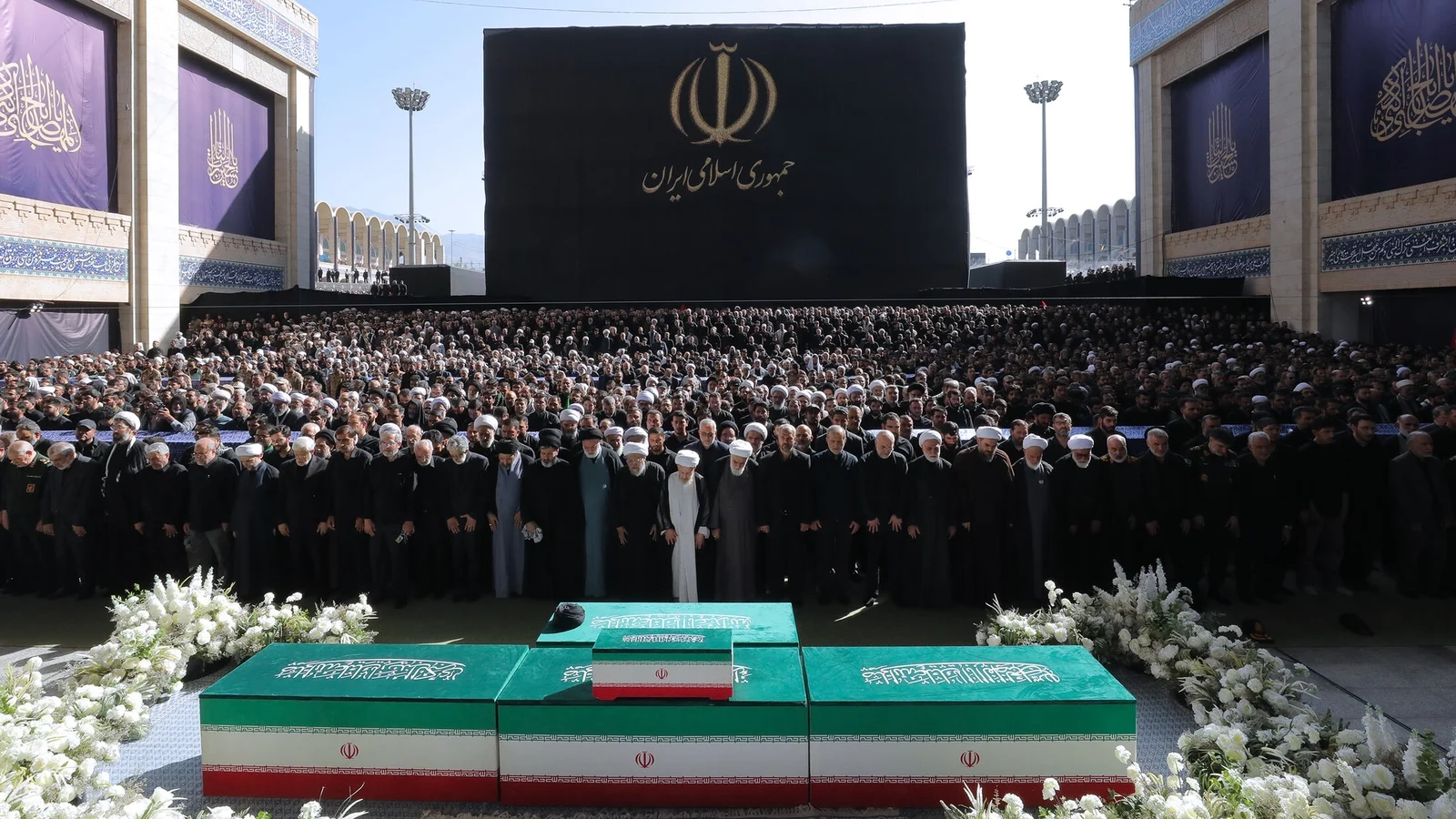
Tehran’s streets began filling before dawn as the funeral procession for Iran’s late supreme leader Ali Khamenei — and three members of his family — got underway, according to state television.
“The funeral procession for the revered body of the martyred Imam and leader began a few moments ago in the capital,” Islamic Republic of Iran Broadcasting (IRIB) posted on Telegram, saying a “massive crowd” of mourners had turned out.
Organisers said Khamenei, who lay in state for two days at Tehran’s Grand Mosalla religious complex, will be carried through the city for 10 to 12 hours starting at 6:00am (3:30am Irish time).
The scale of the operation recalls the extraordinary scenes of 1989, when the funeral of his predecessor, Ayatollah Ruhollah Khomeini, drew around 10 million people, according to state news agency IRNA. In the crush, crowd surges killed more than 10 people and injured over 10,000.
Thousands had packed the Grand Mosalla yesterday to pay their respects to Khamenei and four family members, all killed on 28 February in Israeli airstrikes based on US intelligence.
To reduce the risk of deadly surges, massive concrete walls separated members of the public from the coffin.
Even so, how close mourners will be allowed to get during the procession remains unclear.
Officials have been careful to avoid a repeat of 1989, when authorities ultimately resorted to transporting Khomeini by helicopter for burial after mourners overwhelmed his vehicle, tearing his burial shroud and causing his body to fall to the ground.
Ali Khamenei’S sons, Masoud Khamenei (2nd L), Meysam Khamenei (2nd R), and Mostafa Khamenei (R), made a rare appearance at the funeral
Beyond laying to rest a leader who ruled the Islamic republic for more than three-and-a-half decades, the ceremonies also serve as a public test of resolve for Iran’s authorities after five weeks of war with Israel and the United States.
Mohammad Bagher Ghalibaf, Iran’s speaker of parliament and chief negotiator with the US — and one of the most prominent figures in the post-Ali Khamenei era — praised the turnout on X, saying the “proud and invincible nation of Islamic Iran unanimously” honoured its “martyr”.
Organisers said Tehran’s procession will be followed by similar events in the clerical hub of Qom tomorrow, then in Iraq’s holy cities of Najaf and Karbala on Wednesday, before Khamenei is buried in his hometown of Mashhad in northeastern Iran on Thursday.
At yesterday’s funeral, three of Ali Khamenei’s sons appeared publicly — a rare sight that also underscored the continuing absence of Mojtaba Khamenei, named supreme leader shortly after his father’s killing but not yet seen in public.
Officials have said Mojtaba was wounded in the airstrikes, though the severity of his injuries has not been disclosed.
Also visible again was Ahmad Vahidi, the new commander of the powerful Revolutionary Guards whose predecessor was killed on 28 February. He attended for a second time, this time outdoors, after remaining unseen throughout the war.
Esmail Qaani, the shadowy head of the Guards’ Quds Force, responsible for foreign operations, also made a rare appearance.
The Iranian government is eager to tout the mass mobilisation in support of the authorities
While the state has sought to project unity, none of President Masoud Pezeshkian’s surviving predecessors — whose relationships with Khamenei were marked by tensions — have so far been spotted at the ceremonies.
The government is also eager to highlight the mass mobilisation behind the authorities after mass protests in January that rights groups say were suppressed in a crackdown that killed thousands of people.
For now, the broader Middle East war remains paused after a ceasefire and an initial accord struck with the US.
But both Washington and Tehran have warned they are prepared to resume military action, and calls for vengeance have echoed through the funerals.
“The killers (of Khamenei) must face punishment,” a 38-year-old man who gave his surname as Miremadi told AFP at the prayers.
“We back our revolution and our leader and we demand revenge for the blood of our loved ones,” said a woman, 39, with the surname Bakand.
Khamenei, throughout his rule, pursued a posture of confrontation with the West.
For years Tehran has supported anti-US and anti-Israel armed groups across the Middle East, including Palestinian Hamas and Lebanon’s Hezbollah — both of which sent delegations to the ceremonies.