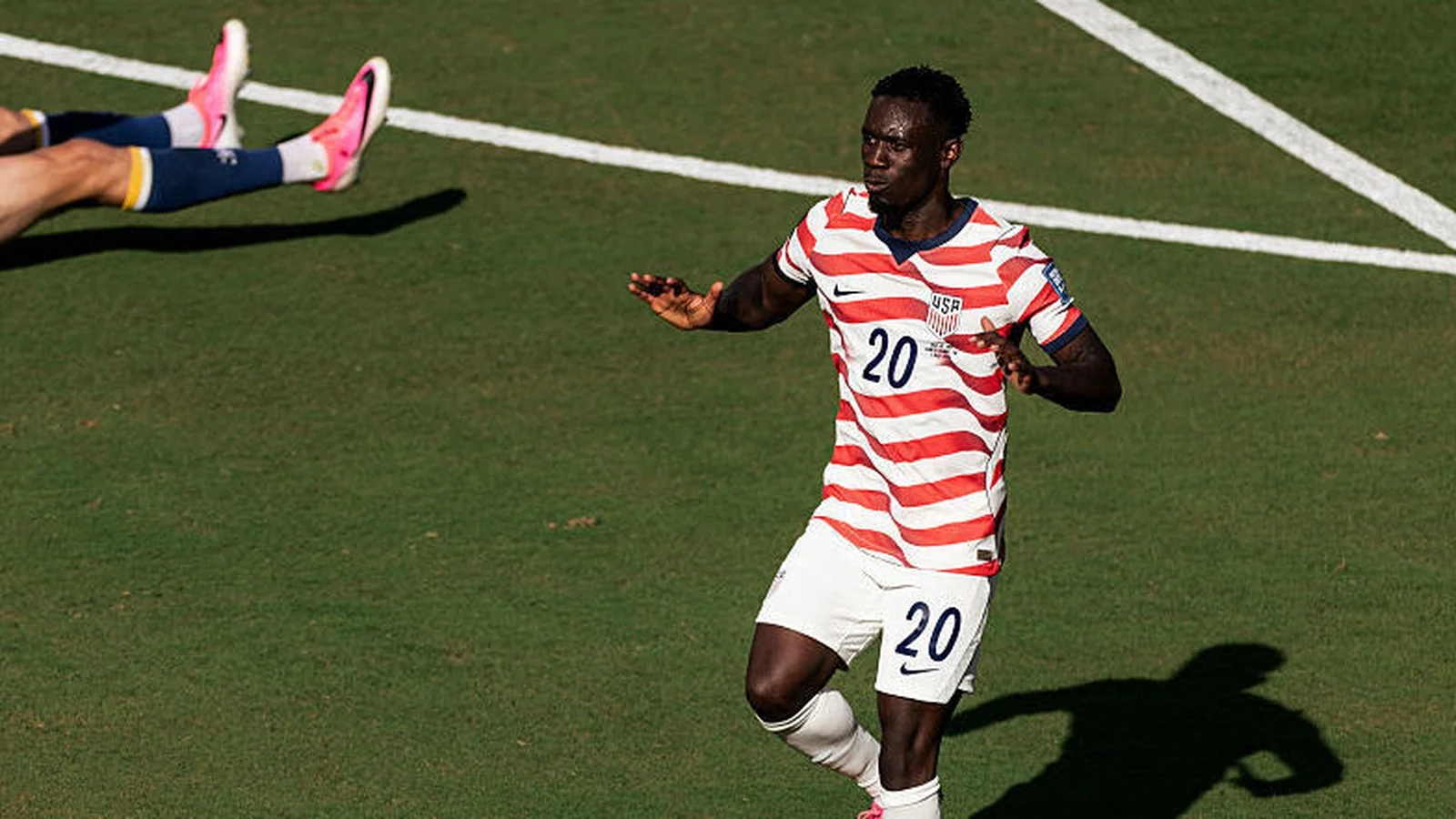
When Folarin Balogun steps onto the pitch in the early hours of Monday morning, it won’t just be the biggest match of his career — it will be the latest flashpoint in a story where football, identity and US politics have become tightly intertwined.
His sudden return to the spotlight comes after an extraordinary intervention from US President Donald Trump helped thrust Balogun into the middle of one of the World Cup’s most talked-about controversies.
Balogun, in fact, was not meant to play in the United States’ round of 16 clash with Belgium. He had been sent off in the previous game against Bosnia and Herzegovina and was facing a World Cup suspension.
Then FIFA announced it would suspend the World Cup ban.
The reversal arrived with a sharp twist of irony.
Mr Trump — who has repeatedly argued for ending birthright citizenship — publicly pressed FIFA President Gianni Infantino to revisit Balogun’s case.
Donald Trump and FIFA President Gianni Infantino at the White House (file image)
Balogun’s path to US citizenship traces back to birthright citizenship itself. His Nigerian mother was in New York when she became too far along in her pregnancy to fly home. He was born in the United States and gained citizenship by birth.
She returned with her son to Britain when he was one month old. Balogun would grow up in London before eventually deciding to represent the United States internationally.
He first played for England at youth level but joined the US Soccer set-up in 2023.
That origin story has added fresh intrigue to an already remarkable World Cup ascent. As Balogun’s reputation has surged on the sport’s biggest stage, he has also become part of a broader shift for U.S. Soccer, which is moving beyond its decades-old reputation as a development system dominated by overwhelmingly white talent.
At the same time, supporters of birthright citizenship have rallied around his performances as debates over citizenship, immigration and national identity take centre stage in US politics.
Balogun “prove(s) birthright citizenship isn’t a loophole – it’s America,” declared a headline from a Miami Herald editorial on Thursday.
“Mr. Balogun’s case is an extraordinary example of the good that is made available to us by things like birthright citizenship, giving people an opportunity that they would not have otherwise, to be their best and to contribute to the United States in ways that benefit all of us,” said Jorge Loweree, who is the managing director of programs at the American Immigration Council.
The United States is one of 33 countries, most of them in the Western Hemisphere, that allow unconditional birthright, after an 1898 Supreme Court ruling affirmed that the 14th Amendment allows for birthright citizenship.
‘Extraordinary to witness’
For years, Christian Pulisic has been the face of the American men’s team — a rare, genuine celebrity in a country that has often been ambivalent about the sport.
But even with “Captain America” Pulisic still drawing the strongest sponsor affection, it was Balogun who emerged as the breakout figure of this tournament. Three goals turned him into the catalyst for rising belief that the United States could make a serious run.
A year and a half after Pulisic drew attention with his “Trump dance” celebration, Balogun began generating his own cross-sport buzz. He received shoutouts from LeBron James after echoing the NBA star’s “silencer” gesture following a goal.
Momentum abruptly soured on Wednesday. After a Video Assistant Referee (VAR) review, Balogun was shown a red card for planting his boot on the ankle of Bosnia defender Tarik Muharemovic — contact that appeared inadvertent.
Florian Balogun receiving a red card for his challenge in the game versus Bosnia and Herzegovina
Pulisic put an arm around him as the 25-year-old striker absorbed the moment. In the days that followed, Balogun said he would pour his energy into supporting his teammates from the sidelines for the Belgium match.
Instead, less than a week after the Supreme Court dealt Mr Trump a stinging defeat on his central policy objective of ending birthright citizenship, the US president phoned FIFA chief Mr Infantino seeking relief.
“The timing and the development of the story has been extraordinary to witness,” said Mr Loweree.
A Reuters/Ipsos poll this year found that most Americans opposed ending birthright citizenship.
While Mr Infantino confirmed that he had heard from Mr Trump, he denied that the US president had any impact on the suspension of the red card.
‘I’m at home’
Raised in London and developed in Arsenal’s academy, Balogun had several potential international futures: England, Nigeria and the United States were all in play for the prolific forward.
“It feels like I’m at home here,” Balogun explained in US Soccer’s announcement that he would play for the ‘Stars and Stripes’.
He said he made the decision with his family and that a vacation to Orlando also influenced him.
“I think that’s when I really saw the full force of the US fans,” he said at the time.
“It’s just something I’m really happy that I’ve decided to do.”
Read more: ‘I understand sports really well’ – President Donald Trump admits he lobbied FIFA over Folarin Balogun suspension