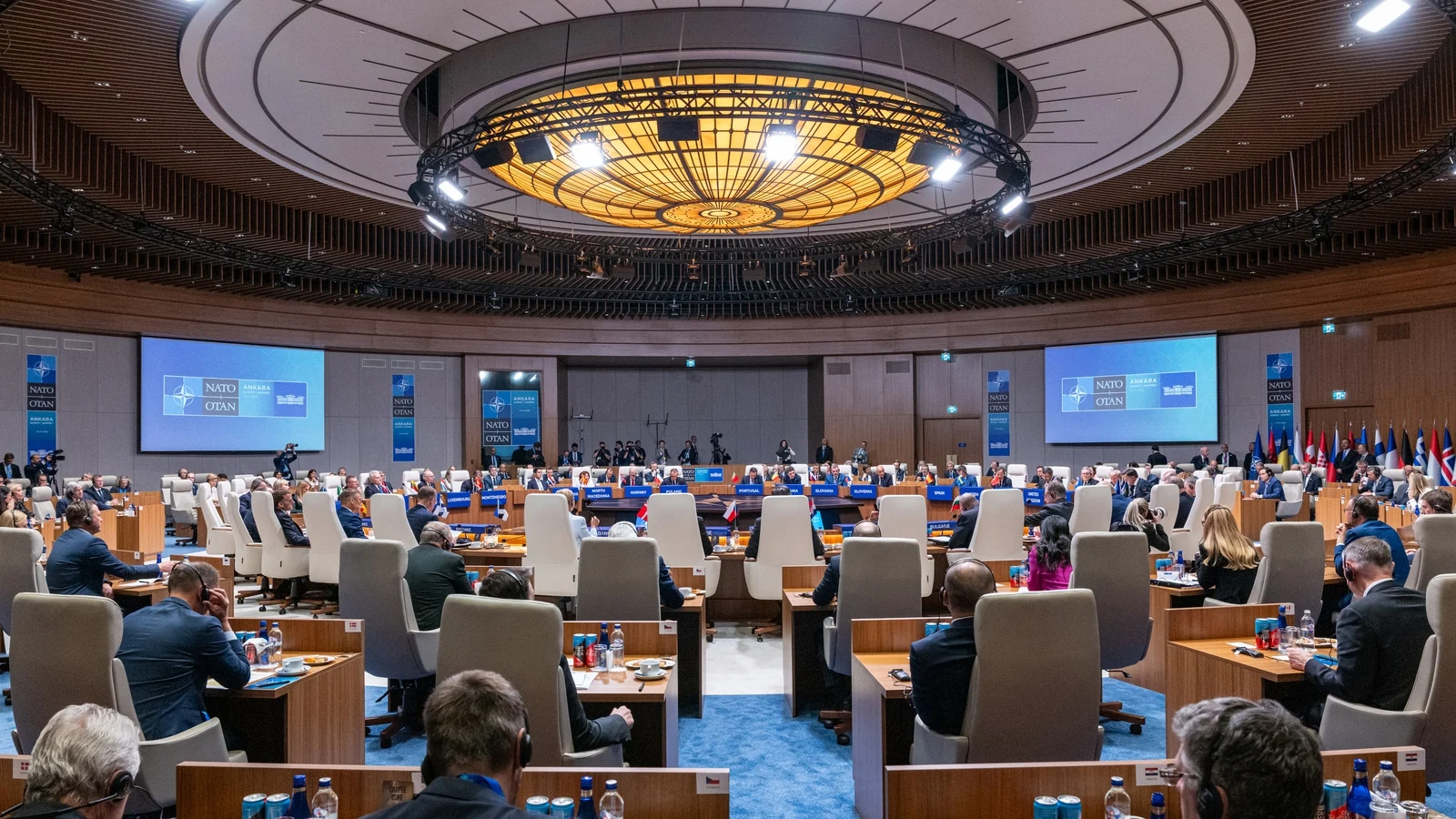
A closed-door gathering of NATO’s 32 leaders in Ankara ended with a familiar promise — collective defence remains non-negotiable — even after a day in which US President Donald Trump publicly scolded allies over Iran, threatened Spain with trade retaliation, and again raised the issue of Greenland.
NATO leaders – including US President Donald Trump – have reaffirmed their “ironclad commitment” to the alliance’s article five mutual defence clause and the “transatlantic bond”.
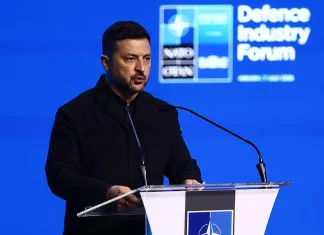
The allies said they were “united in our unwavering support for Ukraine”, pointing out the European states and Canada “now finance the vast majority of security assistance” to Volodymyr Zelensky’s country.
The Ankara summit declaration also noted the Europeans and Canada “are assuming greater responsibility for the alliance’s defence”.
Mr Trump offered NATO allies an unexpected warm embrace as they wrapped up a key summit after earlier lashing out at them over their response to his war on Iran.
Mr Trump has berated European states for failing to pay enough for the defence of the continent and he has also hit out at NATO allies for failing to support his war against Iran.
The NATO declaration reiterated the alliance’s position that Iran must never have a nuclear weapon and called on Tehran “to fully respect freedom of navigation in the Strait of Hormuz”.
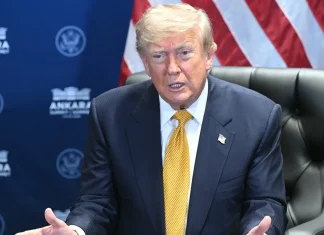
“It was a great meeting, there was a lot of love in that room, a lot of unity,” Mr Trump told reporters after the closed-door meeting of 32 heads of state at the NATO summit in the Turkish capital Ankara.
Behind closed doors, Mr Trump had reassured them he wanted the US to stay in the military alliance, saying: “We want to remain with you”, a source inside the session told AFP.
That message carried into NATO’s final text, which again underscored the alliance’s core pledge under Article 5 — the commitment that has long been treated as the bedrock of European security.
“An attack on one is an attack on all,” it said, in wording that sought to ease concerns about Washington’s commitment to the alliance.
NATO Secretary General Mark Rutte and US President Donald Trump gave a briefing earlier
The day had not begun well with Mr Trump lashing out over NATO allies’ failure to back his Iran campaign just before the session, threatening to cut trade with Spain, and insisting he still wants NATO member Denmark’s territory of Greenland.
“I’m very upset with NATO… because of what they did with Greenland, and… because of the fact that they didn’t want to help us with the number one state sponsor of terror, that’s Iran,” he said.
Earlier, the EU said that “decisions about the future of Greenland are for Greenlanders and Danes” after Mr Trump said he still wanted the Arctic island.
“Territorial integrity, national sovereignty and inviolability of borders are fundamental principles of international law,” EU spokesman Olof Gill said.
“The EU stands in full solidarity with Denmark and the people of Greenland.”
Mr Trump made it clear earlier that he has not dropped his desire for NATO member Denmark’s territory of Greenland.
He was speaking during a briefing with NATO Secretary General Mark Rutte.
“Greenland is a big problem for us,” Mr Trump told reporters, saying it was “very important for the United States, but it’s not important for Denmark”.
“We need it for protection of the world, not just the United States.. It doesn’t help Denmark, but it helps us.”
“In fact, when Denmark was overrun by the Nazis in less than one day – Hitler beat them out in one day, took over – they asked us to take care of Greenland.
“In fact, we took Greenland, and then stupidly we gave it back.”
Danish reporter asks NATO’s Rutte about Trump’s toll on his ‘self-respect’
Mr Rutte insisted that the US and Denmark would stick to a deal to hold talks over potentially increasing the US footprint on the Arctic island.
Danish Prime Minister Mette Frederiksen insisted that Copenhagen remained clear that Greenland is “not for sale”.
NATO allies had shown resistance to Mr Trump’s position that the Arctic territory should belong to the United States and not Denmark.
“I’m not happy with NATO because of what they did with Greenland, and I’m not happy with NATO because of the fact that they didn’t want to help us with the number one state sponsor of terror, that’s Iran. They were unwilling to help us,” the US President said.
UK Prime Minister Keir Starmer and US President Donald Trump during the summit in Turkey
Trump orders halt to US trade with Spain over NATO spending, Iran
Tensions sharpened further when Mr Trump ordered an immediate halt to all trade with fellow NATO member Spain, a dramatic step linked to disputes over defence outlays and his Iran war — even though European Union rules require trade negotiations to be handled by the EU as a single bloc.
It was the second time he has instructed Treasury Secretary Scott Bessent to halt commerce with Spain over its refusal to commit to NATO’s new defence spending target of 5% of GDP.
However, after his first such promise in March, trade between the two countries continued normally.
“Spain doesn’t agree to anything, and you shouldn’t carry them,” he told Mr Rutte, who later tried to soothe the tension by saying that Spain “made a huge step last year” raising its spending to 2%, although he added that “there are still issues we have to solve”.
“I don’t want to do any trade with them, alright?” Mr Trump said, turning to Mr Bessent, who replied: “Yes, sir.”
Mr Trump then added: “Take it immediately. Don’t even talk to them. They’re hopeless. They’re bad people … They make so much money with us, and we’re going to see that they make a lot less.”
Spanish Prime Minister Pedro Sanchez said his country’s ties with the US were “very positive” despite Mr Trump’s latest threat to cut off all trade.
“Relations between the United States and Spain are very positive relations in social, cultural, economic and also political terms.”
It is unclear what power Trump would have to end trade with Spain, after the US Supreme Court struck down his use of emergency powers to impose arbitrary tariffs.
Mr Sanchez said he held “an informal chat” with Mr Trump in Ankara about football and “there was absolutely no kind of tension”.
“On the contrary, everything was kind words and friendliness,” he said.
Donald Trump said he did not want to talk to Spain on trade
Bark worse than bite
Once leaders moved into the private session, Mr Trump’s approach appeared to soften, according to a source present for the talks.
“There is a strong contrast between what Trump says in public and what he actually says inside,” he told AFP.
The source said Mr Trump also toned down his earlier language on Iran — after previously describing Iranians as “scum” and “vicious, violent people” — with his comments in the room “not as harsh”.
He made no further mention of Spain or Greenland.
Estonian Prime Minister Kristen Michal said Mr Trump’s message inside the meeting was steadier, describing it as “kind of constructive… that Europe must step up, invest more in defence”.
“So it was kind of a good mood with sort of constructive messages,” he said.
Lithuanian Foreign Minister Kestutis Budrys urged observers not to treat Mr Trump’s flare-ups as proof of NATO coming apart.
“I wouldn’t see in it an indicator that we are somehow weakening NATO, and that the transatlantic bond is not there,” he said.
“I think we should dramatise things less.”
On the eve of the key session, the alliance published figures showing core defence spending by Europe had risen by 11% in 2026 and would hit $634bn (€554bn), up from $571bn (€499bn) a year earlier.
A Turkish Stars NF-5 aircraft seen after completing a demonstration flight during the NATO Summit
With allies eager to avoid another clash with Mr Trump, they rolled out tens of billions in new arms contracts — a show of intent aimed at demonstrating progress on commitments to spend more on defence.
Mr Rutte said allies were “delivering” by moving to take more responsibility for the defence of their continent in the face of Russia.
“This is a big win for the American president.”
Mr Rutte insisted the alliance was emerging stronger from the summit in Turkey, despite the disagreements.
“I always felt that families where sometimes you have a heart to heart and sometimes you fight each other a bit are much stronger,” he said.
Boost for Ukraine
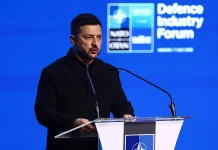
Ukraine remained central to the summit discussions as stalled efforts to halt the war returned to the agenda and Mr Trump held talks with Mr Zelensky on the sidelines.
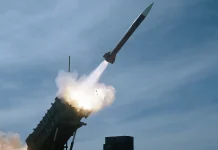
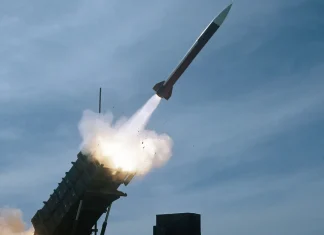
Mr Trump pledged to give Kyiv “the right to make” Patriot air-defence missiles, a notable offer as Ukraine struggles to blunt Russian ballistic attacks while supplies of US-made Patriot interceptors dwindle.
“We’re going to give a licence to you to make Patriots. That’s pretty cool, right,” Mr Trump told Mr Zelensky, whose forces have been struggling to shoot down Russian ballistic missiles as supplies of crucial US-made Patriot interceptors run low.
President of Turkey Recep Tayyip Erdogan (right) welcomes US President Donald Trump and NATO Secretary General Mark Rutte
Despite Moscow’s heavy bombardments in recent days, Kyiv appears to be turning the tide by stabilising the front line and conducting strikes deep into Russia – strikes that Mr Trump said could help end the war.
“It’s an escalation, but it’s also an escalation that can help lead to an end,” he added, repeating his belief that both Mr Zelensky and Russia’s Vladimir Putin wanted to strike a deal to halt the fighting.
Also in the final NATO declaration, Europe and Canada pledged to keep military support flowing to Ukraine to the tune of €70 billion a year in both 2026 and 2027.
Before leaving Ankara, Mr Trump was also set to hold talks with Syrian President Ahmed al-Sharaa as he seeks to rebuild the country’s international image as it emerges from years of civil war.
Erdogan gifted fellow leaders pistols – Starmer
Turkish President Recep Tayyip Erdogan offered a pistol as a gift to each of his fellow leaders who attended this week’s NATO summit in Ankara, British Prime Minister Keir Starmer has said.
Mr Starmer, speaking to reporters on his flight home, said the pistols were inscribed with the name of each leader and accompanied by a box of ammunition.
Mr Starmer said he had to leave his gift in Turkey because importing it into Britain would be illegal, despite a letter from Erdogan lifting export controls on the weapons.
The NATO summit was the last major international event for Starmer, who announced his resignation on 22 June.
He will remain in office until a new prime minister is chosen within the ruling Labour Party, with former Manchester mayor Andy Burnham now looking likely to run unopposed.