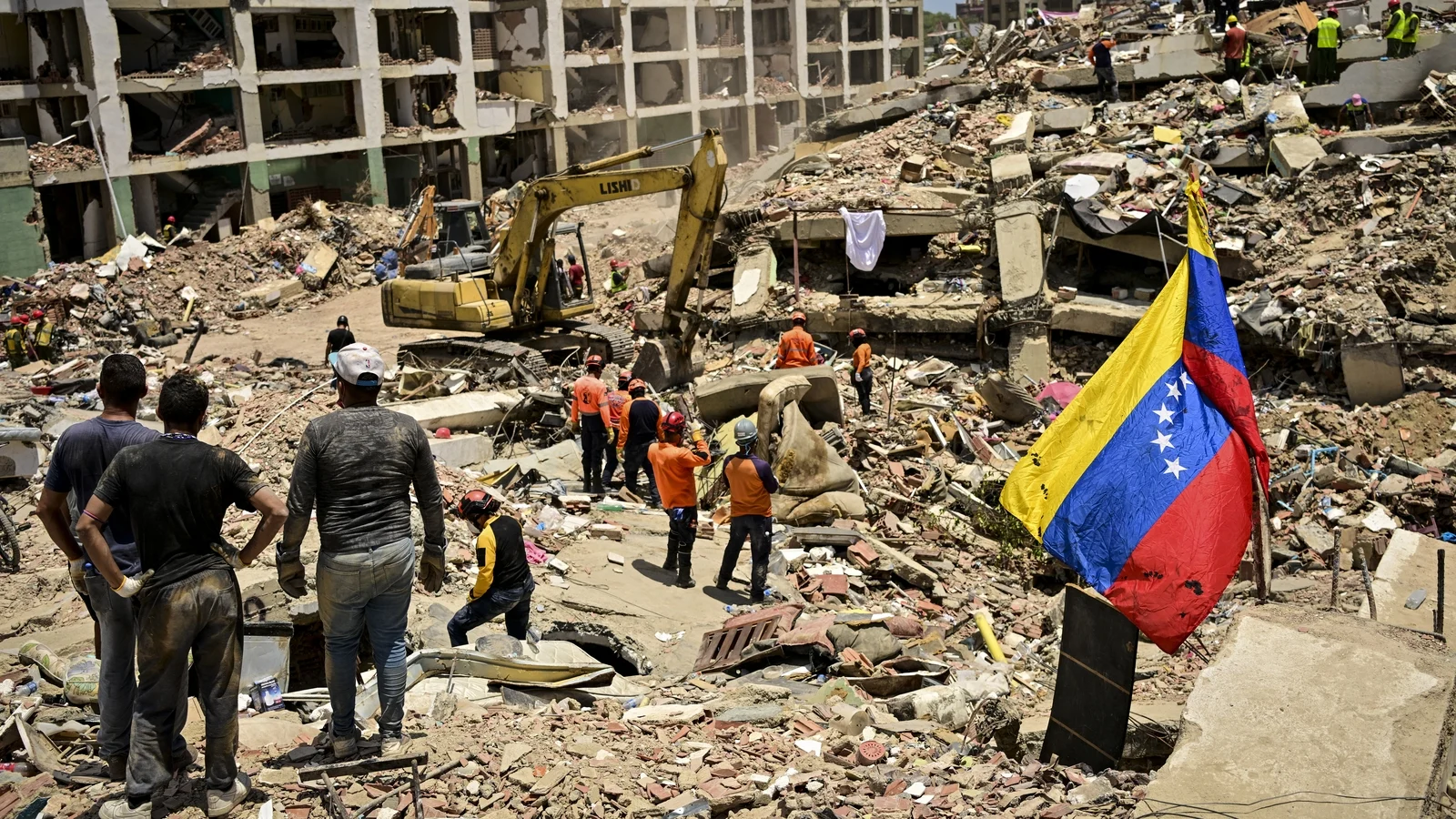
A devastating earthquake catastrophe in Venezuela has prompted the United Nations to seek nearly $300 million (€262m) in emergency funding, as the confirmed death toll climbed above 3,600 and families in hard-hit areas continued searching the rubble for missing relatives.
Humanitarian needs remain immense after one of Latin America’s most severe earthquake disasters, with thousands left without homes and many others still unaccounted for. In La Guaira, where destruction has been extensive, residents have been seen digging through debris in the hope of recovering the bodies of loved ones.
“Donors are already stepping up, and I pay tribute to them, and I thank them,” UN humanitarian chief Tom Fletcher said during a meeting on the disaster.
He said officials were requesting $296 million to deliver critical assistance to 1.3 million people over the next six months.
Caracas also used the UN forum to press for access to funds it says are currently out of reach, arguing the money is needed to finance recovery.
“We call upon all countries currently holding blocked funds belonging to Venezuela to initiate a plan to release these funds so that they can be used for recovery efforts,” Foreign Minister Yvan Gil told the UN meeting.
“There are accounts belonging to the Venezuelan state in various parts of the world that have been frozen as a result of illegal sanctions.”
Mr Gil pointed specifically to gold held by Britain and financial assets frozen by the United States.
The US government has already lifted a number of economic sanctions against Venezuela for four months to facilitate relief operations.
Washington had imposed sweeping economic sanctions on Venezuela, particularly from 2019 onward, in an effort to squeeze the leftist government of president Nicolas Maduro, whom the United States considered illegitimate.
Since US forces toppled Maduro in January, ties with Caracas have improved.
The Trump administration has supported interim president Delcy Rodriguez and has gradually eased sanctions, particularly to facilitate the development of Venezuela’s huge oil reserves.
Even before the 24 June tragedy, Venezuela was already grappling with years of economic turmoil that weakened infrastructure and strained health services.
The UN estimates the quakes caused $6.7 billion (€5.86bn) in damage – equivalent to 6% of Venezuela’s GDP.
Damage also hit the international airport serving Caracas, which remains closed to commercial flights.
Venezuela quake survivor ‘reborn’ after 8 days in rubble
Now in hospital, Hernan Gil managed to talk to his children via video call accompanied day and night by his wife
One survivor of Venezuela’s twin earthquakes has described a harrowing week trapped beneath a collapsed building, a story that has resonated across the country as rescue crews continue their work.
Hernan Gil was on duty as a security guard in the basement of a building on the afternoon of 24 June when the shaking began.
Speaking to AFP from his hospital room after his rescue, Mr Gil said the first tremor was brief.
His survival — eight days buried alive after the double quake devastated the country’s north and left at least 3,535 people dead — turned him into a rare symbol of hope amid the scale of loss.
“The second one was incredibly strong,” said the 43-year-old, recalling how he froze inside his guard booth, gripped by fear.
Watch moment Hernan Gil pulled out of rubble alive after eight days
He said he heard a neighbour in the car park identify what was happening — and then, in an instant, “everything collapsed”.
As the structure gave way, Mr Gil said debris struck the back of his head and his eye.
“I lost consciousness for a moment. When I woke up, everything was dark… From then on, everything was uncertain.”
Unable to see and unable to hear anyone nearby, he tried calling out to the neighbour he had last noticed moments before the building fell, “but nothing”.
“At that moment, despair overwhelmed me,” Mr Gil said, describing how he shouted for help but heard no reply.
In pitch darkness — partly kneeling, fighting for air and almost unable to move — he endured one aftershock after another.
“I felt like the wall was completely crushing me.”
Hernan Gil is seen carried on a stretcher away from the scene
There were jubilant scenes among rescue teams after Hernan Gil was pulled from the rubble
‘I prayed a lot’
Seventy-two hours after being brought out alive from beneath the remains of the eight-storey building, Mr Gil appeared upbeat despite his ordeal.
Sitting in an armchair in a blue hospital gown, his left arm supported in a sling, he said faith helped him hold on through the long hours underground.
“I prayed a lot. I cried out to God, and I said, ‘My God, why me? Why like this? Please, at least let me see my children.'”
Trapped in an awkward position, he said he tried to shift onto either side but could not sleep.
He later learned his legs were bruised from the rocks beneath him; his nose had bled; and his right eye was swollen and red, though he said he did not realise the extent of his injuries at the time.
Alone in the darkness, he thought of his wife, Gusbimar Gonzalez, who was outside searching desperately for any sign of life.
He said his mind also went to his children and to his late father.
“So many memories came flooding back,” he said.
Time blurred, he added, until the third day, when he detected footsteps, “but very far away”.
Rescuers from Chile and the US reached Hernan Gill after more than three days of complex operations
He began yelling again, and this time he finally heard an answer.
Mr Gil said — smiling as he recalled it — that his first thought was, “Oh my God, there’s a step. There’s a glimmer of hope.”
What followed was an exhausting extraction effort that he called “a fierce struggle”.
‘I was reborn’
As rescue teams from seven countries worked to reach him — bringing water and trying to keep his spirits up — Mr Gil said he could feel the shifting debris tightening around him.
When two rescuers from Chile and the United States ultimately reached him after more than three days of complex operations, he said he could not immediately celebrate.
“The hardest part was getting out,” recalled Mr Gil, explaining that his legs had become tangled in a chair.
He said he believes he survived a miracle that changed his life.
“I was reborn,” he said.
From his hospital bed, Mr Gil has managed to speak with his children by video call and says he is eager to return home, though doctors have not yet told him when he will be discharged.
Sleep comes more easily now, he said, but the memories of being buried sometimes jolt him awake.
With his wife staying by his side around the clock, Mr Gil said he does not yet know what his next chapter will look like.
For now, he said he is focused on celebrating his son’s birthday on 15 July, taking long-delayed holidays at the beach — and one firm resolve: he will never work in a basement again.