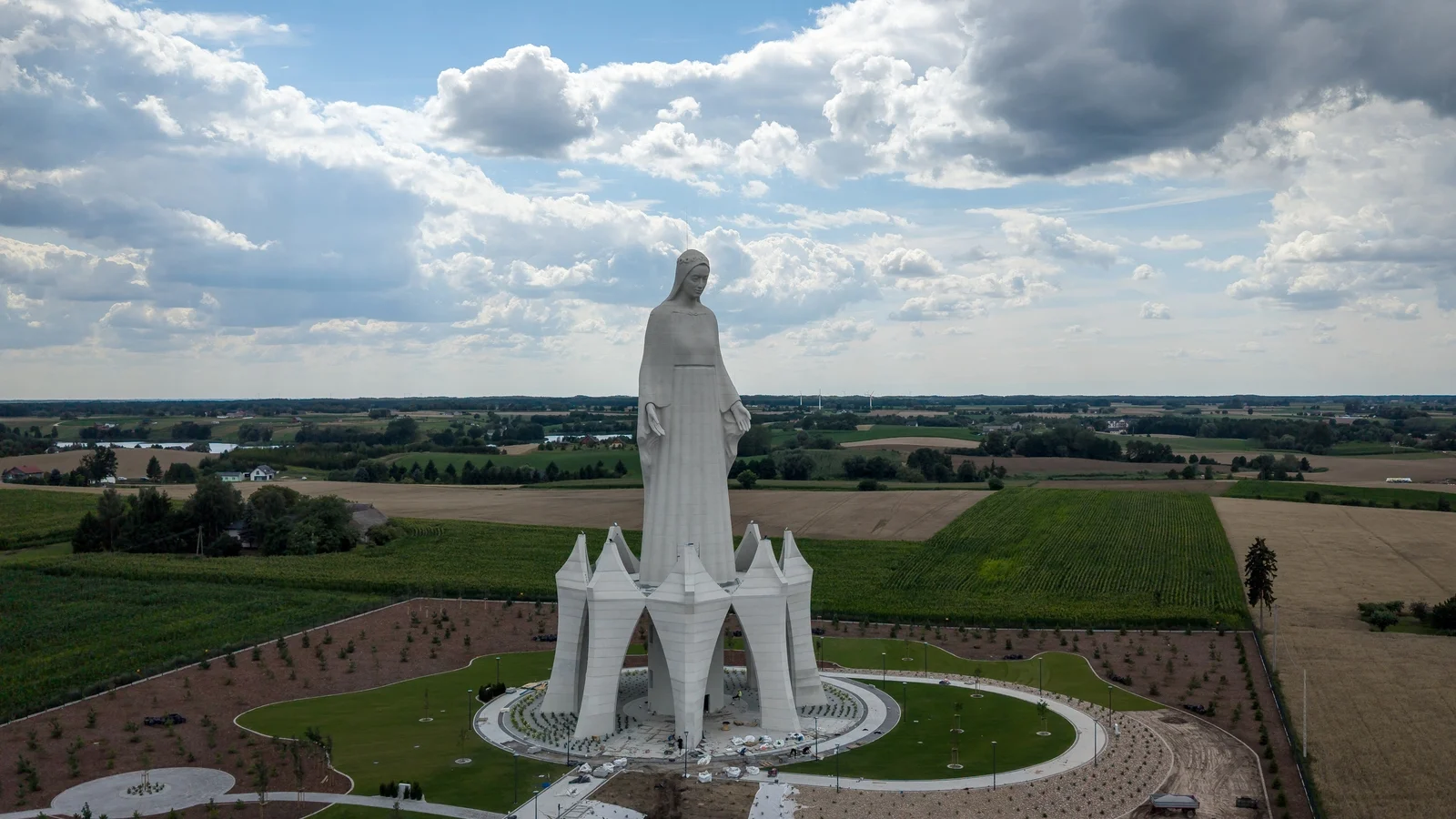
A towering new Virgin Mary statue is rising over the Polish village of Konotopie, and locals hope the colossal monument—financed by a billionaire—will turn their rural community into a destination for pilgrims.
Standing 55m tall and built from concrete and steel, the figure is the tallest Marian statue in Europe and the second-highest in the world, behind the 98.15m Mother of All Asia statue in the Philippines.
The monument is scheduled to officially open after a blessing ceremony on Assumption Day, 15 August, the Catholic feast dedicated to the Virgin Mary. For now, the site still looks like a work zone: the statue remains unfinished, and concrete blocks and debris lie scattered across a muddy parking lot.
Even so, in a country long regarded as a Catholic stronghold, visitors are already streaming to Konotopie—some driven by devotion, others simply by curiosity.
“There was scaffolding (and) you could not see anything, but there were coach buses coming,” said Andrzej, a security guard at the statue, describing the early rush of interest.
Local media estimate the Konotopie Virgin Mary project at about 100 million zlotys (€22.85 million).
The entire bill is being covered by billionaire Roman Karkosik, 75, who is frequently listed among Poland’s wealthiest tycoons.
For many who make the trip, the price tag is beside the point.
“People come here … in search of faith,” visitor Marek Gizinski told AFP, calling the monument “something monumental”.
“And just like with any miracle… you just can’t forget about it, because it’s simply impossible to forget,” he said, looking up at the Virgin.
Construction at Konotopie began in March 2025
Still, the enormous statue has its critics. Some residents argue it is a questionable way to express Catholic faith in a country already filled with religious landmarks, including numerous monuments dedicated to Polish Pope John Paul II.
Poland’s best-known Marian pilgrimage site remains far from Konotopie: the revered “Black Madonna” painting in Czestochowa in southern Poland, which draws between 3.5 and five million pilgrims each year.
Rather than funding a massive statue, the money “should be invested in a hospital or orphanage,” a married couple from Sierpce—about 30km from the monument—told AFP.
Construction at Konotopie began in March 2025, reportedly as a religious gesture by Karkosik and his wife.
“Last Sunday he visited the construction site from the backseat of his Maybach”, the security guard told AFP.
Karkosik, founder and principal shareholder of industrial group Boryszew, lives nearby in the small town of Kikol, in a restored 18th-century palace opposite the parish church.
Local officials are betting the statue will do more than draw visitors—it could also lift the local economy.
“I have not heard any negative opinions … everyone is rather satisfied,” said Renata Golebiewska, the mayor of Kikol.
She said she hopes the investment will “be a chance for (the area) to grow, and create new jobs”.
The stakes are high in a community with limited resources. Finance ministry data show that in 2024, Kikol’s municipal tax revenue per capita was just 1,117 zlotys (€259), placing it among the poorest municipalities in the region.
Just one kilometre from the new statue, a smaller echo of the project already stands: along the outer wall of Kikol’s parish church is a bronze figurine that closely resembles the larger monument.
A scale model by sculptor Adam Matejowski was installed there in 2024 as a preview of what would follow.
The Catholic Church remains deeply woven into Poland’s national identity, and the Virgin Mary is widely regarded as the country’s patron and protector—even as the country experiences one of the world’s fastest rates of secularisation.
In Poland’s 2021 census, 71% of residents identified as Roman Catholic, down from 88 percent a decade earlier.
“We hope this place will bear the fruits of a deeper return to faith, or at least help people deepen their faith,” said parish priest Marek Mrowczynski.
But some visitors question whether monumental displays can counter what they see as a broader spiritual drift.
“Right now, in 90% of cases, everyone’s thinking about what they’re going to get out of it, how much they’ll get out of it, what they can claw out of it for themselves,” said Wanda, who travelled from the city of Plock with two friends to see the statue.