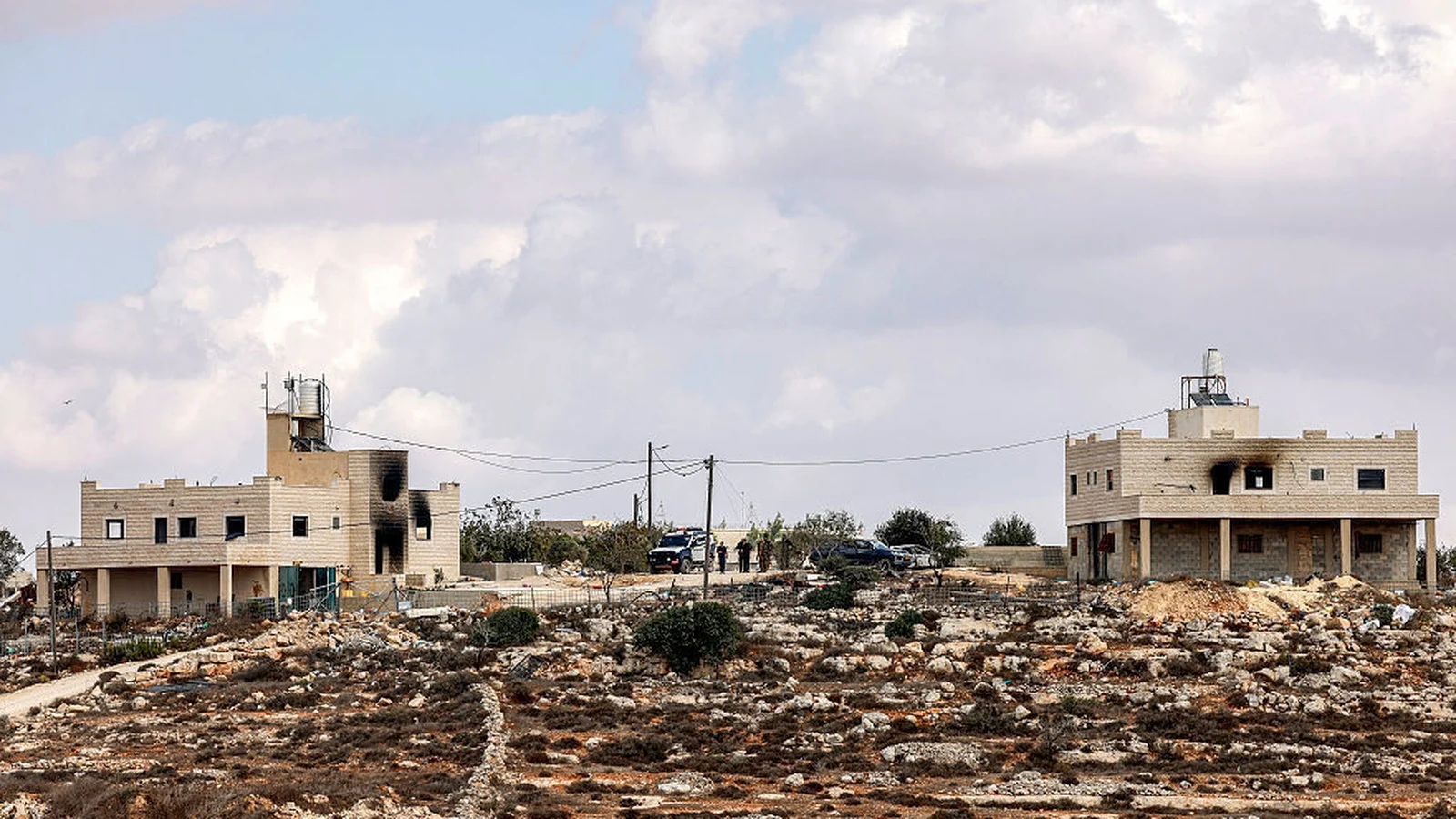
A predawn assault by more than 100 Israeli settlers on a Palestinian village in the occupied West Bank has triggered an unusually blunt rebuke from Israel’s leadership, after three members of the security forces were injured trying to restore order.
The raid, and another attack on a separate West Bank village, unfolded as international scrutiny of settler violence intensifies — an issue Israeli Prime Minister Benjamin Netanyahu sought to play down in a speech to the United Nations last week.
According to accounts from the ground, settlers descended on Jalud in the northern West Bank as Israeli troops attempted to escort a Palestinian family back to their home, two months after the family said it was driven out by earlier settler attacks.
In a statement, the Israeli military said “more than 100 Israeli rioters” were present overnight and that soldiers and border police moved in to disperse them.
“As a result of the clashes, three Israel Border Police officers were lightly injured, and a security forces vehicle was damaged,” it said.
Police said one person was arrested, and two minors were taken in for questioning.
The military described a chaotic scene: it said settlers blocked roads, burned tyres and hurled stones at security forces, while also setting fire to Palestinian buildings and vehicles inside the village.
It said the violence ultimately stopped the displaced family from returning home, noting they had left after “several incidents of (Israeli) nationalist crime against them”.
Israel has occupied the West Bank since 1967 and has been accelerating settlement expansion. Some 500,000 Israeli settlers live among three million Palestinians.
Mr Netanyahu condemned the attack, saying it was carried out by “a small group of rioters”.
Their actions “cause great harm to that community and interfere with our forces as they carry out their mission,” he said.
President Isaac Herzog, whose role is largely ceremonial, issued an even sharper denunciation, calling the assault “a moral stain, an assault on the rule of law and our most fundamental values as a people and a nation”.
Public criticism at that level is rare when Palestinians are the victims. The United Nations says settler attacks against Palestinians — including beatings, vandalism and arson — averaged six a day in the first half of the year.
At the same time, recent weeks have brought prominent attacks against Israelis in the West Bank as well, including the shooting death of a settler by a Palestinian.
Israel has voiced outrage and imposed diplomatic repercussions after Britain, the Netherlands and other countries have imposed sanctions against products from Israeli settlements in the West Bank, which are illegal under international law.
Rising settler ambitions
Mahmoud al-Toubasi, a member of the family seeking to return to Jalud, said his relatives left their home more than two months ago and that settlers had occupied it until the latest violence.
“My wife, my son and I went to the house in the car, accompanied by an army vehicle in front of us and another behind us,” he said.
He said settlers attacked as they reached the house, and that soldiers drove them back using pepper spray.
Elsewhere in the West Bank, another incident was reported when dozens of settlers from hilltop outposts raided al-Mughayyir, a Palestinian village northeast of Ramallah.
The area has seen repeated attacks, which residents and observers link to its isolated geography and the presence of several settlement outposts in close proximity.
Separately, Palestinian witnesses and local authorities said hundreds of Israeli settlers entered the Al-Aqsa Mosque compound and the nearby Bab al-Rahma cemetery in occupied East Jerusalem during Sukkot.
Witnesses said groups entered the compound through the Moroccan Gate from around 7am, moving through the courtyards while performing religious prayers and rituals associated with the festival. Gatherings were also reported at the adjacent Bab al-Rahma cemetery, where participants prayed and sang near the site’s eastern wall.
In another development, dozens of settlers gathered in the town of Beitunia near Ramallah to hold Sukkot prayers using loudspeakers, according to Mayor Ribhi Dawla.
“This gathering is a dangerous precedent,” he said. “There are ambitions for settlements in the area, they placed a caravan in the western part of the town and installed an iron gate.”
This month’s Jewish holiday period began with Rosh Hashanah and continued through Yom Kippur and Sukkot, with Simchat Torah expected later this week.
Violence has increased in the West Bank since the start of the Gaza war in October 2023. According to an AFP tally based on Palestinian health ministry data, at least 1,111 Palestinians have been killed by Israeli soldiers or settlers during that period, while Israeli figures show at least 49 Israelis have been killed in Palestinian attacks or during Israeli military operations.
Separately, an Israeli airstrike killed Izz al-Din Al-Beik, the head of Hamas’s armed wing in northern Gaza, according to Israeli and Palestinian officials.
Israeli Prime Minister Benjamin Netanyahu and Defence Minister Israel Katz said the Israeli military had targeted and killed Mr Al-Beik, whom they accused of being involved in planning attacks and recruiting militants.
Hamas confirmed his death in a statement after a strike that medics said hit an apartment building in Gaza City’s Nasr neighbourhood around dawn.
Health officials said another person later died from wounds sustained in the attack.
Israel, which says Hamas has been rearming and launching attacks in violation of an October ceasefire, has stepped up strikes against the group in recent weeks.
Yesterday, Israeli strikes killed at least two Palestinians and wounded several others in two separate attacks in Gaza, according to health officials in the enclave.
Medics said a woman was killed and her husband and several others were wounded in a strike on the roof of a residential building in Gaza City.
In a separate attack, another woman was killed and several people were wounded in the Nuseirat refugee camp in central Gaza.
The Israeli military said it had targeted a militant in Nuseirat but provided no further details.
The military says it has killed at least 20 Hamas figures this month, including people it identified as senior commanders and others who took part in the 7 October 2023 attacks or held Israeli hostages.
Hamas has denied attempting to carry out attacks or rebuild its arsenal and has accused Israel of undermining the Gaza ceasefire agreement.
A US-brokered ceasefire agreed last year calls for the eventual reconstruction of the territory, but little progress has been made as negotiators have failed to agree terms for Hamas to disarm and for Israel to withdraw its troops.
According to Gaza health officials, at least 1,400 Palestinians have been killed since the ceasefire took effect, while the Israeli military says four Israeli soldiers have been killed.
Palestinian authorities say more than 73,000 people have been killed in Israel’s military campaign in Gaza, launched after Hamas-led militants killed about 1,200 people in southern Israel in October 2023.