As rescue crews in Colombia raced against the clock after a devastating earthquake, the European Union said it is stepping in with funding and satellite support to bolster relief efforts that have already followed more than 100 deaths.
The EU is backing operations on the ground after yesterday’s quake, according to EU foreign policy chief Kaja Kallas.
“The EU has mobilised Copernicus, our satellite service, to support rescue and relief operations. We are providing funding to support the response, including through the Red Cross,” Ms Kallas posted on X.
“We have also activated the EU’s crisis consular assistance mechanism to support EU citizens caught in the disaster,” Ms Kallas said.
Watch: People search rubble for survivors in aftermath of earthquake
Across western Colombia, rescue work pressed into a second day today, with emergency teams digging through collapsed buildings and crushed homes as officials warned the toll from the country’s most powerful earthquake in decades could still climb.
The 7.4-magnitude earthquake struck Colombia’s coffee-growing heartland yesterday, leaving at least 164 people dead.
In cities including Pereira and Cali, multi-storey buildings were reduced to rubble, while in Manizales one of the towers of a historic cathedral was split apart.
A man carries a dog as he walks past the rubble of a collapsed building in Pereira, Colombia
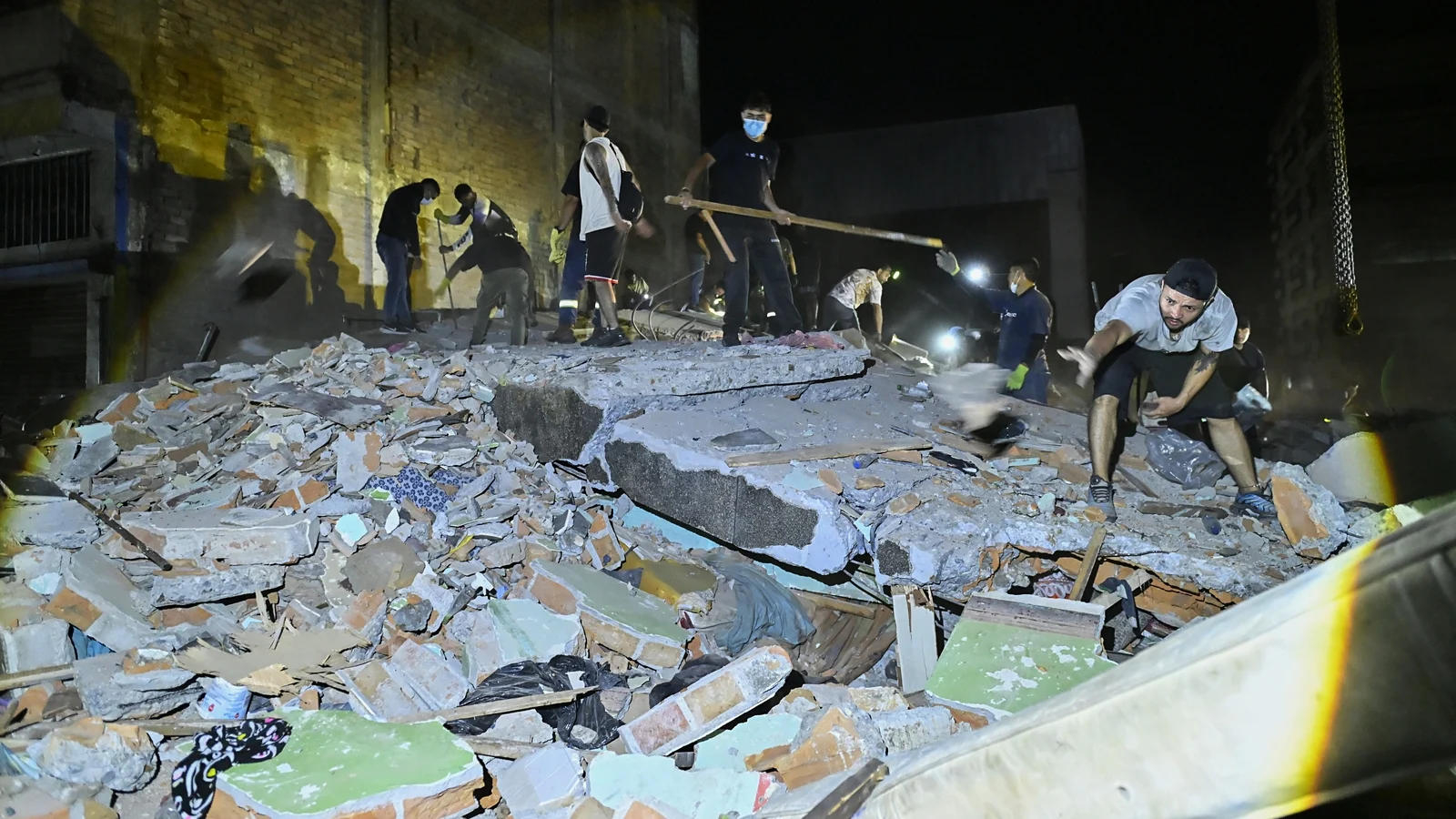
Emergency workers, supported by police, soldiers and volunteers, laboured through the night — using excavators when possible and their hands when necessary — searching for survivors beneath shattered concrete and twisted metal.
In Cali, a city of about 2.2 million people, at least 85 people were killed. The quake left dozens of buildings destroyed or dangerously tilted, driving many residents out into the streets.
Parts of one hospital also gave way. Several upper floors — including areas dedicated to paediatric care — collapsed in on themselves, trapping some patients and pushing medical staff to treat around 600 others outside on a rubble-littered street, hospital director Irne Torres Castro told Caracol television.
People are pulled from a collapsed building after an earthquake in Cali, Colombia
Carmen Yasmin Garcia, 43, a resident of Cali who joined volunteer rescue efforts, said yesterday afternoon that her group had pulled seven people from a collapsed building, but that four others — along with a dog — were still inside.
“A moment ago there was scratching, but now we can’t hear anything; we still have faith that the dog is alive and we can get these people out,” Ms Garcia said. “We need people with sticks and spades; the more people lending a hand, the better.”
In Pereira, the capital of the severely affected state of Risaralda, authorities reported 66 deaths.
There, some of the most striking damage was visible: whole residential blocks were turned into mounds of concrete and mangled steel. Footage shared on social media and verified by Reuters showed the city’s airport shaking violently during the tremor, with large sections of ceiling falling as people took cover.
A further 13 people were reported dead in Choco, the rural province closest to the quake’s epicentre.
Security forces headed to Cali
President Abelardo De La Espriella, who took office only days ago, said 35 people had died in Cali alone and that 188 were missing. He said 1,000 members of the security forces would be deployed to the city by dawn after reports of looting. Cali and Pereira both imposed curfews last night.
“Our intention is to cooperate in any way necessary. Here, there are no distinctions or ideological divisions when it comes to defending our people or showing solidarity,” Mr De La Espriella told journalists yesterday evening.
The disaster has revived memories of a deadly 1999 earthquake that ravaged the same coffee-growing region and killed more than 1,000 people, and it has also been compared to catastrophic quakes in neighbouring Venezuela in June that claimed more than 6,300 lives.