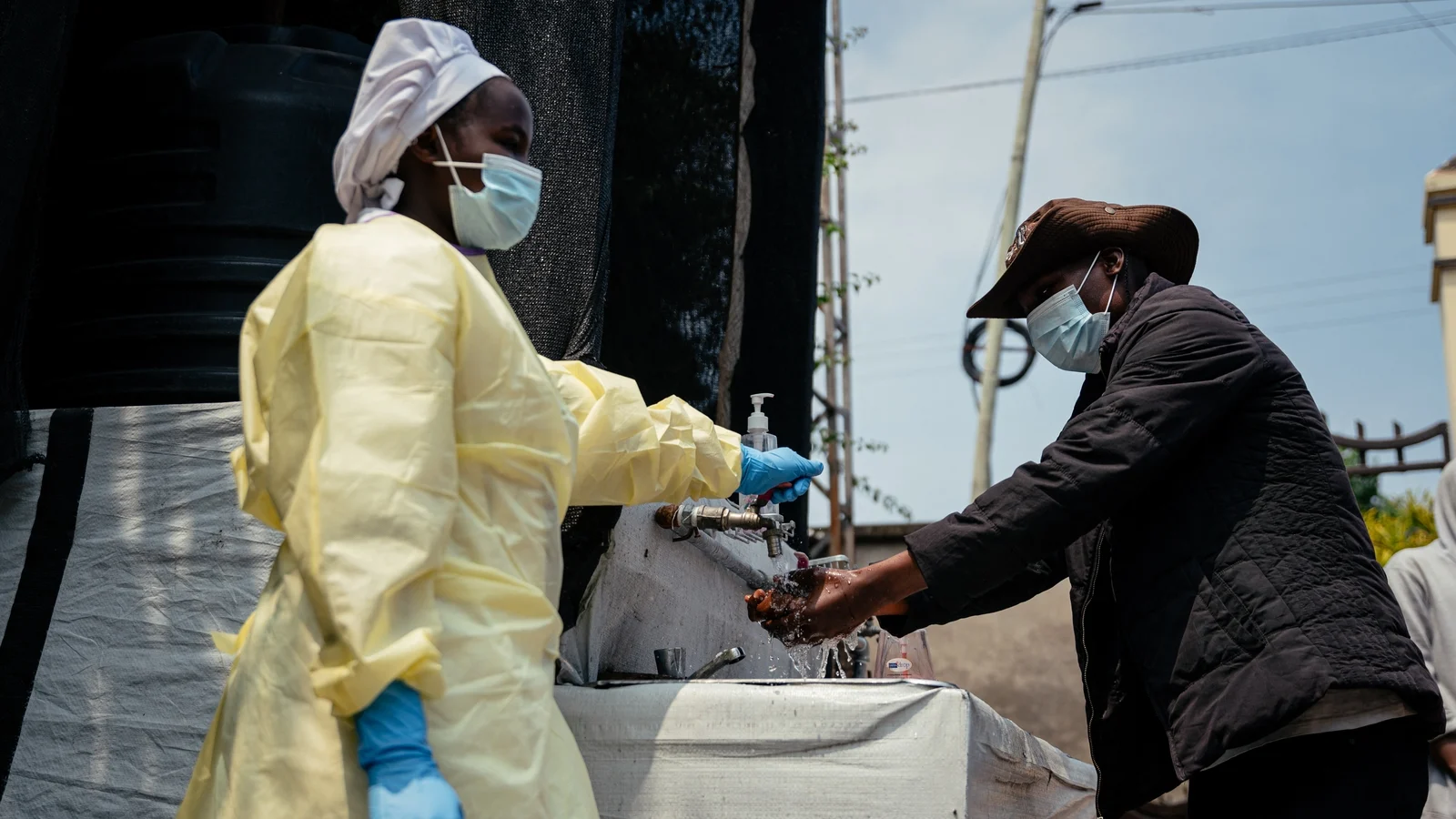
More than 2,000 people have now died in the Democratic Republic of Congo’s latest Ebola outbreak, pushing the crisis toward the scale of the country’s deadliest episode on record.
The outbreak, concentrated in the DRC’s conflict-hit eastern and northeastern areas, was officially declared on 15 May, though health officials believe the virus had already been circulating for several weeks before that announcement.
This is the DRC’s 17th resurgence of the highly contagious disease and is already being described as the largest outbreak the country has faced. Sania Nishtar, chief executive of the Gavi global vaccine alliance, said it is the biggest in the DRC’s history “and could well become the largest outbreak ever”.
New figures from Congolese health authorities put the toll at 2,011 deaths from 4,381 confirmed cases.
That total brings the current outbreak close to the DRC’s worst Ebola emergency, which ran from 2018 to 2020 and killed nearly 2,300 people out of 3,500 recorded cases.
The surge started in Ituri province in the northeast before spreading into other provinces, including North Kivu—areas where health services are limited and government presence is often minimal.
Congolese health authorities estimate the current case fatality rate at 45.9%.
“We haven’t reached the peak yet,” Health Minister Samuel Roger Kamba said in an interview his ministry shared on X.
“Within the next three months, we expect to have already brought the spread under control and to start seeing it decline,” he added.
‘Slow’ response
Efforts to contain the outbreak have been complicated by insecurity linked to armed groups and by mistrust among local communities in affected areas, factors that have repeatedly challenged public health campaigns in the region.
“We are only seeing 30% (of infected people), where 70% of people are dying at home. This is why this Ebola is different,” Mohamed Yakub Janabi, the World Health Organization’s regional director for Africa, told reporters Monday in Bunia, the provincial capital of Ituri.
Jean-Jacques Muyembe, a Congolese virologist who helped discover Ebola in 1976, said the response has fallen short. Speaking to Le Monde in an interview published Tuesday, he described it as “slow and ineffective”.
“There is an internal problem at the level of the national coordination of the response,” he said.
“Everyone wanted to show they were doing something, even though nothing had actually been organised,” he added.
Clinical trials
On Friday, WHO vaccine experts advised moving ahead with a full-scale human trial of the only approved Ebola vaccine to determine whether it can provide cross-protection against the strain now spreading in the DRC—one for which no dedicated vaccine currently exists.
The Ervebo vaccine has been shown to be safe and effective against the more common Zaire strain of the Ebola virus. WHO experts said early evidence, including findings from animal studies, suggests it could also offer some protection against the rarer Bundibugyo strain now surging in the DRC.
Gavi—founded in 2000 to help developing countries secure affordable vaccines—holds a stockpile of 500,000 doses of Ervebo.
The alliance said doses from that reserve would be provided for the trials, with some already in the DRC.
Two candidate vaccines targeting Bundibugyo are in early-stage human clinical trials, while work continues on a third to advance it to that point.
Ebola spreads through contact with bodily fluids and causes a haemorrhagic fever.
Over the past 50 years, it has killed more than 15,000 people in Africa.