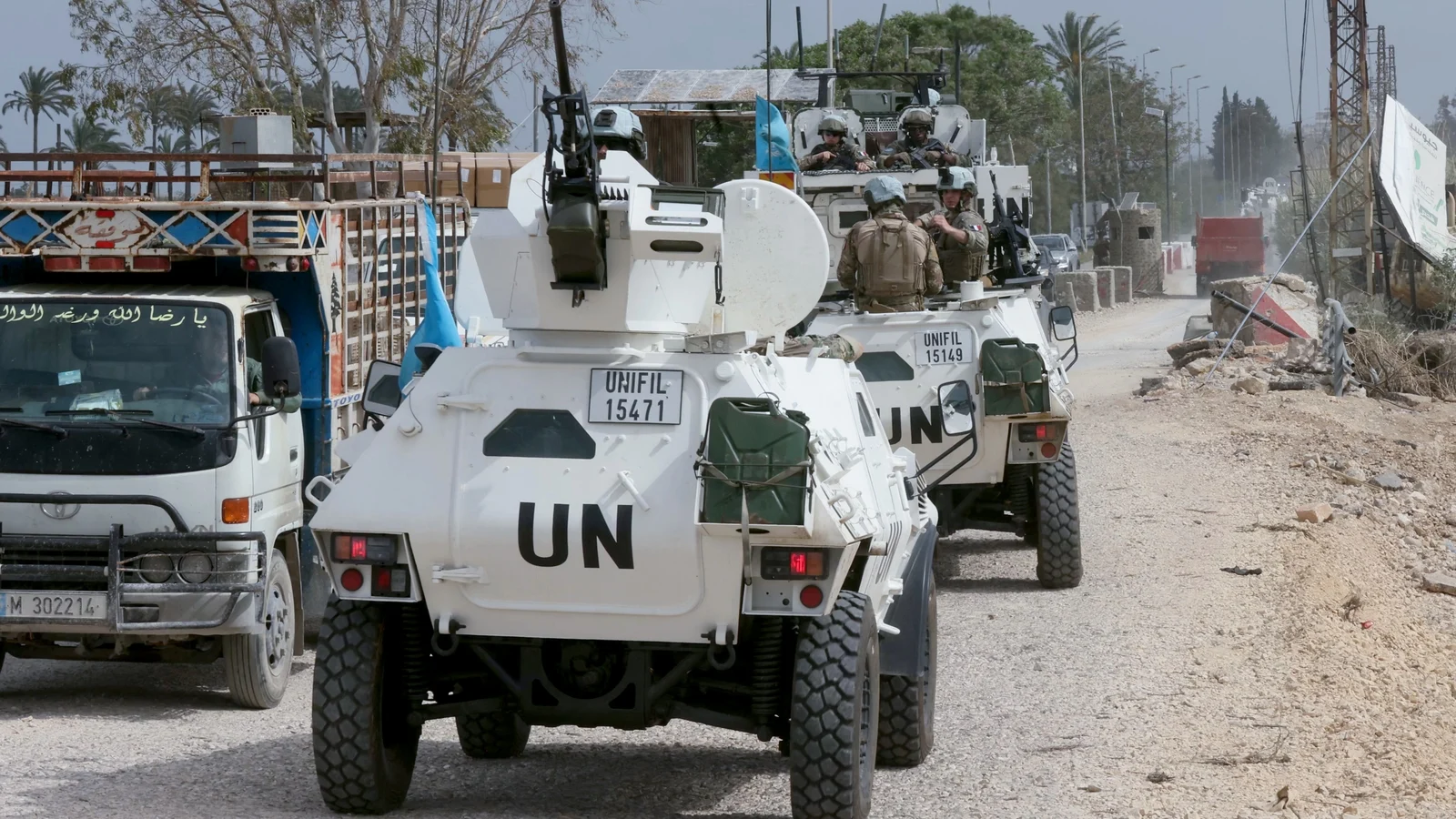
As the clock ticks down on the UN peacekeeping mission in Lebanon, the Taoiseach has drawn a clear red line: Irish troops cannot stay on without a United Nations mandate.
Micheál Martin said that without backing from the UN Security Council, “we would not be in a position to participate in any post-UNIFIL force that may be pulled together.”
Calling the looming end of the operation a “big concern”, the Taoiseach warned that “if there’s a complete pullout of Lebanon, that could lead to a deterioration of the situation from a humanitarian point of view.”
Mr Martin said Ireland could potentially assist in other ways, including training the Lebanese armed forces and “monitoring any peace agreement” between Israel and Hezbollah.
Yesterday, Minister for Foreign Affairs and Defence Helen McEntee said Ireland was working alongside other EU states to help support Lebanon once the current UNIFIL mission concludes in December.
She said there was a “desire to ensure that Irish peacekeepers remain on the ground” and added: “I utterly regret the fact that the Unifil mission is coming to an end.”
This evening, a spokesperson for Ms McEntee said: “The Minister for Defence has confirmed that it is her intention to see the legislation [amending the Triple Lock] enacted and commenced as soon as possible.
“In the event that any post UNIFIL mission of a peacekeeping nature in Lebanon lacks a UN security Council mandate, absent any legislative change, the Defence Forces (DF) will not be able to take part.
“If the legislation is changed, and the heads have been published, there may be possibility of participation on the basis as set out under the heads.”
Last month, 86 Lebanese politicians signed a letter urging the Security Council to keep the peacekeepers.
UNIFIL, which now counts some 7,500 personnel from nearly 50 countries, has been in place since 1978, although its presence has not prevented repeated outbreaks of conflict.
Members of the 128th Infantry Battalion on a training exercise prior to their deployment (Pic: Collins)
In May, 344 Irish peacekeepers were deployed to Lebanon with UNIFIL, which marked their final mission in this form.
The deployment of the 128th Infantry Battalion marked the end of an era spanning almost 50 years.
While there is hope Irish personnel will continue working in the region, what form any future presence might take remains uncertain.
The Government had signalled its intention to remove the requirement for UN approval when deploying more than 12 members of the Defence Forces outside the State, the third element of the “Triple Lock”.
Under existing rules, any foreign deployment of 12 or more Irish Defence Forces personnel can only take place when it has been approved by the Dáil, the Government and has received a United Nations mandate.
Irish troops will not be able to serve in Lebanon without UN mandate – Taoiseach
We need your consent to load this rte-player contentWe use rte-player to manage extra content that can set cookies on your device and collect data about your activity. Please review their details and accept them to load the content.Manage Preferences
The draft legislation proposed by the Government removes the requirement for United Nations Security Council authorisation.
Under the proposed bill, the number of soldiers that could be deployed as part of any mission would increase from 12 to 50.
It also planned to raise the threshold at which a Dáil resolution is necessary to when more than 50 members are deployed.
However, the legislation that would be required has not materialised, amid backbench and opposition concerns around the impact on Ireland’s neutrality.
Concern expressed over Triple Lock removal
Minister McEntee’s assertion yesterday that Ireland was “absolutely” among over 10 EU member states willing to contribute to a European mission in Lebanon has prompted concern both on the coalition and opposition benches amid Government plans to remove the Triple Lock this autumn.
Mr Martin, for his part, has insisted that troops cannot be deployed to Lebanon without UN approval.
However, if the Government proceeds with removing the Triple Lock, responsibility for authorising any deployment after UNIFIL ends would rest with the Cabinet and the Dáil — a shift that some critics argue would run against Ireland’s long-standing stance of neutrality.
Fianna Fáil Limerick City TD Willie O’Dea told RTÉ News he was “worried” that was proposed by Ms McEntee “could lead to a situation where Irish troops are deployed without the benefit of the backing of international law or sanction from the United Nations”.
Mr O’Dea led a group of Fianna Fáil backbenchers in June in writing a letter expressing opposition to Government plans to scrap the Triple Lock, noting how it constituted a “fundamental change” to Fianna Fáil policy.
He said Ireland should use its EU Presidency to secure UN General Assembly approval for any future mission in Lebanon, considering approval is not forthcoming from the UN Security Council.
The former minister for defence added how the Government should explore all avenues possible to secure UN backing for the deployment of Irish troops rather than proceeding to dismantle the Triple Lock.
McEntee comments ‘very, very concerning’ – Murphy
People Before Profit Dublin South West Paul Murphy told RTÉ News he found Ms McEntee’s comments yesterday “very very concerning” and “that it proves we [People Before Profit] are right to oppose the Government getting rid of the Triple Lock”.
Mr Murphy appealed to Fianna Fáil backbenchers to continue their questioning of the proposal to remove the Triple Lock, noting how it has already delayed the Government’s plans beyond the Dáil’s summer recess.
“What we’re talking about there is sending Irish troops to Lebanon not for peacekeeping but, as Kaja Kallas [EU Foreign Policy Chief] has said, for strengthening Lebanese armed forces. This is Irish troops intervening in an internal situation and civil conflict,” he said.
“This is a fundamental attack on what is left of our neutrality,” he added.
Sinn Féin’s spokesperson on Foreign Affairs and Defence Donnchadh Ó Laoghaire expressed similar sentiments.
“Ireland should be pursuing every avenue to make the case for a new UN-led peacekeeping mission in Lebanon, or for an extended mandate for UNIFIL – even at this late stage – because UN-led missions are the gold standard when it comes to ensuring missions meet their objectives, and in ensuring that international law is upheld,” he said.
The Cork South Central TD said he does not “support the deployment of Irish troops as part of non-UN mandated peacekeeping missions and there exists no provision in international law for the establishment of peacekeeping missions that are not sanctioned by – or that do not support the implementation of – a UN resolution”.