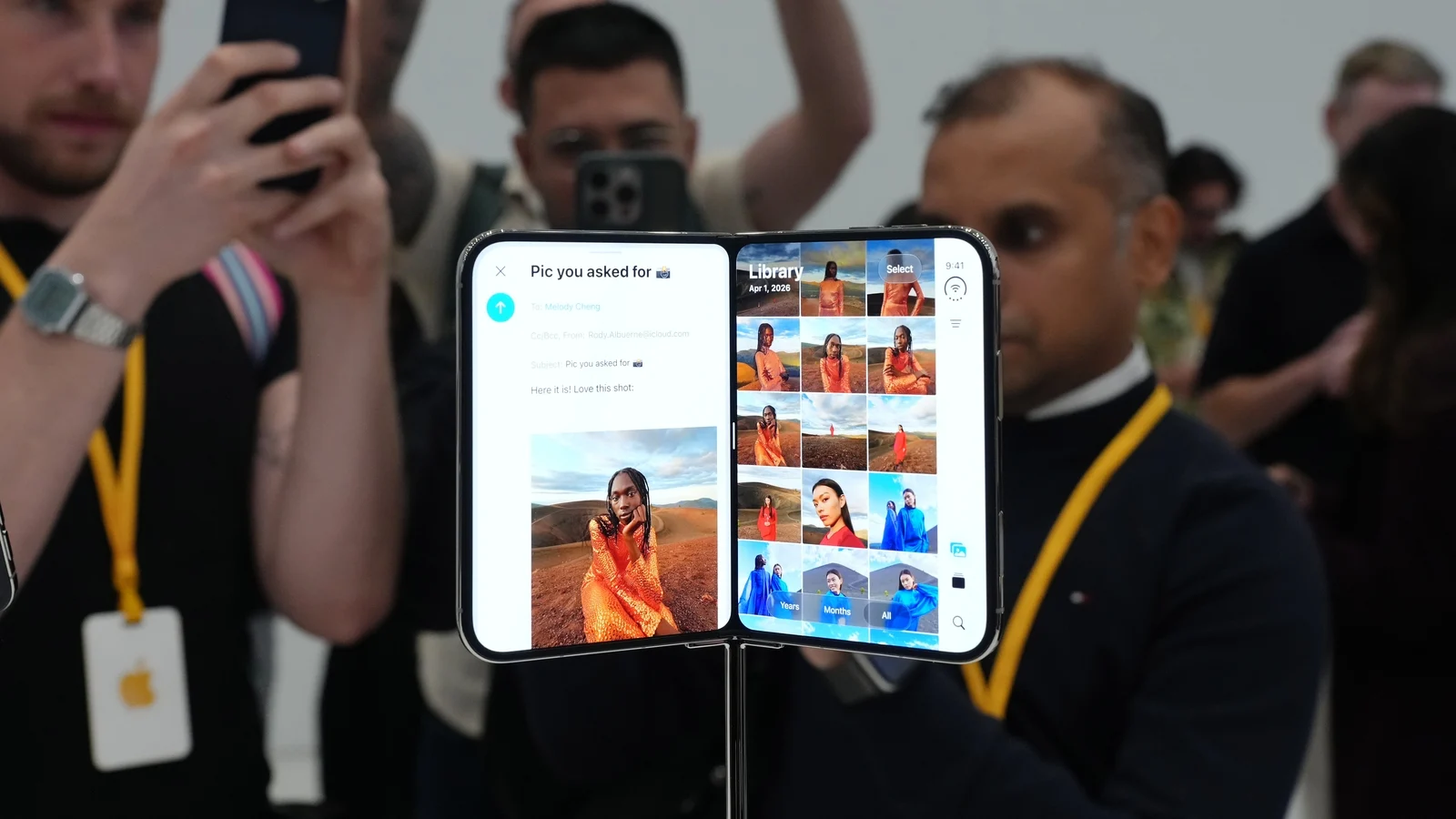
Apple has pulled back the curtain on a foldable iPhone called Duo, pitching it as the most dramatic shift in the company’s signature product line in years.
Built with rounded edges and roughly the size and shape of a passport, the Duo folds shut into a compact form and then opens into a wide, horizontal display that can also be used vertically.
When closed, the device offers a smaller single screen on the front. Apple said that when opened, the Duo becomes the thinnest iPhone the company has ever made.
The unveiling — the first major Apple launch led by newly installed CEO John Ternus — stands out as the biggest redesign of the iPhone since Apple eliminated the physical home button with the iPhone X in 2017.
In Apple’s most recent fiscal year, the iPhone generated $209.6 billion, accounting for just over half of the company’s sales.
Former CEO Tim Cook formally passed the spotlight to Mr Ternus with a short video that set up the event. It ended with a close-up of Mr Cook, who said, “Not me. That’s your guy,” as he pointed toward Mr Ternus.
Taking the stage, Mr Ternus framed the iPhone as a personal AI hub built around privacy, arguing that competitors sought to collect and store user information.
“Honestly, trust only goes so far when your data is no longer yours to control,” he said. “That’s why Apple Intelligence runs on device whenever it can.”
John Ternus took over from Tim Cook as the CEO of Apple
Lilian Rincon, the Apple executive in charge of AI products for the iPhone maker and a recent hire from Google earlier this year, introduced an updated Siri that she said will work with 300,000 apps at release.
Apple also used the event to showcase its non-folding flagships, unveiling the iPhone 18 Pro and iPhone 18 Pro Max as the newest entries in its familiar lineup.
Those models will start at $1,199 and $1,299, respectively — a $100 increase over the starting prices of the iPhone 17 Pro and Pro Max.
Alongside new hardware, Apple announced a feature aimed at rising anxiety over AI-generated and manipulated imagery.
The company said it has created a new standard called “Apple Reference Image” designed to verify the authenticity of photos captured by the iPhone 18 Pro’s cameras. Apple also said it will support the emerging SynthID standard, which is intended to help identify images that have been created or altered using AI.
Apple said the Apple Reference Image capability will not be available in the EU or China.
The iPhone 18 Pro will run on a new A20 Pro chip, which Apple said brings upgrades designed to help advanced AI models operate directly on the device.
“Apple Intelligence and Siri are front and centre. Apple is using its biggest strength, the sheer scale of its hardware base, to make AI an integral part of the everyday experience across devices,” said PP Foresight analyst Paolo Pescatore. Apple shares were down about 1% during the presentation.
In other announcements, Apple said a new version of AirPods will start at $129 and include noise cancellation — a first for its budget earbuds. A $149 version will add features including wireless charging and on-stem volume control, allowing users to raise or lower sound by swiping up or down on the stem.
Apple also introduced the Apple Watch Series 12 and Apple Watch Ultra 4, casting the devices as substantial upgrades focused on health.
The company said they include a redesigned sensor system that measures heart rate more frequently and enables new tools intended to assess recovery and fitness.
Apple said the watches pair new Apple silicon with improved sensors to deliver what it called the most accurate heart-rate tracking in a wearable.
Analysts believe that the iPhone Duo could cost more than $2,000 (over €1,700)
Premium pricing challenge
Mr Ternus, previously Apple’s hardware chief, has typically avoided the public spotlight aside from a small number of product launches and sustainability efforts.
Now, he faces the task of convincing customers they need a foldable device that analysts believe could cost more than $2,000.
Rivals including Samsung Electronics and Huawei Technologies have offered foldable phones since 2019, but the category has largely remained a niche for tech enthusiasts.
Even so, analyst firms such as International Data Corporation expect Apple to sell every foldable iPhone it can manufacture and to capture a 40% share of the high-end niche by the end of next year.
The event is also expected to signal a shift in Apple’s annual product calendar.
While analysts anticipated new watches, they also expect Apple to delay updates to its more affordable iPhone models until next spring, choosing instead to concentrate on the new folding device and its iPhone Pro and Pro Max range.
The strategy is aimed at smoothing Apple’s yearly sales pattern, which typically sees a pronounced revenue jump in the year-end holiday quarter in the US and Europe.